

Broadcast News
A CNN producer's behind-the-scenes
look at life in a New York City newsroom.
BETH GOODMAN
Special to the Jewish News
S
W
11/16
2001
82
ept. 11 was like any other day. At 8 a.m., I
took the' teeming subway from the Fifth
Avenue and 60th Street stop to Penn
Station on 34th Street and 6th Avenue. It
was Tuesday, Election Day in the Big Apple. I won-
dered how the mayoral race would change the lives
of New Yorkers.
Rudy Giuliani, elected in 1994, the first
Republican mayor in a generation, had transformed
the crime-ridden city into a comparative wonder-
land. New York City was safer than Boise, Idaho.
But there were many who hated Rudy. They were
glad to see him go. Too law and order, too by the
book, too eager to assert control.
Within 20 minutes, I arrived at New York City's
CNN offices, where I took the elevator up to the 21st
floor, picked up the mail, grabbed a cup of coffee and
began reading the morning papers.
At around 8:50 a.m., I walked past the news desk,
glancing quickly at the 18 monitors located on the
wall of the CNN newsroom — until I focused on
one monitor.
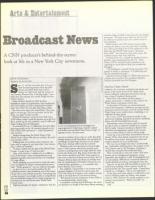
Smoke coming from the North Tower of the
World Trade Center! Was this an accident, the work
of a terrorist, a fire?
Walking back to my desk in the newsroom, not
quite able to register in my head what I was witness-
ing, I called my husband.
"A plane crashed into the side of the World Trade
Center. I've got to go. I'll call you later."
After a few minutes, I walked over to a different
area of the bureau, where several producers were
gathered around a television "setnear our Greenfield
At Large offices.
Barely speaking, we continued to watch the televi-
sion set together in silence, mesmerized and morti-
fied. "What's going on?" was our collective thought.
At about 9 a.m., as I stood transfixed by the
unfolding events, I saw something out of the corner
of my eye on one of those monitors. Something that
at that moment I was simply unable to comprehend:
the unmistakable image of yet another passenger jet
hurtling into the side of the other World Trade
Center tower.
Fighting through the shock, I checked in with the
newscast, from my desk in the heart of a now frantic
newsroom. "We need to get Aaron on the air now!"
he yelled as he sprinted up to the control room on
the 22nd floor.
Edith Chapin, the CNN deputy bureau chief,
manned the phones near the news desk, shouting
for a full accounting of the CNN producers in the
field near the World Trade . Center. "Shannon,
Rose, Phil!" She wanted to hear their voices. She
needed to know they were still alive.
At about 9:45 a.m., I heard my brother-in-law's
familiar voice emanating from the TV. Chris
Plante, CNN's national security producer, was
reporting to Aaron Brown from just outside the
Pentagon.
"The building is currently being evacuated. The
plume of smoke is enormous. It is billowing into
the sky, hundreds of yards."
American Airlines Flight 77, filled with innocent
civilians and steered by five kamikaze hijackers,
had just burrowed into the Pentagon.
America Under Attack
In the most devastating terrorist onslaughts ever
waged against the United States, hijackers crashed
two airliners into the World Trade Center on Sept. 11,
toppling its twin 110-story towers.
executive producer of our show to verify that she'd
already spoken to Jeff Greenfield, who watched the
unfolding of events from his home on the Upper
West Side. She had. Jeff would be in shortly.
Working in the news business for the past eight
years, I have, however reluctantly, become accus-
tomed to covering what some might label the sensa-
tional side of the news. Big, brassy stories that titil-
late viewers, but have very little, if any, impact on
their lives or the lives of those around them: the O.J.
Simpson Bronco chase, the Monica Lewinsky scan-
dal, the impeachment of President Clinton for acts
unbecoming a gentleman — or a president, Jon
Benet Ramsey, Gary Condit.
But suddenly, traumatically, I was witness to the
greatest slaughter of American citizens since the
Civil War battle of Antietam, and a sudden, jarring
shift in the fault lines of 21st-century history.
We'd passed from the exuberance of the 1990s to
an incomprehensible, darker place.
I remember watching David Bohrman, the execu-
tive producer in charge of the Aaron Brown evening
Suddenly, the newsroom exploded with shrieks and
groans as the Sourh Tower of the World Trade
Center collapsed, rolling downward from the sky
into a heap of smoking, flaming steel.
There were wild rumors of other planes —
unseen, uncounted — headed to the Capitol, the
White House, God knows where else.
As the reports of horrors yet unseen bounced
around the newsroom, I looked up yet again at that
monstrous wall of monitors to see the second World
Trade Center tower tumble down, imploding in on
itself and all those inside.
By 11 a.m., CNN had moved its studio to the
roof of our building, framed by the horror unfolding
below, and Jeff Greenfield had arrived.,
Maintaining a sense of mature calm, he assured
me that as soon as someone needed him to report,
he'd be ready: Executive producers, flushed with
adrenaline and aggression, rushed to the control
room to initiate weeks of wall-to-wall coverage.
I went up to the roof where Aaron Brown was sta-
tioned. There, three laptop computers were set up
for staff to write scripts, monitor wire stories and
conduct research on an as-needed basis.
The sun was so bright that day, I could hardly
see. I remember thinking about the people in the
Twin Towers and in the Pentagon, thinking to
myself that countless thousands had died.
Here I stood safe on the roof of the CNN news
bureau on an incongruously gorgeous, sunny
September day draped in a pall of unspeakable hor-
ror and sadness. Behind me, enormous billows of
smoke spiraled up and up, smearing the blue sky.
Later on in the day, Jeff Greenfield stood on the
roof of our building, where cameras would be
positioned for the next several weeks. I heard him
remark to a colleague, "This is the nightmare."—
In the days and weeks ahead, I reached for corn-
fort by thinking about my father, who passed
away in 1999, and how he would respond to our
present circumstances. "Watch yourself," he
would say.
I do.