

Spirituality
Teacher
Of Melody
Examples of Cantor Fuchs' life work
in volume to be sold at Book Fair.
26103 Novi Road ' Novi 0 248 r 449 i 9024
Specializing in New and Estate Jewelry
DR. GERALD KATZMAN
Special to the Jewish News
F
THE
RBAN
COLLECTION
In Fabulous, Fashionable Downtown Ferndale
Hirschel and Toni Levine welcome you to fashionable downtown Ferndale.
We now offer an eclectic montage of home furnishings as well as handcrafted gifts and jewelry.
Come see what's uniquely new, comfortably vintage or just plain funky.
22961 Woodward Avenue,
Ferndale, Michigan 48220
urbancollect@aol.com
phone 248-399-9449
ADMIRAL OPTICAL
fax 248-399-9943
— known for its prices & service
$99 FRAME
& Progressive no-line
bifocal. SCR & UV
*offer
expires
ovember 30, 2001
WES- 1MM LAKE VILLAGE SHOPS • 248-960-2
Haggerty Rd. & Pontiac Trail W. Bloom
HAIRS 011-51"-Lete-
ZO% OFF
L . 1
11/2
2001
58
any service or
product with this ad
Not good with any other promotion
expires 12/01/01
ALL ABOUT YOU!
or more than three
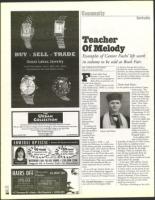
decades, Cantor Israel
Fuchs served Congregation
Beth Ahm as associate can-
tor and choir director.
His volume T Plot U.6nirot Yisrael
(Tara Publications, 1994) is a compi-
lation of his origi-
nal musical works.
The compositions
of cantorial, cha-
sidic and Israeli
melodies fill 500
pages of sheet
music. The book
will be available at
the 50th Annual
Jewish Book Fair
at the Jewish
Community
Center of
Metropolitan
Detroit.
In reading the
mini-autobiogra-
phy that prefaces
Cantor Israel Fuchs
his volume, I
wondered how
Cantor Fuchs
came to make
aliyah to Israel in 1936 — and
escape the Holocaust in which most
of his family perished. According to
his wife, Ayala, with whom he shared
54 years of marriage, it was his
involvement in the B'nai Akiva reli-
gious Zionist movement that caused ,
him to move to Israel from
Czechoslovakia. That move probably
saved his life and allowed him to
make important future contribu-
tions.
At an early age, Cantor Fuchs was
able to learn complicated niggunim
(melodies) quite easily. Exposure to a
number of masters of liturgical music
Limited time!
RECTROLYSIS
Dr. Gerald Katzman is a pediatri-
cian who lives Farmington Hills.
60 tvIINUTLS- $35
offer good for up to 13 treatments
New clients only
expires 12/01/01
6413 Farmington Rd. at Maple • West Bloomfield • Z48.865.086
.i ce
in Eastern Europe did much to
develop his innate musical abilities.
However, he always maintained that
the primary source for his creativity
was the beit midrash (house of study,
that is, Jewish scholarship).
Torah And Music
In the preface to his volume, Cantor
Fuchs states, "We
must not forget that
Torah and music go
hand in hand. Moses,
at the end of his life,
tells the children of
Israel, "Now, there-
fore, write ye this
song and teach it to
the children of Israel"
(Deuteronomy 31:19).
Moses refers to the
Torah as a song.
It is very likely that
this idea of a bond
between melody,
study and prayer
inspired Cantor
Fuchs to be such a
prolific composer of
liturgical music.
In an address deliv-
ered to the Cantors
Assembly of America in 1969, Cantor
Fuchs refers to melodies termed
Misinai (literally, from Sinai), such as
Kol Nidre or Borchu for the High
Holidays. These are melodies that
have become inseparable from the
prayer itself. The mood and the
impact of the prayer would not be the
same without the melody.
In the same 1969 address, Cantor
Fuchs states, "Of course, we cannot
stand still. We have to move forward,
to renew and to use the power of our
creativity to bring in new sounds, but
we build on the old as we say in the
Yotzrot Chadoshim V'Gam Yeshonim
Bimoginat Ov Nishonim (new and also
old generations rely on their forefa-
thers for protection)."
This focus of building on the old is