

Striking Back
Patching Differences
Rejecting talk of schism, Jewish leaders rally behind Bush policy.
MICHAEL J. JORDAN
Jewish Telegraphic Agency
New York
Nir ith the launch of the
U.S.-led war on terror-
ism, American Jewish
leaders are rallying
behind Washington.
At the same time, anxiety that
Israel's interests may be shunted aside
seems to be dissipating.
In the weeks since Sept. 11, the
Bush administration seems to have
acted upon the realpolitik equation
that beginning with a narrow goal —
going after Osama bin Laden and his
al-Queda terrorist network — would
garner a broad international coali-
tion. Pursuing a broader goal from
the get-go — such as eradicating all
terrorism — might result in a nar-
rower coalition.
In the days before Sunday's initial
airstrikes against Afghanistan, two
well-publicized dust-ups over the
administration's course hinted at
Jewish and Israeli dissent, and per-
haps a schism within American
Jewry.
Many Israelis and American Jewish
leaders felt blindsided last week by
news reports that the Bush adminis-
tration had been prepared to launch
a new Israeli-Palestinian peace initia-
tive and declare support for a
Palestinian state.
Mortimer Zuckerman, chairman of
the Conference of Presidents of
Major American Jewish
Organizations, was quoted as
describing such policy — perceived
as a leak to entice more Arab states
into the anti-terrorism coalition —
as "very short-sighted and erro-
neous." He said it would reward the
Palestinians for their past year of vio-
lence against Israel. Zuckerman later
said his words had been taken out of
context and misunderstood.
Israeli Prime Minister Ariel Sharon
expressed the fears of many Israelis
when he warned the Bush adminis-
tration not "to appease the Arabs at
our expense." He recalled the infa-
mous appeasement of Hitler in 1938
when the West sold out
Czechoslovakia in an effort to avoid
a wider European war.
Rancor Dies
Sharon's speech sparked a diplomatic
tiff, and a schism appeared to be
developing in the American Jewish
community as the weekend
approached, when some 50 Jewish
leaders wrote a letter of support to
Bush.
Sharon and the White House
reportedly patched up relations over
the weekend, before the airstrikes.
And on Monday, with America
embarked upon a new military cam-
paign, Jewish leaders voiced their
support — and banked on off-the-
record reassurances from Washington
that the anti-terrorist dragnet likely
will extend beyond bin Laden and
his network to include enemies of
Israel, such as Hamas and Hezbollah.
Most Jewish leaders expressed the
belief that U.S. and Israeli interests
more or less coincide.
"There is broad consensus and sup-
port for the administration, both for
what it's doing right now and for
going after the global terrorist infra-
structure, to not make it a one-shot
deal," said Malcolm Hoenlein, execu-
tive vice chairman of the Conference
of Presidents.
"If you address those who are a part
of this terrorist network, you are
enhancing Israel's security, in addition
to America's security and interests."
The Jewish Council for Public
Affairs, an umbrella group for Jewish
communal organizations nationwide,
also was backing the president. "We
support the direction in which the
president is going, and it's important
we go on record saying so," said
Martin Raffel, the group's associate
director.
"It's not a question of 'wait-and-see.'
We support the president based on
what he's said, that we're striking out
against those who use violence against
civilians," Raffel said. "This is the
beginning but certainly not the end of
the campaign against terrorism."
Israeli Focus
Other views were predictably mixed
about the appearance that
Washington was linking the
Palestinian issue to the anti-terrorism
campaign.
Numerous analysts and Middle
Easterners — including bin Laden
himself — have pointed to the Arab-
Israeli conflict as one of the main, if
not the primary, source of anti-
American anger in the Muslim world.
The Israel Policy Forum, while
praising the Bush administration's
steps against terrorism, also welcomed
its renewed push to get Israelis and
Palestinians back to the 'negotiating
table.
"The Arab-Israeli conflict, with few
exceptions, has only moved forward
with help from the Americans," said
Tom Smerling, director of the IPF's
Washington Policy Center. "Parties
involved in deep conflict are almost
never able to extricate themselves
without third-party involvement."
On the other side of the spectrum,
though, Morton Klein, the president
of the Zionist Organization of
America, said Bush had done "serious
damage" to Israel's attempts to repel
Palestinian violence.
While stressing his support for
Bush's efforts to fight terror, Klein
warned, "By saying he has a vision for
a Palestinian state, he is whetting the
appetite of the Arabs to continue their
terrorism. He pledged that we will
end all regimes that harbor terrorists,
but then he turned around and asks
precisely those regimes to join the
coalition. That proves Sharon's charge
that [Bush] is appeasing regimes of
great danger to Israel."
Still, Klein implied that the fight
ultimately would be broadened, to
Israel's benefit. "I remain confident
that, overall, Bush's policies will be of
benefit to both the U.S. and Israel,"
he said. To destroy only bin Laden
and the Taliban, he said, "while allow-
ing the others to continue with busi-
ness as usual will mean we'll lose the
war on terrorism.
"He'll have to destroy them, or ter-
rorism will persist." D
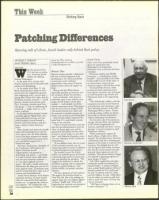
Ariel Sharon
Mortimer Zuckerman
Morton Klein