
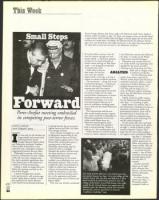

British Foreign Minister Jack Straw walks with Palestinian leader Yasser Arafat at
Amman airport in Jordan on Sept. 24. Straw was enroute to Iran, on the first leg of
a regional tour, which includes Israel and Egypt, to build support for the anti-terror
coalition the United States is building. He infuriated Israelis by telling an Iranian
paper that `One of the factors that helps breed terror is the anger that many people in
the region feel at events over the years in the Palestinian territories."
by Israeli military sources, that the
level of violence, though not com-
pletely halted — Palestinian gunmen
carried out two fatal ambushes of
Israeli Women driving on West Bank
roads — has dropped considerably
during the past week.
Israeli sources also say
that Arafat, for the first
time since the intifada
began exactly a year ago, is acting in
earnest to restrain would-be terrorists.
This sentiment — along with much
international pressure
helped pro-
vide the opening for Wednesday's
meeting near the Gaza airport.
In a joint communique issued after
two hours of talks, the rwo sides
renewed their commitment CO recom-
mendations made in May by the
Mitchell Commission, a U.S.-led
international panel that set out a
series of confidence- building meas-
ures to help end the Israeli-Palestinian
violence.
The communique said the two
sides would resume security coopera-
tion, Israel would lift its blockades on
Palestinian population centers and
Arafat would clamp down on
Palestinian attacks against Israel.
Peres and Arafat also agreed to
hold a second meeting "within a
week or so," the communique said.
Arafat's decision to end the violence
is seen as a direct response to the pop-
ular Palestinian reaction that followed
the Sept. 1 1 attacks on the World
Trade Center and the Pentagon.
Palestinian and outside observers
say Arafat and his top leadership were
appalled by the scenes of public
rejoicing in the Gaza Strip, the West
Bank and in refugee camps
in Lebanon and Jordan.
For the Palestinian lead-
ership, these scenes, captured by
Western media despite the Palestinian
Authority's strenuous efforts, evoked
memories of Arafat's dalliance with
Saddam Hussein during the 1991
Gulf War and the huge price, in
terms of Western support and popu-
larity, that the Palestinian cause paid
for that blunder.
Indeed, American public support
for the Palestinians fell dramatically
after Sept. 11, according to polls.
Arafat knows, say analysts, that if
the Palestinians' standing continues to
plummet in American public and
governmental opinion, there will be
powerful forces in Israel that will
move to exploit his weakened situa-
tion, perhaps even by removing him
and his coterie altogether.
On the Israeli side, that is precisely
the sentiment one hears on the politi-
cal right — much of which is repre-
sented in Sharon's Cabinet. They
argue that the new world configura-
tion against
terror immediatelyfollow-
b
ing Sept. 11 presented
the Jewish state with a
golden opportunity to
defeat and perhaps even
remove Arafat. After all,
Arafat had encouraged
— or at least not pre-
vented — acts of indis-
criminate terrorism per-
petrated against Israel
over the past 12
months.
Another powerful
player on the right,
with influence over
Sharon, is former Prime
Minister Binyamin
The body of Salit Shitreet is carried by mourners
Netanyahu.
during her fitter al on Sept. 24 in the village of Sde .
In a slew of state-
Eliahu, Israel. She was shot and killed in a West
ments since Sept. 11,
Bank ambush by Palestinian gunmen near the
Netanyahu openly
village of Bardaleh. Israel-Palestinian truce talks
compared Arafat to
AN ALYSIS
Peres Arafat meeting embroiled
in competing post-terror forces.
DAVID LANDAU
Jewish Telegraphic Agency
Jerusalem
t is too early to tell whether the
:E
long-awaited and controversial
meeting between Israeli
Foreign Minister Shimon Peres
and Palestinian Authority President
Yasser Arafat will produce a true
cease-fire and a resumption of peace
negotiations between the two sides.
Wednesday's meeting, which pro-
duced a commitment to turn a shaky,
week-old truce into a lasting cease-
fire, had a symbolic significance that
went beyond any of the details con-
tained in its final communique.
Indeed, it made its impact felt even
before the meeting was held on the
eve of Yom Kippur.
It almost brought down Israel's
unity government, with intense argu-
ments raging about whether to hold
the meeting at all. Prime Minister
Ariel Sharon found himself awkward-
9/28
2001
24
ly placed between his government's
rightist faction and Peres, his Labor
Party foreign minister.
And it became entangled in a web
of diplomatic maneuvering by the
United States to form an interna-
tional coalition against terror. If the
Peres-Arafat meeting does prove a
turning point in the Israeli-
Palestinian relationship, and the
course of events is markedly
changed, the catalyst will have been
the terror attacks on America and
the diplomatic aftermath.
The Palestinians say the armed
intifada is now effectively over, or at
least greatly reduced. They cite the
categorical orders issued publicly by
Arafat, in Arabic, last weekend to
military and paramilitary groups
under his command to cease their
attacks on Israel and Israelis and to
rein in the opposition and funda-
mentalist groups such as Hamas and
Islamic Jihad.
They cite, too, the fact, confirmed
sought by the United States were again put off
Monday after the shooting attack, but resumed
Wednesday with an agreement on interim
"confidence building" steps.