

Question of the Week: When United Nations SecretaryTh
General Dag Hammarskjold was killed in an airplane crash, he was
working on a translation into Swedish of what well-known Jewish
philosopher?
lies
•(C961 - 8L8[)
n g uprew :Jamstry :Jamsuv
Yom Kippur
At A Glance
ELIZABETH APPLEBAUM
Apple Tree Editor
When: This year, Yom Kippur begins the evening of Wednesday, Sept. 26,
and ends the evening of Thursday, Sept. 27.
What The Holiday Is About: Yom Kippur is the day of atonement (yorn
in Hebrew means "day," and kippur means "atonement"), the day we seek
expiation for our sins.
Why We Celebrate: The commandment to observe Yom Kippur is found
in the Torah: Leviticus 16:29, and Numbers 29:7. Further expansion on
the holiday is in Leviticus 16:30-34, 23:26-32. and Numbers 29:8-11.
Rites And Rituals: The commandment to observe Yom Kippur also states
that the Jews shall "afflict" themselves. The ancient rabbis interpreted this
to mean five things: no food or drink, no wearing leather shoes, no
bathing for pleasure, no marital relations, no anointing with oils (in
ancient times, people used oil to clean, soften and perfume the skin). The
prohibition against food and drink also includes smoking.
Persons on a regimen of medication should consult with their rabbi for
the proper procedure for taking medicine.
Like all Jewish holidays, Yom Kippur includes extra prayers and a Torah
reading. The prayers of Yom Kippur, however — for all services — are the
longest of any day in the year. In many congregations, the recitation of
prayers takes up the better part of the day. A significant feature of the
Yom Kippur liturgy is the vidui, or confession.
This consists of two parts: Ashamnu (We have trespassed), an alphabeti-
cally arranged list of sins, and Al Chet (For the sin), a long inventory of
transgressions, accompanied by beating or the breast..
The confession is recited at all of the services of Yom Kippur.
Along with Rosh Hashanah, Yom Kippur is the only day we prostrate
ourselves in prayer — in a modified form — as was done in the days of
the Holy Temple in Jerusalem. The prostration is done during the cantor's
repetition of the Musaf service.
Prostration is performed by kneeling and touching the forehead to the
floor. It is practiced almost exclusively by Orthodox Jews.
Yom Kippur includes two unique prayer services: the famous Kol
Nidrei, which begins Yom Kippur and in which we nullify all personal
vows for the coming year, and Neilah, which closes the holiday. The holi-
day ends with a blast of the shofar.
Thematic Significance: Yom Kippur is regarded as the day that God seals
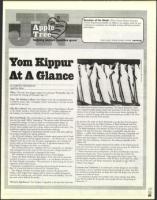
This sketch ofJacob Kramers famous painting "The Day of Atonement," shows
men wrapped in tallitot (prayer shawls) that reach down to their feet. The facial
features consist of stripes resembling those on their prayer shawls, sign
. ifiiing the
men are so involved in prayer, their shawls have become part of them. The 1919
painting is done in pencil, brush and ink.
the decision He made on Rosh Hashanah as to the fare of every person.
The image created for the High Holidays of Rosh Hashanah and Yom
Kippur is the Book of Life, in which appears the name of every human.
On Rosh Hashanah, God decides the fate of each person, and on Yom
Kippur, He seals His deci.,ion. Although it is generally said that Yom
Kippur — unlike other holidays such as Pesach, Shavuot, Chanukah and
Purim
does not commemorate a historical event, traditionally we
believe that Yom Kippur is the anniversary of God's forgiving the Jewish
people their first disastrous, national sin: the infamous episode of the
golden calf.
Moses chastised the people, destroyed the tablets of the Torah given by
God and went back up the mountain a second time to pray for God's for-
giveness and to receive new tablets (Exodus 32:30-35).
Moses returned to the encampment, and then ascended the mountain a
third time (Exodus 34). This is reckoned as the first day of Elul, the
month preceding Rosh Hashanah. Moses prayed for God to grant the
Jewish people complete atonement. After 40 days, God erased the collec-
tive sin of the Jews and Moses returned to the people on the 10th of
Tishrei, Yom Kippur.
Customs And Traditions: It is traditional on Yom Kippur to wear white
to remind us of our mortality because burial shrouds are white, and also
as a symbol of purity because we hope that God will forgive our sins and
restore us to lives of virtue.
It is customary to greet one another with: Gmar chatima tova (May
your fate be sealed for the good); some people shorten the greeting to
Gmar- toy.
eitkikeemtre
9/21
2001
87