

Living Well
Travel
Telling A Story
New Jewish Museum-Berlin offers "between the lines" historical look.
ture and exhibits.
Architect Libeskind has his own
name for the museum. He calls it
"Between the lines. I call it that
because it is a project about two lines
of thinking and organization and
about relationship. One is a straight
line, but broken into many fragments;
the other is a tortuous line but con-
tinuing indefinitely."
Indeed, besides the broken lines that
pummel the exterior of the building
— that many see as the pieces of a
broken Jewish star — cutting through
the interior is a Void, a straight line
whose impenetrability forms the cen-
tral focus around which the exhibi-
tions are organized.
The museum contains 3,800
objects — a third of which are on
loan. Shaike Weinberg, the founding
director of the Holocaust Memorial
Museum in Washington, was instru-
mental in creating the concept for the
permanent exhibit. "A lot of American
Jews contributed," Bodemann-Ostow
says. "American Jewish people feel
very attached to a museum that will
JUDITH DONER BERNE
Special to the Jewish News
Berlin
T
he opening of the Jewish
Museum-Berlin, starting
Sunday, Sept. 9, has such
huge implications for
Germany and world Jewry that it will
be staged over four days.
It leads off with a "political open-
ing" for political, business and cultur-
al leaders from Germany and abroad.
Monday is the "emotional opening"
for those who donated and loaned
their memories and memorabilia.
Tuesday is the "student opening" for
250 high school students from Berlin
and Brandenburg, followed by a "pub-
lic opening" from 7 p.m. Tuesday to 1
a.m. Wednesday. The museum then
will be open from 10 a.m. to 8 p.m.
daily except for Rosh Hashanah, Yom
Kippur and Christmas Eve.
The main building and its striking
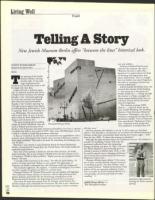
The Jewish Museum-Berlin.
design by Daniel Libeskind, who was
born in Poland and lost most of his
family in the Holocaust, has made architectural headlines ever since it opened
its exhibit-less halls in the winter of 1999. More than 300,000 people toured
it before it closed to install the permanent collection.
In fact, as I waited at its side door to be cleared for my appointment with a
museum press representative last month a bus carrying architecture students
from Japan unloaded. They had to be settle for examining the building's exte-
rior. So did I.
However, I was treated to some firsthand details by Naomi Bodemann-
Ostow, a young Jewish woman from the United States, who helps handle the
museum's press relations.
Since one of her parents is American and the other German, she holds
dual-citizenship. She is one of nearly 100,000 Jews who have chosen to live
in Germany, 12,000 of them in Berlin. "Eighty percent are immigrants from
Russia," she says.
"I actually prefer Germany to the states," she tells me quite frankly. 'It's
such an exciting time here. Berlin is a new capitol. My generation of
Germans can hardly understand how the Holocaust could have happened."
The museum's approach, she explains, "is mainly chronological, but broken
up with a couple of sections not fixed to a certain time."
Museum Director W. Michael Blumenthal says the exhibits will highlight
"the 2,000-year history of Jews in Germany with its high points and low
points; Judaism and Jewish life; the devastating consequences of the
Holocaust and the hesitant new beginnings of Jewish life in Germany."
More than 60 years have passed since the Gestapo closed Berlin's first
Jewish museum and confiscated the inventories. But this is not a Holocaust
Museum, although that devastating period looms large in both its architec-
9/7
2001
92
tell their story."
And the museum, she explains, is set up "to tell a story, not just show
objects." She describes a circumcision set inscribed with Hebrew lettering of
German words and a circumcision bank bearing the German eagle — both
from the late 1800s. "It shows the attempt to assimilate."
Although the hype has been about the Libeskind structure, the museum is
actually two buildings. Visitors will enter the
permanent collection from the contrasting
baroque building next door. In 1962, it became
the "Berlin Museum" that eventually grew to
include a section on Berlin's Jews. Now, it will
be used for special events, changing exhibitions
and to house the museum shop and restaurant,
Bodemann-Ostow says.
teilfiggaiM
Museum officials expect debate "if the exam-
ple of other recently opened national museums
is anything to go by," says Ken Gorbey, muse-
urn project director. "Indeed the liveliness of the
debate will be an important indicator of just
how successful the Jewish Museum Berlin is in
C4
raising public awareness and levels of under-
standing."
Judy Berne holds materials
detailing the Berlin museum's
,
❑
Judith Doner Berne is a
West Bloomfield resident.
••
opening.