

Travel
A
SIN AGO Gik
S
0
BET. EU:ABU
'.. :k
...,,
ij
In uisr
111
Spanish and Portuguese Christians
discover their Jewish roots.
Beating Great Odds
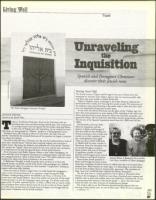
The Tomar Synagogue entryway, Portugal.
JEANNIE WEINER
Special to the Jewish News
oday in the Iberian Peninsula, there are the Christians who are
searching their roots and discovering a Jewish past. One such person
is a young woman who has opened the first Judaic shop and library
in the town of Toledo since the Inquisition. As we entered her beau-
tiful shop, we were greeted by "Shalom," spoken in a lilting Spanish accent.
Moments later, after asking us where we were from, she said, "Are you
Jewish?" Startled by the unusual bluntness of the question we began a conversa-
tion about her identity.
She told us that she was a Christian, but she and her husband believe both of
them have "Jewish blood." She has been studying Judaism and maintains a
kosher home. She keeps the Sabbath and celebrates all of the Jewish "festivals."
Her parents are "happy" about her search for her roots and her new enterprise.
It is important to her that the Spanish know of their Jewish history.
At an encounter with Rabbi Shlomo Vaknin in the Lisbon Synagogue, we
were told that some Portuguese Christians are studying Judaism and still others
are coming forward to "learn of their Jewish roots." The rabbi could have more
students but takes only those he believes to be most serious.
In Belmonte, Portugal, a small mountain town an hour or so from the
Spanish border, we found a newly built, lovely white synagogue on a hillside
overlooking the valley. It is home to a few hundred "Crypto-Jews" looking to
reassert and renew their Judaism.
Down the road in Tomar, a larger town, we easily found the synagogue, a
major tourist attraction because it is a museum, except during the High
Holidays. Inside greeting visitors was Alfredo Luis Vasco, a Christian with
Jewish roots who speaks Hebrew. Vasco lives nearby and was part of the neigh-
borhood project to save the synagogue many years ago. The lovely, small syna-
gogue with 12 arches, representing the 12 tribes, is filled with an eclectic collec-
tion of Judaica from various donors from all over the world. As Vasco "guides"
us in the room, he discusses the Jewish history of Spain and Portugal and the
basic tenets of Judaism and the Jewish holidays
The Jewish history of Spain and Portugal is the story of those Jews who
attempted to maintain their religion against what are insurmountable odds
and those who were unable to sustain Jewish life.
-
Today in Madrid, artistic renderings in the Prada Museum indicate Jews
bound and tied as small, slow-burning fires smoke nearby. The depictions of
the infamous autos-dale (burning at the stake) make it clear that open resist-
ance was impossible during those terrible years.
At one time, the Iberian Peninsula was the place of the "Golden Age" for
Jews. Jews were prominent in every aspect of life, including at the royal court.
Moors and Jews lived in basic harmony. When the Christian monarchs con-
quered the Moors, life for both Jews and Moors became progressively perilous.
The horrors of the Spanish Inquisition lasted from the 1300s until the late
1800s.
Fast forward to the year 2001.
After the Inquisition and the
absence in Spain and Portugal of
Jews due either to their fleeing and
forced conversions, their torture and
murder or to their expulsion, Jews
are a small presence once again.
There are about 3,000-5,000 Jews
in Madrid and the same number in
Barcelona. Some few thousand more
are spread throughout southern
Spain, Lisbon and parts of Portugal.
A significant number of today's
Spanish and Portuguese Jews arrived
from Morocco and South America.
Jeannie Weiner is flanked by Mr. and Mrs.
Some former Jewish quarters in
Luis Vasco, caretakers of Tomar Synagogue.
Spain and Portugal are major tourist
attractions consisting of narrow streets in walled cities that once housed thou-
sands of Jews. What remains are street signs. It is disturbing to see the memo-
ry of the Jews of Spain laid out museum-like, past-tense. The reminders of
what "once was" would be better replaced by vibrant, living Jews.
The fact that there is a Jewish presence at all in Spain is what gives cheer.
Sitting in the synagogue in Madrid as more than a hundred men, women and
children came to pray and socialize was a real celebration of Jewish life. To me,
it demonstrated the tenacity of the Jewish people — those who have main-
tained the faith even after centuries of wandering and danger.
The word is still out on the Christian Spanish and Portuguese who are
learning of their Jewish roots. As one of them said, "Who we are is a mystery
... a mystery."
❑
8/31
2001
87