

Arts & Entertainment
ll
On The Bookshelf
Le i
Special menu for the cost and calorie-conscious.
This menu is not available after 5 p.m. on Saturdays,
`What
You
Owe
Me'
For her latest novel, African American
or with any other specials (coupons) or during the month of December.
All entrees served with Soup or Salad and S•a•hetti
BEEF SHISH KABOB
OSSO BUCCO
Veal Shank slowly marinated
in a seasoned vegetable
sauce served over rice.
$993
Skewered cubes of Tenderloin,
fresh peppers and onions served
over a bed of spanish rice.
s(195
author draws from her experiences growing
up in a Jewish neighborhood.
BUTTERFLY PASTA
MANDARIN
SPINACH SALAD
FRAN HELLER
Finely sliced boneless breast of
chicken lightly sauteed in olive oil
with garlic, peppers and basil
tossed with tarfalla pasta.
Fresh spinach, mandarin oranges
and pine nuts ladled with our
raspberry vinaigrette dressing.
Special to the Jewish News
I
$995
SANDWICHES
Sliced beef tenderloin sandwich
covered in our famous "ZIP" sauce.
5950
And many more delicious dishes!
Our regular menu is also available. -
248-373-4440
Call us for details and reservations
855 Opdyke Road (Across from the Silverdome)
Serving memorable Italian lunches and dinners since 1939
Monday - Thursday 11 a.m. to 10 p.m. • Friday 11 a.m. to 11 p.m.
Saturday 3 p.m. to 11 p.m. • Sunday 12 noon to 9 p.m.
• Excellent
choices for lunch
specials.
aj f
HONG HUA
t- if A yz- FINE CHINESE DINING
h
27925
• We cater parties
• Cliff certificates
available
()RCIIARD LAKI. ROAD • FAliMI\GION Huts
248-489-2280
twits:
I I .XXI — MID\ Rail, Si X t.\ \NS X XVI I k
Special C1iinese, AniericAn Er J a panese Buffet
All YON Call Eat
elk
r
L
8/31
2001
68
d
ENTIRE
oi s
" FOOD
OFF BILL a
,
Expires 9130101 • I coupon per table
Not good with any other coupon
1
j
29205 Orchard Lake Road (next to Staples • 248-553-8880 • Fax: 248-553-8708
Open Hours: Mon-Thurs 11 am-10 pm; Fri-Sat I I am-1 I pm; Sunday 12 noon-10 pm
her prospects of going to college were
non-existent, even though she was a
straight-A student.
It was a perceptive Jewish teacher
who made the future social worker
switch from a commercial program to
an academic one in high school, and
helped her secure a full scholarship to
the University of Pennsylvania in the
1930s. "My mother credits that
woman for changing her life and for
changing the family history," says
Campbell.
n African-American author
Bebe Moore Campbell's fourth
novel, What You Owe Me, Gilda
Rosenstein, a Holocaust sur-
vivor, and Hosanna Clark, a black
woman, first meet as maids in a Los
Angeles hotel in 1948. The two
become friends and eventually busi-
ness partners, but a bitter betrayal
leaves a legacy of retri-
bution to the next gen-
eration — as well as the
challenge of reconcilia-
tion.
Campbell, best-selling
author of Brothers and
Sisters and Singing in the
Comeback Choir, is a
compelling storyteller.
Even though real life is
never as tidy as her fic-
tion, one of the book's
major strengths is the
evenhandedness with
which she writes not
only from the black
point of view but the
white and Jewish per-
spective.
That perspective, she
says, in a telephone
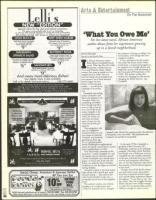
interview from her vaca- Campbell credits Nobel Prize-winning author Toni Morrison
as her greatest writer role model "She symbolized what
tion home on Martha's
Vineyard, was honed by I wanted to do and that it was possible."
growing up, from age
10, in a predominately
In the early 1970s, Campbell, a
Jewish Philadelphia neighborhood,
graduate of the University Of
where her family moved from a mostly
Pittsburgh, took part in an exchange
black neighborhood in 1960.
program.
The father of her Brazilian
on
the
"Our house 'had a mezuzah
host family was a Holocaust survivor.
back door," recalls Campbell, 51, and
Campbell saw the numbers tattooed
the Baptist church where her grand-
on his arm and heard the story of his
mother worshiped was a former syna-
survival and emigration after libera-
gogue. A cousin who lived with the
tion. It was that experience that led to
family was asked by their Orthodox
the creation of the Jewish protagonist
neighbors to turn the lights on and off
in her novel.
during Shabbat.
Though none of the book's charac-
Campbell walked to the local junior
ters and events is true, the author's
high school with a Jewish girl, until
sensitivity toward the Jewish experi-
the girl's family — like most of the
ence and the black experience informs
other Jewish families in the area —
throughout. "It was clear to me," she
eventually moved out of the neighbor-
has stated, "that the struggles between
hood.
blacks and Jews were similar enough
The author's mother, one of three
to make the two groups allies and yet
daughters of a single parent who
different enough to create enmity.-
worked in domestic service, thought