

•
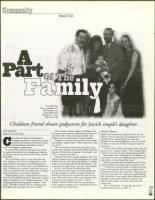
From left: Alan
Havis, godparents Dr.
Sharon Havis and
David Yaldo with
Isabelle Rose, Carol
Havis and Lilly.
Chaldean friend chosen godparent for Jewish couple's daughter.
LISA BARSON
Special to the Jewish News
C
antor Howard Glantz of Adat Shalom
Synagogue conducted a special baby-naming
ceremony this summer at the home of Alan
and Carol Havis of Franklin for their 3-
month-old daughter, Isabelle Rose.
As a part of the ceremony, Alan and Carol named
two special individuals to act as godparents: Alan's sis-
ter, Sharon, and his close friend, David Yaldo of West
Bloomfield.
Havis and Yaldo, both 41, met when the two
were students at the Detroit College of Law. Like
many of Havis' classmates at Southfield-Lathrup
High School in the 1970s, Yaldo is of Chaldean her-
itage. Chaldeans are Catholic Arabs from Iraq, tak-
ing their name from the same region that in biblical
times was home to the patriarch Abraham.
Despite growing up in a multicultural community,
Havis had no Chaldean friends in high school and had
negative impressions of his Chaldean classmates. "The
two groups were pretty segregated in school," recalls
Havis. "We didn't socialize with the Chaldeans, and
they didn't want anything to do with us, either."
After earning a business degree at Michigan State
University, Havis headed to Detroit for law school in
the fall of 1981. There, he became friendly with
Yaldo, as the two shared most of classes together.
"Religion is not part of the equation in an intellec-
tual setting," explains Havis. "More important is what
you think."
The two friends_ remained close after graduating
and became important parts of each other's close-knit
families. "David is like a member of our family," says
Havis. "Everyone loves him."
Alan and Carol have an older daughter, Lilly. They
selected cousins to act as Lilly's godparents, but when
Isabelle was born, the choice was obvious. "I couldn't
think of anyone better for the job than David — he
always does the right thing." says Havis of his friend.
At first, the Havises wondered how their
announcement of having a non-Jewish godparent
for their daughter would be accepted within the
family, but they found they had no cause for con-
cern. The family knows Yaldo, and recognizes that
if anything ever happened to Alan or Carol,
Isabelle would be looked after by a good person
with complete integrity, who understands who she
is and where she comes from.
Serious Honor
Yaldo was honored and surprised when he was
asked to serve in the role. He recognizes the seri-
ousness of the responsibility, but says that
whether he is named godfather or not, he would
be there to take care of Alan's family should the
need arise.
"I don't look at Alan as anything other than the
person he is," explains Yaldo. "We worship differ-
ently, but we have the same fundamental beliefs."
Havis agrees that "although we are different in
some ways, in the most important areas of family
and values, we were raised the same."
Havis is proud of the example he set by bring-
ing his friend David Yaldo into his family circle:
"I think this ceremony had a twofold meaning.
First, it honored the birth of our daughter and
the history of where she came from. Second, it set
forth for all present the importance of friendship,
and the ability of two people from different back-
grounds to cast aside stereotypes and see each
other for the quality of person each finds the
other to be.
"Now," Havis says, "if only the rest of the
world could catch on as well."
❑
N. "
8/31
2001
43