

What Is
Jewish Renewal?
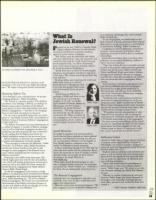
Eli Cohen and Rabbi Arnie Sleutelberg in Israel.
the Jewish Renewal network is a trial one, to be
reassessed at the end of the year, Rabbi Sleutelberg
says, "We expect a long-term fruitful relationship."
Retaining Reform Ties
"Since Renewal is not a denomination, we are not
changing affiliation," Rabbi Sleutelberg.
"Shir Tikvah is a devoted member of the Reform
movement. Our theology is Reform, our kids go to
Reform camps and are members of the Reform
youth group; we have close relationships with other
and that is not changing.
Reform congregations
Now we have both movements as resources."
"It's not such a remarkable thing when you think
about it," says Rabbi Lennard Thal, vice president of
Reform's Union of American Hebrew Congregations
in New York City.
"The Reform movement is an ever-widening tent in
a number of respects. A number of Reform congrega-
tions as well as individual congregants are drawn to
meditation and other practices also seen in Renewal,"
he says, adding that the Reform movement has
offered meditation retreats for the last several years.
Reform Judaism, as Renewal, also recognizes the
evolution and adaptation of Jewish heritage.
"They are eager to maintain full affiliation," Rabbi
Thal says. "As a Reform rabbi, Rabbi Sleutelberg
said he and various members were able to take
strength in some programs of the Renewal move-
ment without jeopardizing their standing in the
Reform movement.
Producing a new siddur every three years, Shir
Tikvah began plans last week for the sixth publica-
tion, which will include prayers from various move-
ments as well as the Siddur Kol Koreh, created for
Jewish Renewal congregations by Aleph rabbinic
director Rabbi Daniel Siegel.
"As the first congregation in the country to dually
affiliate, I am pleased that both movements have blessed
this arrangement and welcome the partnership it repre-
sents," Rabbi Sleutelberg says. "We will be a Reform-
Renewal congregation. We remain very committed and
loyal members of the Reform movement that gave us
our start and helped us all the way through. In no way
is this a step away or our of Reform."
ounded in the late 1960s by Chassidic Rabbi
Zalman Schacter Shalomi, the non-denomi-
national Jewish Renewal movement combines
aspects of varied streams of Judaism.
"Reb Zalman took the spirituality and vitality
and views offered by the Lubavitch movement and
combined them with the world where his young
Jewish students lived," says Marty Kantrowitz,
chair of the board of directors of Aleph: Alliance
for Jewish. Renewal in Philadelphia.
"Jewish Renewal is as old as the Jewish people's
impulse to retool Judaism and keep it responsive
to the times. We're always renewing and that's why
we're still here."
Blending tikkun olam (repairing the world) and
tikkun holey (healing our hearts),
Jewish Renewal congregations tend
to be close-knit groups where social
and environmental justice are para-
mount.
"Jewish Renewal affirms the
teachings of Hillel and Akiva in that
the main practice is loving thy
neighbor as thy self," says Rabbi
Lynn Gottlieb of Nahalat Shalom in Rabbi Prager
Albuquerque, the first woman
ordained in the Jewish Renewal
movement. "We bring compassion
into Jewish life, into the nature of
community life. When a member of
our congregation is ill, there is a real
coming together, all of a sudden a
`circle of angels' surrounds that per-
son."
Jewish Mysticism
Grounded in prophetic and mystical tradition,
Jewish Renewal places emphasis on direct spiritual
experience and kabbalistic teachings. For this rea-
son, it is sometimes referred to as Neo-Hasidic or
Four Worlds Judaism, a reference to the "four
worlds" of Kabbalah or Jewish mysticism.
It also is sometimes thought to be "New Age" by
those who don't realize that the meditation, dance,
chant and mysticism are ways of seeking to restore
spiritual vitality and actually are quite ancient,
according to the Aleph Web site at
www.al eph. org
"What makes Jewish Renewal unique is it also
tries to integrate Jewish mysticism into contempo-
rary Jewish life," Rabbi Gottlieb says. "Kabbalah is
for those who are seeking daily spiritual practice."
The Renewal Congregation
Although there are congregations with their own
buildings, many meet in space rented from syna-
gogues and organizations.
Renewal communities are very participatory. "We
have integrated a process of decision-making based
on a consensus and letting every voice be heard,"
Rabbi Gottlieb says,
"In our congregation, we avoid honors on the
basis of money or power, and instead form relation-
ships based on caring and concern, a real emphasis
on community building," Rabbi Gottlieb says.
Congregations observe egalitarian, inclusionary
processes, welcoming gays and lesbians, those
exploring conversion as well as those in interfaith
relationships.
Jewish Renewal leaders often come from other
traditions, having studied Buddhism, Suffism or
Native American traditions.
"They were looking for more accessible spiritual-
ity and, in the process, rediscovered the spirituality
of their own Jewish roots," Rabbi Gottlieb says.
"Many unaffiliated [Jews] come back to Judaism
through Jewish Renewal," she says of congrega-
tions like hers where the vast majority of members
were not connected with a congregation before
joining.
Some members of renewal congregations, how-
ever, also are affiliated with other synagogues.
Kantrowitz has taught Jewish meditation in
Renewal classes and will soon lead a Kabbalah
class at the Conservative Albuquerque congrega-
tion where he also belongs.
"Jewish Renewal communities are involved in
the revival of traditional cultural arts in the con-
temporary scene," Rabbi Gottlieb says of klezmer
[bluesy Fastern European Jewish music] musicians,
dancers and artisians of Jewish ritual objects, like
ketubah (Jewish marriage contract) artists.
"We produce our own entertainment at wed-
dings and b'nai mitzvah as well as training the
next generation of klezmer musicians," she says of
a 20-member band made up of her congregants.
"Our b'nai mitzvah and weddings will be carried
on, not in a superficial way where the Nora (classic
Israeli dance) and Hava Nagillah are the only
Hebrew songs we know. It's important to teach
how to have a good time in a Jewish context."
Rabbinical School
Headed by Rabbi Marcia Prager, director and dean
of students of the Aleph Rabbinic Program in
Philadelphia, the school is actually a program of
mentored study that has ordained nearly 80 Jewish
Renewal rabbis since 1972.
Students study in seminaries and university pro-
grams as well as Internet and retreat learning pro-
grams that fit the agenda of their particular inter-
ests, all under the supervision of rabbinical men-
tors of all denominations.
"Many hold master's and doctoral degrees in
Jewish Studies to meet core academic require-
ments," Rabbi Prager says. The school is an evolu-
tion of private training once led by Reb Zalman,
she says.
Through its courses, congregations and corn-
munities, Rabbi Prager sees Jewish Renewal "as
the largest, most successful contemporary out-
reach effort because it was created by those who
needed it." Ei
Liebman Dolfman, staff writer
8/31
2001
19