
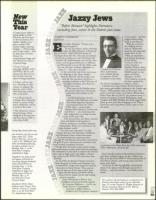

Jazzy Jews
New
This
Year
• Large screen video is
being added to Hart
Plaza for the first time
in festival history. For
added visibility, two
giant mobile LED
screens (light-emitting
diodes) — 20 feet high
and 20 feet wide — will
be placed at the Ford
Motor Co.
Amphitheatre Stage and
the MotorCity Casino
Pyramid Stage.
• From 8-10 p.m.
Saturday, WKBD-UPN
501VWJ-CBS 62 will
telecast the festival live;
for the first time the
show is being simulcast.
• Tickets will be sold
for a drawing to raise
money to support the
festival, with a 2002
Ford Mustang convert-
ible as the prize.
• An official festival
compact disc, featuring
music by many of this
year's headliners, will be
on sale at the event.
• The MotorCity Casino
Pyramid Stage will be
designed to increase seat-
ing from about 2,000 to
more than 6,000.
Facing Page clockwise from top..
Jane Monheit, the 23-year-old
singer whose CD, "Come
Dream With Me," hit the No.
1 spot in the "Billboard" jazz
chart immediately following
its release, performs 6 p. m.
Monday, Sept. 3, on the
Ford Motor Company
Amphitheatre Stage.
Saxophone star James Carter
will appear with both his
neo-swing Django Reinhardt
tribute band (8:45 p.m.
Saturday, Sept. 1, on the
Ford Motor Company
Amphitheatre Stage) and
a funk group (6:30 p.m.
Monday, Sept. 3, on
the MotorCity Casino
Pyramid Stage).
Jazz flutist Herbie Mann
performs with 'Amigo" Dave
Valentin 10..30 p.711. Sunday,
Sept. 2, on the Ford Motor
Co. Amphitheatre Stage.
"Before Motown" highlights Detroiters,
including Jews, active in the Detroit jazz scene.
la
SHARON LUCKERMAN
StafrWriter
ven before Motown, "Detroit was a
happening place.
So says Lars Bjorn, author with Jim
Gallen of Before Motown: A History of
Jazz in Detroit, 1920-1960 (University of
Michigan Press; $22.95). This rich new history
of jazz takes readers on a tour of Detroit that
includes old neighborhoods once Jewish, then
black, and the grand ballrooms on Jefferson
and Woodward avenues. By the 1950s, read-
ers visit the more intimate nightclubs on
John R — "the street of music."
At the end of the trail is the most popu-
lar offspring of jazz, Berry Gordy's
Motown Records. All the studio musi-
cians for this operation, says Bjorn, a
sociology professor at the University of
Michigan-Dearborn, were from the
Detroit jazz scene.
What may not be familiar about
this period, however, is the Jewish
connection that surfaces in the
book.
Jewish businessmen owned a
majority of the ballrooms and clubs
that hosted legendary big bands
and musicians from the 1920s-
1950s. Jews — such as John
Kaplan, Bernie Besman, Devora and
jack Brown — also dominated the
early independent recording business
in the 1940s and 1950s.
This was possible, says Bjorn, because
Jews and blacks lived together in
Detroit, leading to convenient business
relationships. Both were restricted in the
white business world.
"The clubs were important," he adds,
because they gave the musicians a livelihood
and Detroiters a place to hear their music.
The book brings the community alive
through 93 oral histories the authors recorded in
the past 20 years. Extensive jazz, economic and
social research completes the story.
"Though there have been many articles, biogra-
phies and critiques written about Detroit musicians,
the information in this book is collected for the first
time under a single roof," says Gallert, a former
disc jockey for the WDET-FM radio show Jazz
Yesterday.
In the 1920s, the Koppin Theatre (owned by
Henry Koppin) at Gratiot near Beaubien was
considered the "single most important musical
institution in black Detroit." Here, patrons
danced and saw all the major classic blues
singers like Ma Rainey and Bessie Smith,
along with live bands, movies and touring
musical comedies.
Down Woodward at Warren, Jean
Goldkette, Jewish and French, opened
the Graystone Ballroom — but he was
better known as a bandl ea der.
Featured in Before Motown,
Goldkette led "the greatest orchestra
"
in the world ... the first
original white swing
band in jazz history."
With the arrival of
the "talking movies"
and the Depression,
however, the large ball-
rooms died. In the
1930s, an important
new theater sprang up
in the former
Orchestra Hall: the
Cohen brothers'
Paradise Theatre. Here,
A student at the Moscow
Cab Calloway attracted
Music Conservatory,
40,000 people in one
Jean Goldkette became
week, and Duke
an important Detroit
Ellington, 30,000.
bandleader in the 1920s.
(The building currently
has been restored for
the Detroit Symphony as Orchestra Hall.)
A decade later these theaters declined and the
jazz venues got smaller, ushering in the "golden age
of jazz." When people came to these bars, they
came to hear the music, as at Morris Wasserman's
Flame Show Bar on John R. An intimate room, it
hosted such greats as Dinah Washington, Sarah
Vaughan and Billie Holiday. Ifs where singer Della
Reese got her start after dropping out of Wayne
University and young Berry Gordy came to hear
the music.
A gathering at the Flame Show Bar, 1950, with owner
Morris Wasserman, sixth fivm left
Every decade produced talented local musicians
who had a national impact on jazz, Gallert says.
But, as in the recent PBS-TV documentary Jazz by
Ken Burns, Detroit, and its jazz scene, has been
given short shrift.
Until now. In this thoughtfully written book,
many of the players who brought jazz to life in
Detroit — and the country -- are finally remem-
bered. ❑
The authors will participate in a symposium on
Detroit's jazz history noon-5 p.m., Saturday,
Sept. 29, at the Charles H. Wright Museum of
African American History, 315 E. Warren,
Detroit; (313) 494-5800.
4
\
8/24
2001
83