

The 'Sine Scene
Former Detroiters plan the launch of Weeb," a new magazine targeting marginally
affiliated, but culturally identified, Jews in their 20s and 30s.
Spin magazine and covered Ralph Nader's
2000 presidential campaign for workin or-
change.coin, a Web site dedicated to progressive
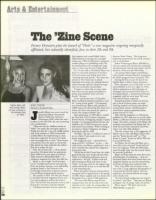
Ophira Edut, left,
and Jennifer Bleyer
are busy working on
the premiere issue
of "Heeb."
8/17
2001
78
JOEL TOPCIK
Special to the Jewish News
3
, ennifer Bleyer was never much for
doing her Hebrew homework.
Back at Hillel Day School in
Farmington Hills, where she was a'
student in the mid-'80s, she was something
of a troublemaker.
"There was sort of a rebellious coterie at
Hillel," she recalls. She won't give names or
details, but after all, it was only middle school,
and if the teachers at Hillel occasionally
scolded Bleyer for daydreaming in class,
they also taught her the power of words
and encouraged her to write. Those forma-
tive preteen years she spent at the Jewish
day school are what made her the radical
Jew she is today, she says.
Now, the 25-year-old — whose family
moved to Cleveland after her graduation
from Hillel and a year spent at Andover
High School in Bloomfield Hills — is
starting a magazine for other Jews like her.
Bleyer is one of eight "social entrepre-
neurs" awarded seed money and training
from the Joshua Venture, a new fellowship
program based in San Francisco that
encourages young Jews to pursue commu-
nity-building entrepreneurial projects.
Her project is Heeb: The New Jew Review,
a national triannual magazine of arts, cul-
ture and progressive politics for Jews in
their 20s and 30s that promises to be a vital
forum for "cool Jews and their friends."
A freelance journalist who has written for
interests, Bleyer is no publishing rookie. She
has distributed her own underground maga-
zines, or 'zines, since she was in high school.
As a 15-year-old in Cleveland, Bleyer was
drawn to the punk feminism of the Riot
Grrrl movement and drifted away from
"anything remotely Jewish." But when she
moved to New York City to attend
Columbia University, she realized that her
radical leanings and her cultural heritage
were not necessarily irreconcilable.
"I began to notice that so many other
kids who were into punk and played in
bands and published 'zines were also
Jewish," she says.
In her sophomore year at Columbia,
Bleyer published Mazeltov Cocktail, a 'zine
for "young Jewish punks." The response
was phenomenal. Bleyer sold upward of
5,000 copies and discovered that there were
others out there who shared her desire to
stretch the category labeled "Jew."
After graduating, in 1998, Bleyer worked
for New York City's Civilian Complaint
Review Board, investigating charges of police
brutality A committed political activist, she
bridled at the CCRB's bureaucratic inertia
and turned to journalism. While working as
an intern at Harper's Magazine, she began
forming the idea for Heeb.
"Actually," she says, "it really just came to
me in a flash: There needs to be a new
Jewish magazine."
The magazine's title — derived from a
slang word for "a Hebrew," or Jew
just
came to her, says Bleyer, explaining it was a
sense of pride that inspired the magazine's
provocative title.
"All the Jewish kids I knew from the under-
ground hip-hop scene would call each other
`Fleeb' as a half-joking, half-proud term of
endearment," she says. "I think words and
their meaning are fluid, and when we say,
`Heeb,' it's to pop a hole in the negative asso-
ciation and let the air out, so we can then fill
it with something else."
When the Joshua Venture announced its
inaugural call for applications in the spring
of 2000, Bleyer applied and was chosen last
December from a pool of 100 applicants.
"We were really blown away by how
visionary Jenn was, by her drive, her com-
mitment to her work, the cutting-edge way
about her," says Joshua Venture's eAecutive
director, Brian Gaines. "Her long-term
leadership potential for the Jewish commu-
nity is tremendous."
Joshua Venture gave Bleyer 560,000 in
start-up capital and will provide continued
entrepreneurial training and support for the
duration of the two-year fellowship.
Last spring, Bleyer began assembling a
nine-member editorial board in preparation
for Heeb's inaugural issue in January 2002.
Among the first to join the board was
Ophira Edut, a fellow former Detroiter.
Edut, who grew up in Oak Park, is a vet-
eran publisher in her own right. In 1992,
while a sophomore at the University of
Michigan, she launched HUES (Hear Us
Emerging Sisters), a multicultural feminist
magazine, with her twin sister, Tali, and
their friend Dyann Logwood.
Eschewing waifish models and dieting
tips in favor of photo essays on single
working mothers and forum discussions
among black women, HUES found an
enthusiastic campus readership before
going national in 1995.
Edut sold the magazine to a Minnesota
publisher in 1997 and went on to edit Adios,
Barbie, a collection of essays on female body
image. (To resolve a dispute with Mattel, the
company that produces the Barbie doll, the
book has since been reissued by Seal Press
with a new title: Body Outlaws).
The two women met at the suggestion of
Bleyer's sister, who told Bleyer about Edut
and the "funky Jewish stuff" on "The
Jewess is Loose," found on Edut's Web site
at www. Ophira. corn.
For Bleyer, the 29-year-old Edut was a
wise older sister who had "loved and lost"
her own magazine. When the fellowship
came through, Edut was the natural choice
for associate publisher.
Bleyer and Edut share the same do-it-your-
self philosophy of publishing — both are
frustrated readers who have started their own
magazines because no one else was printing
the kinds of things they wanted to read.
Now, with Heeb, the two hope to con-
necr with a "long-neglected demographic of
young and hip Jewish readers" who can
appreciate the attitude behind the maga-
zine's cheeky title.
"So many Jewish publications are tragical-
ly serious," says Edut. They have an almost
apologetic way of saying, 'Yeah, I'm Jewish. –
Bleyer agrees. "We don't want to be
'ZINE SCENE on page 83