

helping jewish,farnilies grow'
low"
Pho to by Bob Mc Keow n
Question of the Week: An Academy Award-winning film fea-
tured a major blunder: Though set during World War II, it featured a
scene showing a box that reads "Made in Israel." Can you identify this
film? If so:
1. E-mail your answer, along with your name and address (address
will not appear in the newspaper) to: philapple@earthlinknet Please
be sure to write "AppleTree Question" in the subject line or
2. Call in your answer to: (248) 354-6060 ext. 308. Leave your
guess, and SPELL your name and leave your address, please.
We will run the answer, along with the names of all those who cor-
rectly identified the film, in this very spot on Aug. 31. We must have
your guess NO LATER than Aug. 17.
\b.
'
N .
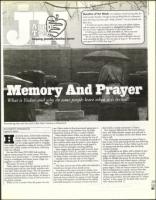
Remembering those who have died at Beth Olam Cemetery in Hamtramck.
ELIZABETH APPLEBAUM
AppleTree Editor
n
ad Jewish leaders followed the reasoning
of Hai Gaon, the leading Babylonian
scholar of the llth century, there might
not be a single appeal made in congrega-
tions today. No speeches, no pleas for money, no little
cards with a dollar number to fold down, indicating
what you will give.
Not that Hai Gaon (939-1038) had anything
against raising money for worthy causes. The issue,
instead, was a certain prayer -- one that guarantees to
bring in worshippers, and hence means a large con-
gregation to reach with an appeal.
The prayer, of course, is Yizkor.
Yizkor takes its name from the opening words of a
memorial prayer said for close family members who
have died. Yizkor literally means "He will remember,"
and it is said on the last day of Pesach, on Shavuot,
on Shemini Atzeret and on Yom Kippur. Its theme is
primarily belief and faith in God, as well as love for a
lost family member.
While no one is certain when the prayer was writ-
ten, Yizkor makes its first documented appearance in
the 11th century, in the Machzor Vitg, by Rabbi
Simcha ben Samuel of Vitry, a student of Rashi.
Most scholars believe Yizkor was formally intro-
duced into the synagogue service during the time of
the Crusades. Christians were murdering thousands of
Jews, and the rabbis used the prayer in utter despera-
tion: Perhaps the dead themselves would appeal to
God to end the seemingly unending suffering.
Many suggest that the prayer itself, however, dates
back to around 165 B.C.E., and that it was written
when Judah Maccabee and his soldiers were praying
for those of their comrades who had died in battle.
Initially, Yizkor was said only on Yom Kippur,
though later it became part of various holiday servic-
es.
Hai Gaon was just one of the rabbis who belieVed it
should never be part of any Jewish service.
According to Hai Gaon and others, holiday time
was when one should be appealing to God on his own
behalf, and pledging to improve himself. These rabbis
believed that one should not appeal to God through
the works of his parents, and should not be making
charitable donations in memory of those who have
died (which is clearly mentioned in Yizkor).
Few, however, followed the Hai Gaon's admoni-
tions, and Yizkor became a prayer not only said in
response to the Crusades, but for close family mem-
bers as well.
One of the great misconceptions about Yizkor is
that it may not be said during the first year following
the death of a loved one. In fact, Yizkor may be recit-
ed starting with the first holiday after the family
member's passing.
It is preferable to say Yizkor with a minyan (a quo-
rum of 10 Jews) in a public setting such as a syna-
gogue, though it may be recited at home. This is
unlike the Kaddish (the prayer for the dead, glorifying
God's name), which does indeed require a minyan.
Most worshippers who are not participating the
Yizkor service at a synagogue will leave when the
prayer begins. There are various reasons for this. Some
feel it's inappropriate to attend a service when they
have not, in fact, suffered the loss of a loved one.
Others might feel uncomfortable witnessing the grief
of those saying Yizkor. And still others say it's "tempt-
ing fate" to say a prayer for the dead when none of
their relatives has died.
❑
8/10
2001
57