
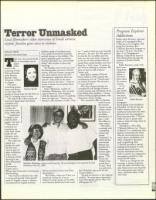

Terror Unmasked
Local filmmaker's video interviews of Israeli terrorist
victims' families gives voice to violence.
ers. "I used to think we were basically
the same," she says. She then goes on
Special to the Jewish News
to describe the incredible pain she
feels over her son's death, compared
isha b'Av, the annual Jewish
to the joy of Arab mothers who are
day of mourning, was an
proud
their suicide bomber sons have
appro-
died
for
a "holy" cause. "It seems to
priate
me
we
have
nothing in common. We
time for the
have
no
basis
to talk of peace,"
screening of Oak
Gedasi
said.
Park multimedia
Joyce Boim, mother of Dovid
artist Deanna
Boim, killed in 1996, laments the
Sperka's video:
senselessness of it all: "Dovid wasn't
Terrorism: A Work
an enemy of anyone. He was just a
in Progress.
17-year-old boy!"
The heart-
Film clips of peace protests are
wrenching presen-
interspersed
with footage of terror
Deanna
Sperka
tation was shown
victim
funerals
and still photos of vic-
to more than 200
tims before their murders — young
people at Young Israel of Oak Park on
fathers holding laughing babies, wed-
July 29, bringing many to tears.
ding shots, family outings.
The bulk of the video consists of
The cumulative effect of Sperka's
interviews Sperka had with family
work is to see
members of 22
the terrorist
Israeli terrorist
victims
as indi-
victims; the
.7:
viduals,
whose
interviews were 7,
loss
leaves,
as
from 1994-1997. :,:• ,-,
one
father
"I established
described it, "a
1.
a rapport, and
gap, a void,"
then let them
that affects so
speak," she said.
many others.
"There was no
The video
structure, no
concludes
with
questions, no
a disturbing
time limit. Some
section cap-
spoke for 20
tioned
minutes, some
"Solutions," in
for 2'/2 hours."
which
Sperka
The video was
interviewed
edited, but
Bassem Eid,
Sperka has used
founder of a
the full inter-
Palestinian
views as part of
human rights
other exhibitions
monitoring
of her work,
group. "The
including a 1996
Koran says
showing at the
[Arabs] must
West Bloomfield
with his parents. He was kidnapped and murdered by Arab
Nachshon
Wachsman,
shown
attack
Jews,"
Jewish
terrorists on Oct. 22, 1994.
he says. "And
Community
not only Jews,
Center and at
until
all will
but
Christians,
too,
kill not just their victim, but all his
Wayne State University's Community
become
Islamic."
descendants."
Arts Building.
He sees no solution to the ongoing
Yael Gedasi, whose son Yishai was
The emotion evoked by the video
conflict.
"So many peace agreements
murdered
waiting
for
a
bus
at
is strong and painful. Some Israelis
have
been
signed, and so what? The
Kibbutz
Yavneh,
speaks
of
the
differ-
speak in English, others in Hebrew
killing goes on." ❑
ence between Jewish and Arab moth-
accompanied by English subtitles.
SUSAN TAWIL
T
Mothers speak of murdered sons;
wives speak of murdered husbands
and the trauma to the children. The
grief is palpable; grief, one family
member described, was "the horrible
reality" that we have to face every
morning.
The families interviewed cut across
the demographic spectrum of Israeli
society: men and women, young and
old, sabras (native born) and ohm
(immigrants), religiously observant
and not. Some lived in the settle-
ments, some in the cities — Arab ter-
rorists, it seems, are not picky about
their targets.
Esther Wachsman, mother of
Nachshon Wachsman, who was held
captive before his 1994 slaughter,
cited the talmudic dictum in speaking
about her slain son: "'Anyone who
destroys a life, destroys a world.' They
Program Explores
Addictions
Rabbi Mark Borovitz, spiritual
leader of Congregation Beit
T'Shuvah in Los Angeles, will
bring the Gateways Beit
T'Shuvah Recovery Program to
the area 7:30 p.m. Thursday,
Sept. 6, at Congregation
Shaarey Zedek B'nai Israel in
West Bloomfield through the
auspices of Jewish Family
Service.
Rabbi Borovitz works with
Jews recov-
ering from
substance
abuse, or
who have
been jailed
for various
reasons.
At 16
years of
age, Rabbi
Borovitz
was presi-
dent of the
Rabbi Borovitz
United
Synagogue
Youth group at his temple in
„Cleveland. At 38, he was the
rabbi's inmate clerk at the
California Institution for Men.
Borovitz met the counselors
from Gateways Beit T'Shuvah
while he was in prison and
came to them for help when he
was released.
Founded in 1987, Beit
T'Shuvah (Hebrew for "House
of Return") is a residential ther-
apeutic community for those
who are recovering from sub-
stance abuse, alcoholism and
other compulsive disorders,
such as gambling. Beit
T'Shuvah provides a special
healing environment to indi-
viduals whose lives have
become disordered and who
wish to recover in a supportive
atmosphere guided by tradi-
tional Jewish values.
There is no charge for the
evening. A dessert reception
with the rabbi will follow his
talk. Reservations are required.
For information and reserva-
tions, call Dave Moss, (248)
559-1500.