

Fashion Backward
) Author uncovers a time in Jewish American history when getting dressed
was more about fitting in than standing out.
SANDEE BRAWARSKY
Special to the Jewish News
A
hat is often more than a
head covering. At the turn
of the century, many immi-
grant Jewish women in
America abandoned the kerchiefs and
wigs of the Old Country, and instead
favored the kinds of hats that were
stylish in their adopted homeland,
adorned with feathers, flowers and all
kinds of ornamentation. Some hats
looked like nests, others like platters
or baskets, and the bigger the better
seemed to be the rule.
"The covered head was transformed
from a traditional symbol of modesty
into an affirmation of American-ness,"
writes Jenna Weissman Joselit in her
engaging new book, A Perfect Fit:
Clothes, Character, and the Promise of
America (Metropolitan Books; $26).
Within its pages, subjects like hats,
footwear, corsets, hemlines and men's
shirts are turned into historical mark-
ers.
Looking at the generation of Irving
Howe's World of Our Fathers and their
American-born children between 1890
and the outbreak of World War II,
Joselit explains how hats and other
items of clothing were tools of accul-
turation and democratization. In a
period when ready-to-wear clothing
was becoming available, a Jewish
immigrant, a former African-American
slave and a farmer's wife in the
Midwest could wear the same types of
making readers think about something
as familiar as clothing in altogether
new ways.
In an interview in a Manhattan
bookstore near her Upper West Side
home, Joselit says that she had a won-
derful time researching this book. Her
sources are not the traditional tools
that historians look at.
She turned to songs, advertisements,
"The covered head was transformed from
a traditional symbol of modesty into an
affirmation of American-ness," says the
author about Jewish women's hats.
— Jenna Weissman Joselit
clothing.
As the book title implies, keeping
up with fashion was a way of fitting
into American society. And fashion
was an expression of national identity,
of shared moral values — an aesthetic
of restraint was embraced.
"Getting dressed was serious busi-
ness," Joselit writes. She succeeds in
"The earliest American designers, who
were working behind the scenes, were
Jewish women. Early on, even in the
'20s, the designer wasn't a big deal. It was
the manufacturer [who was important].
"I came across a remarkable article
from 1925 in The ,-imerican Hebrew
about young Jewish women who were
designing clothing as New York and as
American as the skyscraper. The gar-
ment industry was disproportionately
Jewish, but upward mobility and off-
shore manufacturing has taken Jews out
of this industry."
Among the Fash Bash style trends, some going
back to the time covered in Joselit's book, will be
soft and flirty 1930s full skirts flashed forward with
shorter hemlines and male-inspired patterns and tex-
tures in tweed and leather. These reflect the soft and
strong sides of women today.
Shields — currently appearing on Broadway as
Sally Bowles in Cabaret — will wear a one-of-a-kind
Badgley Mischka gown designed especially for the
three-city presentation.
"Fashion is universal and has played an important role
etiquette manuals, industry publica-
tions, sermons and magazines like
American Jewess, a kind of glossy
Ladies' Home Journal. The publication
urged readers to consider taking off
their corsets when cleaning the house
FASHION BACKWARD on page 60
Fash bash chairs
emeritus Douglas
and Sydell Schubot
enjoy a previous
year's Fash Bash.
in my life as a performer
and person," says Shields,
who recently starred in
ifetime's What Makes a
Family with Whoopi
Goldberg. "I'm happy to
be a part of Fash Bash
because it supports the art
of fashion while giving back to the community through
charitable contributions."
Part of the glitzy pre-reception at the State Theatre
will be an auction of 35 items — trips to destinations
around the world, sporting events, outings, opportu-
nities to create individualized parties and a leased car.
After the style show, in addition to the Comerica
Park activities, there will be entertainment and danc-
ing for all Fash Bash attendees at the State Theatre.
Among the Jewish art and style enthusiasts affiliated
with this year's Fash Bash are chairs emeritus Douglas
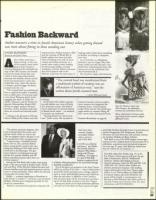
Top: For Paulina, Anna and
Gitel Forman, the elaborately
trimmed hat symbolized America.
Above: Anti-Jewish sentiment made
much of the Jewish woman's alleged
affinity for excess.
and Sydell Schubot; Founders Junior Council directors
Andrea Morganroth, Erik Morganroth, Jennifer
Silverman and Paul Silverman; and honorary commit-
tee members Michele and Brian Schubot.
Fash Bash is one of the DIA's largest revenue-gen-
erating activities, helping fund the preservation of its
collections, acquisitions and educational programs.
Over the past 31 years, Fash Bash has raised more
than $3 million for the museum. III
Fash Bash takes place Friday, Aug. 10, at the
Fox Theatre. Doors open at 6:30 p.m. for pre-
bash entertainment, and the "Hollywood
Glamour" fashion show begins at 8 p.m.
General admission tickets are $50 and $35. Call
(248) 433-1515. Patron ticket holders can
attend a private pre-reception with strolling
supper and auction at the State Theatre begin-
ning at 5 p.m. Patron tickets are $200-$300.
For patron tickets, call (313) 833-6954. All
guests will be treated to entertainment and
dancing at After Bash and After Glow parties at
the State Theatre and Comerica Park. For more
information, call (313) 833-6954.
8/3
2001
59