
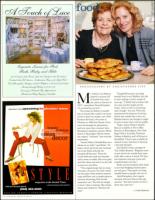

ra Kleinplatz and
en Berke put
of love into
chocolate chip
I bars.
/04z
ei54
.61,7) y azire,ci,cr,e4
7001 CycAct2eci ..6VeRciad,
Awe 430 (kaztec 1 ow de ealt
rclictiec/ Ya
- ZeR, lieticieen ,./1.;:ylkoeote/x/ii
ct9u 4.41celde
ge:It Akowitz egtAdr:ciail 48322 • ...1- eleAkv-te: 248.538 cLace (5223)
PHOTOGRAPHY BY CHRISTOPHER IVEY
L i ./a tkx-oask4L3-- ce:a1/26 10 :00 to 4:30
e
‘ve/ntir• S#;e1ce/nds.
,..V./AAottme/iit
Aa.cia/ cmc/ AaXyger;:sAy
tember issue
E
magazine at the Jewish News
A Jewish Renaissance Media Publication
Call your account rep at:
(248) 354-6060
OAKLAND
1 2 •
COUNTY'S
AUGUST 2001 • STYLE AT THE JN
PREMIER LIFESTYLE
MAGAZINE
y mother, Lea Selesny,
packed a suitcase full
of mandel bars when
she came to America in
1923," remembers Drora Kleinplatz.
"It was food for survival."
The recipe for Selesny's mandel
bars (a biscotti-like cookie) was hand-
ed down from her mother, one of the
Pioneers (bi-luim), who came to
Palestine in 1884 from Russia. It has
survived through the generations,
and now, more than a century later,
Kleinplatz's daughter, attorney Helen
Berke of Huntington Woods, shares
the original, "heirloom" bars with the
community.
"Auntie Helen's Mandel Bars are a
tribute to my bubi," says Berke. "In
Israel, where she lived, she would go
out to the fields and pick the
almonds off the trees. Then she
would shell and crush the almonds
with a stone or mallet. She even gath-
ered the wheat and took it to the mill
to convert it into flour.
"The original recipe had no meas-
urements, of course. My bubi would
use the palm of her hand to measure
sugar and flour, and a yarzheit glass to
measure shortening. Her favorite
expression was, 'You feel the dough
to know what is missing.' She mixed,
baked and cooked by vibration and
taste."
Though Berke grew up eating
mandel bread every Shabbat, she did-
n't start making it until a couple of
years ago. "I finally had a session with
my mom and she taught me the
recipe. I have to rely on measuring
cups, though," she says. When she
experienced the pleasure of serving
friends the mandel bars at her own
Shabbat dinners, she thought it might
be nice to share them with the public.
Today, Auntie Helen's Mandel
Bars are available at The Coffee
Beanery in Birmingham, New York
Bagel Deli in Ferndale, Westborn
Market in Berkley and LaTerrace in
Southfield. They're also available for
catered events. And they're drawing
a devoted clientele.
Says Robin Carney, manager of
The Coffee Beanery, "Regulars come
in and ask for the mandel bars, espe-
cially after work or at lunch. We have
one customer who gets a latte and
mandel bread every day."
Berke and her husband, Jack, hope
to see their fledgling business pros-
per and grow. Their goal is to bring
mandel bread to people who love it.
Adds Kleinplatz, who's experi-
menting with new flavors, like cap-
puccino, "You know there's no fat in
these bars, just love."
— Li nda Bachrack