

Lost Worlds, Found Art
Two
w York art exhibits evoke remnants of Jewish life.
F RAN HELLER
Special to the Jewish News
t first blush, 19th-century German-Jewish
realist artist Moritz Daniel Oppenheim
and 20th-century Russian-Jewish avant-
garde artist Marc Chagall would appear to
have little in common.
But a closer look at two New York exhibits; "Moritz
Daniel Oppenheim: Jewish Identity in 19th Century
Art" at Yeshiva University Museum and "Marc
Chagall: Early Works from Russian Collections" at the
Jewish Museum reveal a number of parallels.
Both came from families steeped in Orthodoxy.
Both romanticized a lost past on canvas.
Both grew up in places hostile to Jews, yet dared
to celebrate their Jewish identity in-their art.
The Oppenheim Oeuvre
Known as both "the first Jewish painter" and the
first painter to make his Jewishness a subject of his
paintings, Oppenheim was born in the Jewish ghetto
of Hanau, a German city, in 1800. The exhibit,
which marks the bicentennial of his birth, was
organized by the Jewish Museum in Frankfurt,
Germany. The Yeshiva University Museum is its only
American venue.
The youngest of six children, Oppenheim's father
was a devout and learned man, a chazzan (cantor) in
his synagogue and a jewelry merchant by profession.
His mother was the emotional center of the family,
.
7/27
2001
66
where religion played a central role.
Oppenheim, who died in 1882, lived through a
period of incredible change in Germany and
Western Europe, particularly for the Jewish people
in the region, notes Gabriel M. Goldstein, curator at
Yeshiva University Museum. "He was both part of
the change and an agent of the change — through
his painting and his life," says the curator.
The exhibit of almost 90 paintings and 14 works
on paper from worldwide collections and museums
is a remarkable feat, given that the Nazis confiscated
all of the works from Oppenheim's estate in 1941
and many of his paintings and drawings were lost
during World War II. According to the scholarly cat-
alogue, of the 737 works by Oppenheim that are
documented, 224, almost one-third, are lost.
A self-portrait of the artist painted when he was
about 15 years old reveals both a prodigious talent
and bold self-confidence in the subject's smirk and
swagger. "He was literally plucked out of cheder
[school] at age 10 and sent to the Hanau Drawing
Academy," says Goldstein. Oppenheim was the first
Jewish artist to receive classical academic training.
The painting Moses with. the Tablets of the Law, paint-
ed at the Munich Art Academy where Oppenheim
studied next, demonstrates both his artistic skill and
Jewish identity. Here, Oppenheim deliberately portrays
Moses as the teacher of the Jewish people and as a
heroic figure in the classical mold. The painting was a
reaction to his professor's latent anti-Semitism.
As he emerged as an artist, he stayed true to his
people and himself, interjects the curator.
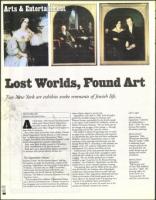
Left to right:
Moritz Daniel
Oppenheim: "Charlotte
von Rothschild as a
Bride," 1836 The artist
borrows from Italian
Renaissance paintings.
Moritz Daniel
Oppenheim: "Felix
Mendelssohn-Bartholdy
Plays for Goethe," 1864.
A celebrated Jewish
composer plays for the
non-Jewish poet, the
artist's discrete way of
dealing with notions
of tolerance.
Moritz Daniel
Oppenheim:
"Self-Portrait with
his First Wife Adelheid,
nee Cleve," 1829. This
painting reflects the
artist's success as a
"society painter" for
both Jews and non-Jews.