

, , „
94",:t
0tOlikkAPV-tgir:MINZASOMM:117
..„
ze,1/4400
Cover Story/The Big Story
•
Hair Care
Hair Extensions
& Hair Pieces
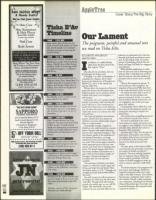
Our Lament
(ponytails, braids)
(customer colors available)
Ra-
Nail Care
2448 1312 BCE
The poignant, painful and unusual text
we read on Tisha bAv.
•
Body Jewels
vt*.
Trench Bratty Accessories
C.4\its
FOR SUMMER FUN.–
ELIZABETH APPLEBAUM
AppleTree Editor
toe rings, hair/face glitter,
makeup, lotions
s te.
Shop Where The Pros Shop
All Products at Discounted
Prices GUARAN'i*EED
r,:,
ukti.
,... i. •„
N SUMMER. 11 URS:
Mon St Tues 9:00am-6:00pm
Wed & Fri 9:00am-8:00pm
3830 70 BCE
D e struction r of Second Ternple b'
Romans under .Titus. MOre than
as rr result :of War,
million Jes die r.r
famine and disease.More than
g pillion Jews exiled to all parts r of
the Roman Empire,
Sat 10:00am-5:00pm
6243 Orchard Lake Rd.
pothack Steakhouse
foorafield
(
r
24 a> 38-4330
-4329 Fax
3892 '132 BCE
Barlcochba revolt crushed More
than 100,00 Jews killed.
3893 133 -BCE
Turnus Rufus ploughs the site of
the Temple. Romans build pagan
city of Adia Capitolina on site of
Jerusalem.
"THE BEST FRESH SUSHI"
SAPPORO
Japanese Restaurant
Lunch Special Bento $6.75
Sushi Lunch Special $7.95
Dinner Special
(Teriyaki or Tempura)
2 For Only_$19.95
r
:5% OFF YOUR BILL
II
(Dinner Only) I
a
I.
6835 Orchard Lake Rd., West Bloomfield, MI 48322
(at Md Orchard Mak, Farmer Jack Center)
(248) 828-8111
4855 1095 BCE
First Crusade declared by Pope
Urban II. Ten-thousand jews killed
in first month. Crusades bring
death and destruction to thousands
of Jews and totally obliterate many
communities in Rhindand.and
France.
.5050:
1290 BCE
Expulsion of Jews from England,
accompanied by pogroms and con-
fis-cation of books and property.
5252 1492 BCE
Inquisition in . pain and Portugal
culminates it the expulsion of Jews
. for the Iberian Peninsula.
5702 1942 BCE
Deportations begin from Warsaw
Ghetto to the Treblinka concentra-
tion camp.
5754 1994 BCE
AMLA. Jewish corn-
ota
mfinity center in Buenos Ai.res kills
86 people and wounds some 300
others.
dr,
7/27
2001
60
Timeline courtesy of Oh_ r Sonayaeli
International www.ohnedu
n Hebrew, it is called Eichah,
taken from the first word of the
first chapter, "How."
How does the city sit solitary, that was
fill of people, the author cries.
In English, it is called Lamentations. It
comprises five chapters, all of which
focus on the destruction of Jerusalem in
586 B.C.E., and it is the central text
read on Tisha b'Av.
Written from the perspective of several
poets who lament the devastation that
befell Jerusalem and its residents, Eichah
is filled with poetry and metaphors —
and mystery.
Sometimes, the writer speaks achingly,
directly to Jerusalem itself, and asks the
city to call out to God; sometimes, he
speaks of its destruction in the third per-
son. At times, the writer is an individual,
while other times it is a chorus that tells
of Israel's loss.
Like many of Judaism's most famous
prayers, Eichah's first four poems are
alphabetic acrostics; additionally, chapter
three is a triple acrostic.
Interestingly enough, chapters in
Eichah are not really devoted to a certain
theme. Instead, each makes references
that are often repeated throughout. The
first chapter speaks of the loneliness of
the destroyed Jerusalem, no longer
inhabited by Jews and without allies in
the world. The second chapter describes
which particular parts of the city were
ruined, and God's role in bringing them
down. The fourth chapter tells of how
the former dwellers of Jerusalem are in
pain, while the final chapter speaks of
the agony of those who stayed in
Jerusalem after the city had been
attacked.
The real heart of Eichah is the third
chapter, in which the motif is great suf-
fering, and hope lost and found. Here,
the author writes in 3:18, "I thought my
strength and hope had perished before
the Lord."
But still, he says, he will not droWn in
his despair, for God cares for those who
trust Him. Though God will certainly
punish, the author says, so, too, will He
forgive. But meanwhile, man must
examine his own soul and reflect on his
behavior to understand why God has
deemed such harsh punishment neces-
sary. As the chapter ends, the author
returns to lamenting what he has suf-
fered, and begs God both for vengeance
and salvation.
While Eichah would seem to make
clear the fact that God is delivering pun-
ishment that is well deserved, nowhere
does the text say what the residents of
Jerusalem did to receive such a terrible
fate.
There is this mysterious phrase: "It
was for the sins of her prophets, the
iniquities of her priests/Who had shed
in her midst the blood of the innocent."
No scholar has been able to point to
exactly what sins the prophets and
priests committed. In fact, it is certain
that Jerusalem's Jewish community was
not engaged in one of the most egre-
gious sins: idolatry
Consequently, many rabbis have said
the writer of this statement simply was
looking for something to explain the
destruction.
One of the most compelling questions
about Eichah is exactly who wrote it.
No name is attached to the verses.
Some point to a variety of authors; oth-
ers suggest it was Zedekiah, the last king
of Judah. Most identify the author as
Jeremiah. Why Jeremiah?
Jeremiah did, in fact, live through the
destruction of Jerusalem, and scholars
throughout history have commented on
the similarities in the writing styles
found in the Book of Jeremiah and
Eichah.
Yet some point to the obvious differ-
ences between the personality evinced by
the author of Eichah and that of
Jeremiah. The most striking: Jeremiah
had no hesitation about telling why
Israel would be punished, while the
author of Eichah struggles to come up
with an answer, and never really finds
one.
No doubt because of its poignant sub-
ject matter and language, Eichah has
inspired numerous works of art, espe-
cially in the field of music. One of these
has become a Gregorian chant used in
the Catholic Church, while contempo-
rary composers, including Ernst Krenek,
Manuel Rosenthal, Igor Stravinsky and
Leonard Bernstein, all composed works
inspired by Eichah. 0