

r-r-----
--
common to him and his time: patriotism. "We of
the Reform school of Judaism ... have long seen in
America the Jew's land of destiny. Building upon
the old foundations ... but filling the old faith with
a new spirit ... we have developed a phase of
Judaism indigenous, as it were, to this soil ...
toward America, the land of promise ..."
But Rabbi Franklin spoke mostly clearly to all
Detroiters and for what he hoped would be a bright
future for them when he concluded his address to the
graduating class of Cass Technical High School in
1942. He relayed this legend: "Three men were
breaking stones ... when one was asked, 'What are
you doing?' He replied, 'Can't you see, I am breaking
stones,' and the second, in answer to the same ques-
tion, replied, 'I am r..aking a living,' but the third, a
man of vision, a man of spirit, a man of imagination,
a man who looked forward to the future, said, 'I am
building a cathedral.'" ❑
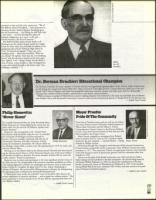
Rabbi
Leo M.
Franklin
Dr. Norman Drachler, 30 years a teacher in Detroit schools, was appointed superintendent of the Detroit Public Schools and
served during the crucial years from 1966-1971. Mayor Jerome P Cavanagh and Gov. George Romney called upon him dur-
ing the 1967 riots in Detroit, and under his thoughtful leadership, summer schools were kept open, and he substantially
increased the number of black teachers, administrators and deputy superintendents.
While serving as a member of New Detroit, summer reading programs were instituted in the inner city and black arts and theater
were funded. Active with the Jewish Community Council, he also served as educational director at Temple Beth El. He died last year.
Judith Levin Cantor
—
Dr. NOrli.
Drachler
Philip Slomovitz:
`Never Silent'
Meyer Prentis:
Pride Of The Community
The notable historian Robert St. John described editor
Philip Slomovitz as "always fighting for causes that are
really noble, for the survival of freedom, equality and
human decency"
Slomovitz, who immigrated to the United States
from Russia with his family when he was 13, attended
the University of Michigan and first majored in
forestry. His poor eyesight interfered with the use of
Philip Slomovitz
microscopes, however, and after winning a writing
award, he switched to journalism. He was an editor on
the Michigan Daily while a student and, after graduating in 1 9 19, he took a job
with the Detroit News.
Moving on to the editor's desk at the Detroit Jewish Chronicle and then found-
ing the Detroit Jewish News in 1942, Slomovitz became one of the most influen-
tial Jewish journalists in America. For seven decades, without fail, he wrote the
weekly column "Purely Commentary"
Slomovitz was a witness and participant in the most significant Jewish events of
the 20th century. He corresponded with numerous American presidents as well as
with leading dignitaries of Israel. He challenged anti-Semites, such as radio priest
Father Charles E. Coughlin; he allied with U.S. Sen. Arthur Vandenberg in
defense of Zionism He continued his lifelong interest in forestry by championing
the planting of trees in Palestine by the Jewish National Fund.
In Slomovitz's own words, he promised "never to be silent when there is the
merest semblance of injustice anywhere ... and to speak out without malice." His
book published in the last decade of his 96-year lifetime appropriately bears the
title Without Malice.
— Judith Levin Cantor
Drive down Detroit's streets and you will see the Meyer
and Anna Prentis School of Business Administration at
Wayne State University and the Meyer L. Prentis
Comprehensive Cancer Center in the Detroit Medical
Center. Enter the Detroit Institute of Arts and you will
find yourself in the Prentis Court.
Meyer Prentis, originally an immigrant from Poland,
came to Detroit from St. Louis in 1911, hired as a book-
keeper for the new company — General Motors — being Meyer Prentis
formed by William Durant.
Advancing through the company's ranks because of his unusual competence,
Prentis became comptroller of the corporation when William Durant was made
president in 1917. Two years later, Prentis was appointed treasurer and remained
with GM during its years of spectacular growth until his retirement after four
decades in 1951.
Prentis was the pride of the Jewish community, one of the rare Jews to hold a
high-ranking executive position in the auto companies. On the founding board of
the Jewish Welfare Federation in 1926, he chaired the establishment of the first
Jewish Community Center on Woodward and Holbrook in 1931. Civic-minded,
during World War II, he was a volunteer USO worker, and later served as vice presi-
dent of Detroit's United Foundation.
— Judith Levin Cantor
7/27
2001
33