

inion
Dry Bones
TIE Go6 tix-es
Editorials are posted and archived on JN Online:
www.detroitjewishnews.com
of3SERNIefz
-- ro
imecr BANK
Am i) GAZA !
Building A Better JCC
et's hope the staff layoffs and program cuts are
enough to offset the projected operating
deficit announced by the Jewish Community
Center of Metropolitan Detroit.
What's at stake is the future of the JCC,
Detroit Jewry's central address, even
though this latest reduction is small corn-
pared to the $10 million budget.
The situation must be addressed because
the Jewish Federation of Metropolitan Detroit won't
always be there to make up deficits — nor should it
be.
Laudably, leaders from both the Federation and
the JCC agree on that pivotal point.
The Federation is rooted in the ideal of serving the
greater Jewish community and being there in times
of communal need. It supplements many communal
causes, especially our schools and social service agen-
cies. But its resources are limited.
The Federation has basically told JCC leaders: We
know you've been operating with deficits since at
least 1994, during a time of extensive renovation,
but expenses are higher than expected and we've got
to have spending controls. So, trim your budget.
It was the second "wake-up" call for the JCC exec-
utive board in less than a decade — and the board
acted by announcing up to $300,000 in immediate
cuts, including the equivalent of six full-time posi-
tions. The highest-ranking layoff is slated to be
Leslie Bash, the popular associate executive director,
who will be sorely missed.
Higher-than-anticipated energy costs and aging
mechanical equipment, coupled with lagging general
L
Related coverage: page 18
FOREIGN
PK - SS
DorNiG ?
fr 4
Y6 4-1 - aUr
A ??Ati2 NM-
-
r
IVO
Fc
1
11.
Empty Gesture
T
'_
operating revenue, drove up the deficit projec-
tion for 2001-2002. Looking back, tighter
t
budgeting these past few years, as a hedge
against the delay that materialized in revenue-
generating improvements, might
have lessened the need for layoffs
Doest.r -r-
A
now.
L(
-- nRusT
Layoffs were inevitable given the
114
k 1 7
n46
--
size of the budget reduction; the
EVEN
2000 2001 annual report shows that 57 percent
126 PORTS 1
Cu IR(WEAK)
of the $9.5 million in expenses were for salaries
coMMUNfrq
and benefits. The upshot is that the layoffs
require sensitive follow-up to quell the shock
and anger they elicited in some parts of the
community.
The same JCC report shows that 24 percent of
the $9.4 million in revenue came from the
4
•
Federation's annual allocation. Over the five-year
period ending in 2001-2002, that allocation
grew from $1.6 million to $2.5 million. Officials
on both sides are committed to a phased whit-
ding of that amount. Their plan, which projects no
Meanwhile, the JCC, led by President Sharon
Hart and Executive Director David Sorkin, must
deficit by the 2004-2005 fiscal year, not only is pru-
meet the challenge of balancing costs, finishing
dent, but also essential if the JCC, a community pillar,
improvements, boosting usage and maintaining
is to begin to operate within its means. Periodic
quality. Certainly, that's everyone's expectation. The
updates to the community should be part of the plan.
leadership also must reaffirm the value of joining
Financial help should come once the health club is
and supporting the JCC if membership is to rise
improved, the sports and fitness wing is completed,
substantially.
•
the Milk and Honey restaurant opens and the Sarah
We're hopeful that the confluence of spending con-
and Irving Pitt Child Development Center reaches
trols and planning contingencies will produce a JCC
full enrollment. But what happens if the economy
that's stronger, more vibrant and more sharply focused
sours further and a deficit remains in three years? A
within the sweep of its 75th anniversary celebration. ❑
Federation subsidy shouldn't be the only contingency
En o RIAL
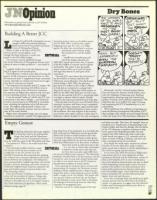
he leading industrial nations got together
in Genoa last week to say, among other
things, that Israel and the Palestinians
ought to invite "international monitors"
into the strife-torn areas of the West Bank and Gaza.
The question is: What in the world would they
monitor?.
They obviously couldn't monitor a cease-
EDITO
fire because the firing hasn't ceased, not for
a single day in the two months since the
Mitchell Commission first proposed that stopping
the violence was a necessary step before talks could
resume between the combatants. The Palestinians
have continued their intifada (uprising) with suicide
bombers, drive-by shootings and mortar attacks on
residential neighborhoods; Israel has retaliated with
guns and missiles aimed at terrorist leaders, but
often harming civilians.
Thus, the monitors would have to concern them-
selves with the incidents of violence. Perhaps they
could station themselves in flash point places like
Hebron or Beit Jalla and run to investigate whenever
they heard explosions and gunshots, which would
OBSERVERS
BU(' ISN'T
OF -1T-1 LUORGI)
WIWI TO SC-AJD
keep them busy, if not productive. It is not likely that
they could convince Palestinian terrorist groups like
Hamas and Tanzim or Israeli terrorists such as the
Committee for Safety on the Roads (a settler group
that took responsibility for the drive-by shooting that
killed three Palestinians) to let them know in advance
where they intend to strike from day to day.
It is not clear to whom these internation-
al observers would report what they saw
nor how their accounts might differ from
the ones provided by news reporters. The Palestinian
Authority is hardly likely to let the monitors visit the
burned out ruins of some ham-handed bomb-mak-
ers when it is so much more in the PA interest to
describe those accidents as Israeli assaults.
Even assuming the monitors did an accurate job,
documenting, for example, the Palestinian mortars
shelling of Israeli neighborhoods or disproving the
charge that Israel is using depleted uranium artillery
shells, it might not be very helpful. The people who
can stop the violence are those who are causing it,
and the Palestinian media aren't likely to broadcast
the findings of international observers when they
contradict the propaganda lines.
Monitors can serve a useful purpose if the time
RIAL
and place are right. They have, for example, been an
accepted and a valuable part of peacekeeping in the
Golan Heights and Sinai for decades. But the failure
of the UN observers in southern Lebanon to help
Israel capture the Hezbollah guerrillas who kid-
napped three IDF soldiers has made it plain that
Israel should only agree to U.S. monitors, such as
those currently working in Hebron, and then only
after a sustained period of nonviolence.
Nor should the world expect monitors to achieve
miracles. If the two sides aren't ready to reach a
peace accord and to observe it, all the monitoring in
the world isn't going stop the violence.
It was ironic that while the Group of Eight indus-
trial nations, the G-8, were taking time at their
meeting to tell Israel and the Palestinians, neither of
them a G-8 member, how to move toward peace,
one of the anarchist demonstrators was shot to death
while threatening Genoese police with a fire extin-
guisher. The incident was eerily reminiscent of so
many of the confrontations that have taken place
since the intifada began, where Palestinian demon-
strators threatened the armed Israelis positioned
against them and paid the price.
Given the increasingly large and stridentanti-glob-
alization protests that surround the G-8 conclaves,
maybe it is appropriate to suggest that the industrial
leaders need international monitors just about as
much as Israel does. ❑
7/27
2001
27