

This Week
Opening For Observers
CIA may serve as Mideast monitor, but details haven't been fleshed out.
MATTHEW E. BERGER
Jewish Telegraphic Agency
Washington
srael has agreed to the presence of
U.S. monitors for a fragile cease-
fire with the Palestinian Authority,
but much remains unclear about
the scope and timing of any international
presence in the Middle East.
Bowing to a growing push for an
observer force in the West Bank and
Gaza Strip — most strongly articulat-
ed at this week's meeting of G-8 lead-
ers in Genoa, Italy — Israel has
accepted the idea of CIA officials serv-
ing as monitors.
But while the CIA has stretched its
mission to include facilitating security
talks between Israel and the
Palestinian Authority, serving as inter-
national observers would move the
agency into uncharted territory.
A monitoring role would be the lat-
est escalation of the Bush administra-
tion's part in the Mideast conflict. The
administration, which has been hesi-
tant to take broad steps, would be
intervening in response to requests
from Europe and the Arab world.
After years of intensive American
involvement under the Clinton
administration, the ground seemed to
have shifted when George W. Bush
took office in January.
. The Bush White House originally
said the CIA would not play a role in
the Middle East conflict, despite the
fact that CIA Director George Tenet
was involved in negotiating ;. final-sta-
tus security agreement at the failed
Camp David talks last July. Within a
few months of the Bush administration
taking office, however, Tenet was back
in the regionTacilitating security talks.
His meetings produced the "Tenet
working plan," a June cease-fire agree-
ment under which Israel and the
Palestinian Authority would resume
security cooperation and end violence.
The Tenet plan — and recommen-
dations of an international commis-
sion led by former Sen. George
Mitchell — have formed the major
policy guidelines for U.S. and other
I
Related editorial• page 27
4114T
7/27
2001
18
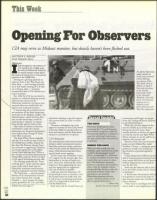
An elderly Palestinian
walks towards an
Israeli army armored
vehicle blocking
an entrance of the
West Bank town of
Hebron on April I.
Both sides lay claim
to the ancient,
fortress-like Tomb
of the Patriachs,
Abraham, Isaac and
Jacob. International
monitors are in
Hebron as part
of the three-year-old
Wye River agreement.
diplomats working to get the negotia-
tion process back on track in recent
months.
However, a subsequent trip to the
_
region by Secretary of State Colin Powell
in late June failed to tone down the vio-
lence and rhetoric, and the Bush admin-
istration is currently low on options.
ressuri
oyerp*
,-tnterriatio,
-
cse
CIA Reluctant
The administration had stood by Israel's
refusal to admit international monitors.
Israel fears monitors merely would pro-
vide cover for attacks by Palestinian mil-
itants, while documenting and criticiz-
ing the Israeli army's response.
On his recent trip, Powell first voiced
U.S. support for the monitor idea, then
backtracked in the face of Israeli criti-
cism. Since then, Israel and the United
States have been negotiating the issue,
and have agreed that an augmented
CIA role would be acceptable.
Israel says only the Americans will
be permitted to serve as monitors, and
the United States has made clear that
it will set up a monitoring mechanism
only if it is approved by both Israel
and the Palestinians.
Both Israel and the United States say
BEHIND TIIE ISSUE
Open access<
iltn Ant
secretive and
t
mop
n orn
esttn s
actions. oriitors tau not pe
able to operate
ere
Allan Gale,
Jewish Community Council
monitoring would begin during the
seven-day cooling-off period outlined
in the Mitchell Report.
While the CIA has dipped its feet
into the Middle East several times
during the past few years, Tenet
remains hesitant to involve the agency
too heavily, and he may fight White
House attempts to use his staff in an
observer role, sources said.
However, Tenet also was reluctant t
jump into the Mideastiray under
President Clinton — seeing the peace
process as outside CIA jurisdiction —
but bowed to a personal appeal by
Clinton.
A State Department official said the
task of monitoring international situa-
tions usually falls either to the State o
Defense departments, and would be
new for the CIA.
Israel sees the observer role as simi-
lar to the CIA's current role as "securi-
ty facilitator."
In Israel's eyes, the monitors will no
be expected to travel to the scene of
each terrorist attack, but will observe
from a distance.
"They want to reconfigure the CIA
role to make it more appealing to the