
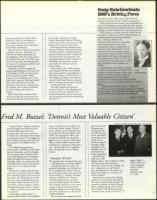

Ossip Gabrilowitsch:
DSO's Driving Force
neering consultant for Albert Kahn
Associates, where he developed the
steel-reinforced concrete bar that
became the module used in all subse-
quent Kahn architecture.
Julius formed the Truscon Company
to produce the bars, used early in
1902 for the Palms Apartments on
East Jefferson. They then were used in
the Packard Plant No. 10 (1905), and
went on to provide the amazing stabil-
ity found in all subsequent factory and
commercial buildings.
With Julius, Kahn designed the
Engineering Building at the University
of Michigan in 1903, and during the
following 20 years, Albert Kahn
designed most buildings on the Ann
Arbor main campus, including Angell
Hall, Hill Auditorium, the Main
(Graduate) Library, the original hospi-
tal complex, the Carillon and Kahn's
favorite building, the Clements
Library.
Albert Kahn's firm worked world-
wide, but locally he is best known for
the factories he built for the industrial-
ists, for their mansions in Grosse
Pointe, Bloomfield Hills and Windsor,
and for their athletic and country clubs,
banks and commercial institutions.
He designed Harper Hospital and a
previous Children's Hospital building
in Detroit. And he designed Detroit's
premier recreational park on Belle Isle:
the conservatory and aquarium, the
orchestra and band shell, the lagoons,
the stables, the boat club and the
yacht club, the pavilions and th,-:
police station.
Kahn died at 73 in 1942, having -
just completed Willow Run Bomber
plant. His significant contributions to
the Allied victory in World War II —
the building of airplane and tank fac-
tories in the United States, and naval
bases at Midway Island and in Hawaii
— have rarely been noted.
No other architect has given so
much of himself to his adopted coun-
try and to the city of Detroit. The
Jewish community and the entire city
can be justly proud of this outstanding
architect. ❑
The famed cellist Pablo Casals called Detroit's
Orchestra Hall one of the "world's unique gems."
Ossip Gabrilowitsch was the man responsible not
only for building this acoustically splendid concert
,auditorium in Detroit's cultural center, but also for
leading the local orchestra to national prominence.
When hired to be music director of the Detroit
Symphony Orchestra in 1919, Gabrilowitsch, an
internationally known Russian pianist
and a friend to Mahler and
Rachmaninoff, insisted on the build-
ing of a permanent concert hall.
CPmPleted ailder his suPervision in
only four and a half months, he con-
tinued.. to lead the orchestra to gre4t:
ess anal his death in 1
U
•
Fred M. Butze• Detroit's Most Valuable Citizen'
• Photo courtesy Walter P. Reuther Library, Wayne State University
"Lawyer Butzel," amateur musician,
received frequent invitations to bar
mitzvah celebrations from East
European Jews. On those occasions,
he would sit at the piano and attempt
to play Jewish music. He struggled to
learn Yiddish and many friends recall
his attempts to tell Yiddish jokes —
badly.
He bridged the gap between
German. Jews, identified as the leader-
ship in Federation, and the Ostjuden
(east European Jews). Butzel would
even make appearances at landsman-
shaftn (immigrant hometown club)
meetings and sit on committees with
Orthodox rabbis. He was among the
most inclusive of Detroit's Jewish
leaders.
Butzel was a visible social humani-
tarian force in Detroit. His law office
door remained open to Jews and non-
Jews alike. One historian has written
that "the most remarkable thing was
that Butzel offered his services with-
out fanfare, without hoopla, without
self-aggrandizement. He just helped
— and no one knows how many lives
he touched."
He brought the Boy Scouts to
Detroit and he aided in the establish-
ment of the Community Chest and
the Detroit Urban League. He pur-
sued a solution to the rampant truan-
cy problem in Detroit schools in the
1920s and, through his efforts, the
jurisdiction shifted from the police
department to a newly created truant
officer, which enabled truants to be
handled by an "educator rather than a
cop." He also effected the establish-
ment of a juvenile court in Wayne
County.
Champion Of Youth
The agencies that interested him most
— especially those involving children
— . became his personal causes. He
opposed orphanages on principle and
his compassion for children was sur-
passed by none. He joined prominent
non-Jews like J.L. Hudson, Clarence
Lightner and Dexter M. Ferry in
foundinc, what became one of his
most cherished projects, the Detroit
Boys' Home. Similarly, he was instru-
mental in the development of the
Children's Department of the Jewish
Social Service Bureau and the Jewish
Children's Home.
He was a constant supporter of the
Fresh Air Society.
His generosity
toward individu-
als, offering loans
or the equivalent
of personal schol-
arships to put
Jewish youngsters
through college,
especially in the
troubled times of
the Depression,
became legendary.
All of Detroit
held him in the
highest esteem. On his death in 1948,
the Detroit Free Press referred to
Butzel as "Detroit's most valuable citi-
zen," calling him one of Detroit's
great philanthropists. His death, the
paper concluded, was "a major civic
loss for Detroit."
Butzel led his community through
perilous times with grace and dignity,
and with a public Jewish persona. He
seemed to embody the best of Jewish
ideals, recognizing the need to move
from "charity" and all that the word
entailed, to the concept of "service." ❑
Judge Charles C.
Simons of the U.S.
Court of Appeals,
Fred M. Butzel
and John
Zurbrick, May
19, 1940.