

This Week
Small Enough To Save
A new program helps declining Jewish communities in the South preserve a precious subculture.
ANDREW MUCHIN
Jewish Renaissance Media
•."
Jackson, Miss.
111
ost Friday evenings, Jerry Krouse
stands with an open prayer book
before the carved Italian marble ark of
Temple B'nai Israel in Natchez, Miss.,
a Mississippi River town of about 20,000 souls
roughly 75 miles southwest of Jackson.
He checks the majestic 96-year-old sanctuary and
generally finds what he's seeking: a minyan.
Remarkable for an 18-person congregation. But
Krouse, the longtime volunteer worship leader,
quickly adds, "I don't read the service if only one
person is sitting in the congregation."
Krouse explains that if two congregants occupy
the pews designed to seat 300, B'nai Israel has
achieved its prayer quorum (a normal minyan is 10).
Six worshipers comprise a crowd.
It would seem that the end is in sight for the tem-
ple and for organized Jewry in Natchez. But the
community has a guaranteed legacy. When B'nai
Israel's local membership falls to 10, the congrega-
tion will transfer ownership of the historic syna-
gogue to the Goldring Woldenberg Institute for
Southern Jewish Living.
The year-old ISJL, based in Jackson, seeks to pre-
serve synagogues and Jewish cemeteries as it works
to develop educational, cultural and rabbinic services
for fledgling communities across 12 southern states.
Struggle Goes On
ISJL's founding director is Macy Hart, a quick-
thinking, slow-speaking force for Jewish activity in
the Deep South for 31 years. "I grew up in this. I
know what the needs are," he declares during an
interview in his obviously worked-in office. "I see
. the struggle of people who want a Jewish experi-
"
ence.
In 1970, Hart was appointed founding director of
the Henry S. Jacobs Camp for Jewish Living near
Utica, Miss. As he met Reform Jewish campers and
their families from throughout the South, he became
keenly aware of the imminent demise of Jewish
communities that in many cases had been central to
their towns.
Before the Civil War, immigrant Jews opened
small stores throughout the region. After the war,
they gained positions of economic and political
prominence. In Natchez, for instance, Jews dominat-
ed the booming cotton economy and built many of
the town's prized mansions.
In many southern towns, Jews constructed grand
Reform synagogues to proclaim their ascension in
twig
7/6
2001
20
Andrew Muchin is a writer based in Milwaukee, Wis.
•
„
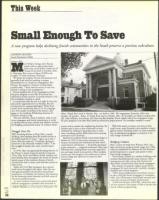
Above: Temple B'nai Israel in Natchez, Miss., was built in 1905. The congregation, formed in 1843, now
numbers 18 members. Below: At Temple B'nai Israel in Natchez, Miss., the worshipers are likely to include, from
left, Zelda Millstein, Jerry Krouse, Jerri Stern and Rae Rozolsky. Krouse explains that if two congregants occupy
the pews designed to seat 300, B'nai Israel has achieved its prayer quorum. Six worshipers comprise a crowd.
society and to emulate the neighboring churches. Yet
Judaism paid a price as Jews conformed to local
standards by working on Saturdays and, in some
cases, attending vacation Bible school and marrying
prominent local Christians.
Small-town southern Jewish communities began to
decline by 1910. As the cotton economy, in turn,
became mechanized and weathered the boll weevil,
many farmers and laborers — the Jewish merchants'
prime customers — migrated northward. Many Jews
followed them, seeking better economic opportuni-
ties and larger Jewish communities. Other southern
Jewish men who fought in the world wars or left to
attend college also opted not to return to their
hometowns.
With little reason to attract new Jews to their
small towns, many formerly active southern congre-
gations endure shrinking rosters. In some communi-
ties, an abandoned synagogue or cemetery is the
only vestige of Jewish life.
Bridging Cultures
Hart, a native of small-town Winona, Miss., has
been involved in southern Jewish triage since 1986,
when he established the Museum for the Southern
Jewish Experience to acquire and preserve items
from dying synagogues.
The museum, housed in a modern building at the
recently refurbished Jacobs camp, features a func :
tioning sanctuary that uses an ark, lecterns and
chairs from several former Deep South synagogues.
Hart dreams of using the region's many former
synagogues for local interracial, interfaith, intergen-
erational and cultural programs.
"We're doing collaborations everywhere we can,"
he says, citing the former synagogue in Lexington,
Miss., that will become a local Jewish museum and
venue for musical and theater performances.
As full-time director of the ISJL, which now oper-
ates the museum, Hart hopes to shift to Jewish com-
munal wellness programming.
0
5