

This Week
Science And Religion
A technical school in Jerusalem is carving an ever-larger niche by mixing engineering and Judaism.
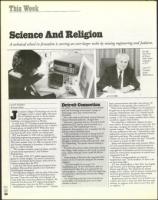
Far left:
Yael Sarel
of Kiryat
Arba studies
computers
at JCT.
Left: JCT
President
Joseph
Bodenheimer
ALAN HITSKY
Associate Editor
1 erusalem College of Technology may not be
the biggest name in Israeli higher education.
But its explosive growth in the last decade
has it acting like the larger institutions,
including a recruiting mission to Detroit.
In early June, JCT President Joseph Bodenheimer
and college officials visited the area to start a Detroit
Friends group on behalf of JCT. While they were
primarily looking for funding, not students, they
may have found a little of both (see related story).
JCT was founded in 1969 with an emphasis on
combining engineering programs and Jewish studies.
In the last seven years, its enrollment has tripled.
This year's student body of 1,400, on separate men's
and women's campuses in Jerusalem, is expected to
grow to 1,600 in the fall.
"We consider ourselves a place of values, and ethi-
cal and moral expectations," said Professor
Bodenheimer.
In the early 1990s, JCT added engineering pro-
grams for Soviet emigres. The school continues to
recruit in the former Soviet Union, with 150 of its
student emigres from the FSU.
It also has 100 French-speaking immigrants from
northern Africa and has created a new curriculum
for Ethiopian immigrants.
The Ethiopian program, with the help of the Israel
Defense Force, is enrolling 20-25 Ethiopians Jews
per year. Those who need help with language and
study skills take a one-year preparatory program, fol-
lowed by the three-year JCT engineering program.
After graduation, they join the IDF as engineers.
Bodenheimer's specialty — electro-optics -- includes
43
6/22
2001
20
Detroit Connection
Dr. Jeffrey and Caren Goldenberg of Southfield
had little knowledge of Jerusalem College of
Technology when they visited Israel last
November.
But a visit with an old friend, former Detroiter
Chaim (Howard) Jutkowitz, changed that.
Jurkowitz is associate director of overseas devel-
opment for JCT, and he took his friends on a
campus tour. The Goldenbergs were so
impressed, they agreed to host a reception for the
school in their Southfield home.
A few invitations to friends at Young Israel of
Southfield and others turned an informal meet-
ing into a fund-raiser with 50 guests. "We
thought it would be strictly informational," said
Dr. Goldenberg, "but people started sending in
checks."
He said a five-minute video presentation about
the college "really turned on the crowd. It turned
into a parlor meeting" which raised $8,500 for
JCT
Some parents at the event also requested infor-
mation on JCT's one-year program for overseas
students.
"This was terrific in two ways," Dr.
Goldenberg said. "It was informative, and suc-
cessful beyond what they ever expected for an
initial program. I hope this will be the beginning
of a long-term relationship between the college
and Detroit."
Dr. Goldenberg wants the event to become an
annual affair, and eventually grow into a yearly
brunch or dinner. El
lasers, communications and night vision devices. All
IDF officers in this specialty were trained at JCT.
When Israeli physicist William Low founded JCT,
his goal was to tap into Israel's yeshiva world. Five
years ago, Bodenheimer said, 12-15 haredi (strictly
Orthodox) students were on campus. Today, the
number is 120-150 as yeshiva students learn techni-
cal skills to support their families.
The school has a traditional, religious environ-
ment and for 30 years it was open to men only. Two
years ago, a program for women was created on a
separate campus. "They study the same topics with
the same professors as the men," Bodenheimer said,
adding that women increase the potential of Israel's
high-tech work force. The women's program,
Machon Tal, had 160 students this year. The profes-
sor expects it to grow to 300 in the fall.
Along with the growth has come outreach efforts.
JCT has created seminars for Israeli businesses on
intellectual property, employer-employee relations,
copyright law, and Judaism and the environment. It
hosted an international symposium on optical com-
munications June 20.
"We have a strong emphasis on research,"
Bodenheimer said. "To be excellent, we have to be
on the cutting edge."
JCT has created offices in New York, Los Angeles
and Toronto, and is forming support groups in
Detroit and Ottawa. The school has an annual
budget of $17 million, with 65 percent coming from
the Israeli government, 20 percent from student
tuition and 15 percent from fund-raising.
Bodenheimer said the school "ties to instill in our
students that there is more out there than just engi-
neering. An engineer with values is more than just
an engineer." Ei