

•
r itq s.;ry ;
4ft
Question of the Week: How old was Theodor Herzl when
he wrote The Jewish State?
cc •auop s! 3pom Atu laNdulud sltp jo uoIluDriqnd atia !pm
lap paj I„ `Q10.1.M uatp
.1-e t( Duo patimcind sum 'auaul
-a/war lsmolz uJapow alp pnuao capplooq at1Z •cc svm ag c.S68
ur cuoysanb qsynaf aqifo uoynios uaapopv v lcithayv uv :awls
qszczaf aye ‘iaitichu- ed aip Jo
lsnj s!ti Q10.1A1 IzraH LiemSuv
• mwonr., ,,
Wft
a MR
•
G oo
Boo
,e4 • 40..
re:'"<wom„„,144", v •• 7
4,
• " 4 7:41.Wftftrif' .ft.n5274•04
WW%
igazAwankem;:,„
.00
ELIZABETH APPLEBAUM
AppleTree Editor
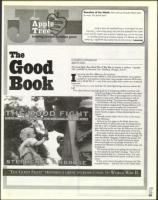
The Good Fight: How World War II Was Won by Stephen E. Ambrose. Copyright
2001, published by Atheneum Press. Hardback. 96 pages. $19.95.
'
I
is amazing what Ben Affleck can do for history.
Put a popular actor like Affleck in a film about Pearl Harbor, then publicize
it, publicize it and publicize it some more. Soon enough, everyone will be inter-
ested in World War II — even if the movie suffers from a severe case of political
correctness.
Or you can turn to a new book like The Good Fight and get the story without the
fluff.
This volume does an amazingly good job of introducing children and those with
limited knowledge of the subject to virtually every aspect
of World War II. There is just enough text to whet your
appetite to learn more, while not leaving you with an
overburdened feeling. The photos are unforgettable.
And Ambrose, who has written numerous books on
historical subjects ranging from Thomas Jefferson to D-
Day, manages to convey complex and controversial
issues, such as President Harry Truman's decision to drop
atomic bombs on Japan, without interjecting his own
opinion.
Naturally, Jewish readers will turn first to the section
on the Holocaust.
Ambrose has four pages on the Shoah, almost two-
thirds of which are photos and maps. It's disappointing
that this is all he included; while certainly there was a
great deal more to the war than the Holocaust, the raison
d'etre of the Nazi Party was the destruction of the Jews.
Fortunately, Ambrose does a good job of covering this
difficult subject, despite the limited number of pages. He
notes that Hider's campaign included other groups, but
makes it clear that the Nazi leader's hatred was always
directed primarily and unceasingly toward Jews. He
mentions the Wannsee Conference, the death camps and
Kristallnacht.
The section's one flaw is its apology for the silence of
so many people during Hitler's rampage. "News of the
Nazi atrocities leaked out," Ambrose writes, "but most
people refused to believe that anyone could be so mon-
strous."
In fact, many citizens throughout Germany and Nazi-
occupied Europe — and later even in the United States
MO AI211C. for'P
wrf
AStittiatiarv::
`THE GOOD FIGHT' PROVIDES A GREAT. INTRODUCTION TO WORLD WAR II.
.
"MW
4.•
4;*
tkc
ksitatt,
.ft
6/15
2001
93