

From world-class performing artists
to free evenings of music and film,
the Ann Arbor Summer Festival offers
three weeks of entertainment for every taste.
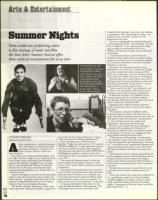
Clockwise from top right:
Josh Kornbluth: Exploring
the life of Ben Franklin.
NPR "Fresh Air" host Terry
Gross: "Anyone who agrees
to be interviewed must
decide where to draw the
line between what is public
and what kprivate,"
Ira Bernstein: "Dance
became all-consuming."
•
SUZANNE CHESSLER
Special to the Jewish News
radio commentator, a political humorist
and a folk dancer-are among the Jewish
entertainers featured at this year's Ann
Arbor Summer Festival, which runs
June 15-July 8.
Terry Gross, host of National Public Radio's Fresh
Air, offers interview insights 4 p.m. Sunday, June 24,
at the Power Center. Monologist Josh Kornbluth
presents Ben Franklin: Unplugged 8 p.m. Monday,
July 2, at the Mendelssohn Theater. Ira Bernstein
and the Ten-Toe Percussion Ensemble showcase
international choreography 8 p.m. Friday, July 6, at
the Power Center.
"Anyone who agrees to be interviewed must decide
where to draw the line between what is public and
what is private," says Gross, whose show airs on 160
stations, including. WDET-FM (101.9) in Detroit
between 3 and 4 p.m. Mondays-Thursdays.
"But the line can shift, depending on who is ask-
ing the questions. What puts someone on guard isn't
A
JN
6/15
2001
74
-,
015,0,
necessarily the fear of being 'found out.' It some-
times is just the fear of being misunderstood."
Gross, who grew up in a Jewish home in
Brooklyn," began her radio career in 1973 at station
WBFO in Buffalo, N.Y., where she hosted and pro-
duced arts, women's and public affairs programs.
Two years later, she joined the staff of WHYY-FM in
Philadelphia as producer and host of Fresh Air, a
local interview and music program that went nation-
al in 1987.
The winner of a Peabody Award in 1994, the
show has featured thousands of interviews with
actors, writers, artists, athletes, politicians and other
newsmakers.
Gross spends hours preparing for her interviews,
most of which are conducted over high-tech phone
lines that create the illusion of an in-studio inter-
view. Since shows are pre-taped and edited, Gross'
guests are free to refuse to answer a question. "It
gives me the license to ask 'anything,'" she has said.
A long-ago newsmaker brings humor to the
stage through Kornbluth's comic approach. The
monologist says he became interested in Ben
Franklin while looking in the mirror and realizing
a resemblance. After researching his subject, the
performer came up with a routine that also
explores his own roots.
"I got his autobiography and started finding out
curious things about him," says Kornbluth, 42, who
lives in California. "It was mysterious and intrigu-
ing, including the relationship with his son,
William, who became a Loyalist and was disowned
by his father.
"I started doing research and meeting with
Franklin scholars, which led me to question things
about my own family and our relationship and poli-
tics. My parents were both communists, and they
believed in revolution."
Kornbluth, who identifies himself as a Jew,
although he's not sure if he's a communist, decided
to go into entertainment after coming up with a
sketch for an office party. He tried standup comedy
and a radio show before moving on to monologues.
With the help of his brother, Jacob, who went to
Michigan State University, Kornbluth recently tried
filmmaking with Haiku Tunnel, based on a mono-
logue about his work as a legal secretary.
"I play myself in the film," says Kornbluth, who
has shown it at the Sundance Film Festival and is
looking toward its limited release in September.
Ira Bernstein will have a very different way of
communicating with his Ann Arbor audience —
step dancing, which plays up the sound of the move-
ment as well as the movement itself.
Appearing with a collective troupe, Bernstein
thinks of performers' feet as sticks and the stage as
their drum.
"We represent a selection of different styles,
including a flamenco dancer with flamenco musi-
cians, a tap dancer with jazz musicians, and a pair of
Irish dancers with Irish musicians," says Bernstein,
41, who will showcase his own talents with
Appalachian, clog, step and boot dancing.
Bernstein, who started with square dancing as
recreation while attending the University of
Pennsylvania, liked the music, the athletics and the
social element. He moved on to clogging and flat-
footing before learning European forms.
"Dance became all-consuming," says Bernstein,
who traveled to many cities to learn about the folk
styles that replaced his goal of becoming a veterinari-
an. "I was asked to join a professional company and
stayed with the group for about a year. We toured
folk festivals and gave school and community pro-
grams."
After Bernstein started working independently, he
found engagements around the United States and in
foreign countries and has worked with Gregory
Hines, Savion Glover and Jimmy Slyde. Raised in a
. Jewish home, he enjoyed going to Israel to perform
and teach.
Bernstein does not wear a costume but he is very
particular about his shoes, numbering about 50
pairs.
"Each style of dance has a shoe that's traditional to
it," says Bernstein, who lives in North Carolina.
"English clogging, for example, is done in actual
clogs, which are wooden-sole shoes with leather
uppers. Contemporary Irish step dancers wear fiber-
glass-tipped shoes." ❑