
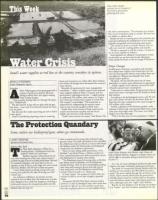

These Golan Heights
reservoirs are an example of
how Israel is going about
gathering fresh water.
the water commissioner. "The situation is so serious
that we are living from hand to mouth. We have lost
our ability to regulate flow."
Besides the ban on watering lawns, the committee has
proposed prohibiting the establishment of new munici-
pal parks and gardens and introducing water quotas.
This could cut down on Israelis' shower time, as
well as on water for washing dishes and laundry.
Tal also is expected to call for at least a 10 percent
cut in water supplies to industry.
Some legislators are calling for compensation to farm-
ers who don't use up their annual water allocations,
which already have been cut by an average of 50 percent.
O
0
Major Changes
Israers water supplies at red line as the country considers its options.
JESSICA STEINBERG
Jewish Telegraphic Agency
Jerusalem
llison Pollack gazes at her green grass with a
mixture of pride and remorse: She loves
having a velvety lawn, but regrets wasting
water to keep it green.
"I feel so guilty letting Asaf run through the sprin-
kler," Pollack said.
She also lets her 3-year-old son play with the gar-
den hose — but only if it's directed toward the lawn,
not the patio.
But the next few weeks may bring an end to Asaf's
water sports.
Israel is considering imposing a ban on watering
A
lawns and automatic car washes after three consecu-
tive winters of drought have devastated the country's
water reserves.
Recently, the government's water management
committee — which includes experts from national
water supplier Mekorot Water Company and the
government's hydrological service — urged cutting
an additional 250 million cubic meters, or 10 per-
cent, from the existing water supply to avoid what
they termed "a catastrophe." The committee is •
responsible for safeguarding the nation's water
reserves and ensuring supplies of fresh water.
Israel's three main sources of fresh water are the
coastal and mountain aquifers and the Sea of
Galilee, also known as Lake Kinneret.
"Israel's water sources are empty," said Shimon Tal,
Locally grown tomatoes, cucumbers and avocados
have always been staples of the Israeli diet, but the
costs of watering these thirsty crops makes them not
cost-effective. Mekorot has declared that Israel
should import produce.
Tal agrees. He has said the main aim of water
planning is to reduce water allocations to agriculture
— which, together with industry, accounts for half
of Israel's annual water consumption.
Crops and car washes aside, the government has to
ensure that there is enough water for Israelis to drink
this summer.
According to the hydrological service, only 87 mil-
lion cubic meters of water can be drawn from the
Kinneret this year, compared to the usual average of
420 million cubic meters.
Indeed, a glimpse of the Kinneret reveals a wide
expanse of dense reed- and seaweed-filled sand, yards
away from knee-high water. The water was visibly
deeper just a few years ago.
"This is the first year we are pumping to a degree
The Protection Quan
Some settlers use bulletproof gear, others go commando.
LARRY DERFNER
Special to the Jewish News
T
Hebron, West Bank
he West Bank settlement of Efrat has a
"lending library" of bulletproof vests that
residents "check out" and return.
Resident Annette Cohen drives her car
only when wearing one of the vests, and as much as
possible she gets around on bullet-proof buses. She and
her husband, Yehoshua, will never drive in the car
together, so that if the car is the target of a terror attack,
their four children will still have at least one parent.
"I don't think there's anything wrong with swal-
lowing your pride for the sake of saving your life,"
Cohen says.
The settlement of Hebron, by extreme contrast,
refused all sorts of offers from the Israeli army to make
their dangerous lives a little less dangerous, including a
bullet-proof minivan for transporting adults and chil-
I EK'f
6/15
2001
24
Related editorial: page 33
dren; a security roof to protect the settlement's play-
ground, where 10-month-old Shalhevet Pass was killed
by a Palestinian sniper in March; a security wall around
the Hebron enclave of Tel Rumeida; and bulletproof
windows for the settlement's apartments.
"Once we start taking safety precautions, we're
finished," says Ruth Hizme, a Hebron mother of
four, maintaining that each safety precaution incites
the Palestinians to escalate their attacks.
"The Palestinians started throwing rocks, so the Jews
got shatter-proof windshields, and the Palestinians
started shooting. Then the Jews started bullet-proofing
their buses and putting up fences and walls around
their settlements, and the Palestinians started firing
mortars. There's no end to it," Hizme says.
In Israel "proper" the question of which safety pre-
cautions to take or not to take is largely a practical
matter.
Among the 200,000 West Bank and Gaza settlers;
however, it is also an ideological issue. How much does
one want to "give in" to terror, and how much does
one want to protect one's own or one's children's lives?
Israeli Prime Minister Ariel Sharon, right, blesses the
body of Yehuda Shoham, drapped in a prayer shawl, out-
side his office in Jerusalem during a funeral procession
on June 11.
As a rule, the more ideological settlements take more
chances, the more "suburban" settlements take fewer.
The death of 5-month-old Yehuda Shoham after his
family's car was stoned in the West Bank is a case in
point. The stone crashed through the car's front wind-
shield, which seemed odd because the government
provides shatter-proof car windows free to all settlers;
even the Hebron settlers drive with shatter-proof win-
dows, although some now "regret" their decision.
But the car the Shohams were driving was evident-
ly a "loaner," says Yael Avraham, spokesman for the