

•
•
•
•
•
Ages 2 1 /2-6
Cooking • Art
Creative Dramatics
Storytime
Puppetry
And Much More...
Scissors & Pans
Reconstructionist congregation hosts rabbi with answers.
Judy Caden, Instructor
SHELLI LIEBMAN DORFMAN
StaftWriter
T
We woe Vate ton Spicing
(
Tut
we've eattay
tole
clic% ga ineftchandtse
is
So Soul/Sum/no
ES OA Sae nu).
• Silhouette®
• Luminette®
• Country Woods®
• Vignette®
• Duette®
• Blinds
• Palm BeachTM
Custom Shutters
HunterDouglas
5528 Drake at Walnut Lake Rd, W. Bloomfield.
248-661-3840 • www.windowsandwalls.com
M, Th 10-6 • T, W, F 10-5 • Sat 10-4
hough the
Reconstructionist move-
ment has been around for
80 years, a commonly
asked question still arises: What
exactly is Reconstructionist Judaism?
"I get calls all the time from
people who want to know more
about our movement," says Sandy
Hansell, president of Congregation
T'Chiyah, one of four
Reconstructionist synagogues in
Michigan. "We know there are peo-
ple looking for something they
can't find in other established
movements and they don't know
who to ask about it."
In the absence of a spiritual leader,
the member-led, 39-family congrega-
tion has enlisted a specialist to
address the issues of philosophy and
observance within
Reconstructionism.
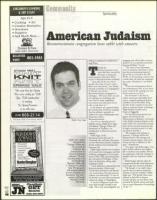
At a 10 a.m. Saturday, June 9,
Shabbat service, Rabbi Steve Segar
will address "Change Within the
Framework of Tradition: An
Introduction to Reconstructionist
Judaism."
Rabbi Segar, of the
Reconstructionist Havurah of .
Cleveland; also will lead a discussion
on how Reconstructionism integrates
Jewish tradition and contemporary
American life.
Rabbi Segar's family were members
of a Conservative synagogue and later
a Reform congregation in his home-
town of Flint. After graduating from
the University of Michigan in Ann
Arbor, he found his calling while
studying in Israel.
"I met rabbinical students from the
Reconstructionist, Reform and
Conservative seminaries and became
very excited about Reconstructionist
Judaism and philosophy," he says of
his decision to attend the movement's
rabbinical college in Philadelphia.
It was this background and enthu-
siasm that brought Hansell to the
-rabbi. "He is very knowledgeable and
engaging and will be able to answer
questions at our special community-
learning Shabbat," he says.
"The vision of our movement,
since its inception, has been to trans-
pose the encompassing nature of
Jewish life as it existed in the Old
World, in the European context, into
a mode that will work for contempo-
rary open, liberal Jews," says Rabbi
Segar.
"What was contemporary then is
not contemporary now, so our move-
ment is known for creating new ritu-
als for events in our lives."
The movement is the first to
ordain openly gay and lesbian Jews
and to recognize patrilineal descent
(children of a Jewish father being
Jewish). It also created its own com-
plete set of prayer books, including a
High Holiday machzor and a
Passover Haggadah.
The first Reconstructionist syna-
gogue, the Society for the ,
Advancement of Judaism, was found-
ed by Rabbi Mordecai Kaplan in the
early 1920s. He was the first to intro-
duce the bat mitzvah ceremony and
to begin counting women in a min-
yan (prayer quorum.)
"We recognize that Judaism is
dynamic, it changes within the
framework of a rich heritage and
includes cultural aspects, such as lit-
erature and art in addition to reli-
gion," Hansell says.
"Our goal," says Rabbi Segar, "is to
allow Jewish tradition and modern
life to reinforce one another. We see
the application of Jewish tradition in
tandem with our American civiliza-
tion."
Rabbi Kaplan did this when he
incorporated Jewish ritual observance
and liturgy into American holidays.
"He thought it was really impor-
tant for Jews to observe American
holidays in Jewish modality," Rabbi
Segar says. "The Jewish vision once
infused in daily life in Eastern
Europe still goes on, but there is the
potential for Jewish culture and tradi-
tion in every dimension of everything
we do." ❑