

Question of the Week: Where was comedian Soupy Sales
born?
• a.accam.V.. .
sifiV
4sci
/4 " 7,Nrscrfi:
'
What is the proper way to thank God after a meal?
ELIZABETH APPLEBAUM
AppleTree Editor
n Judaism, food is more than suste-
nance; it is God's gift to humanity .
As our parents taught us, it is always
proper for the recipient to properly
thank the giver for a present.
Judaism does indeed require us to thank
God for the gift of nourishment. In fact, an
ancient rabbi once said that eating without
thanking God for the food is akin to stealing.
Our obligation to express gratitude for food
is more than good manners, however. It is part
of Halachah, Jewish law, that is derived direct-
ly from the Torah. "/ Lad you shall at and you
shall be satisfied and you shall bless the Lord
your God for the goodly land that He gave
you." Deuteronomy 8:10 is our source for
thanking God for food.
Although the verse implies that one should
thank God only when he or she has eaten to
satiation, Halachah directs us to recite words
of thanks even if our stomachs are not full.
The basic requirement is eating an amount of
bread equal to the volume of an olive (and
there are various opinions as to how much
that is).
Halachah requires a very short . blessing to be
said before eating bread and all the food that
goes with it in a meal; after eating, we recite a
rather long set of blessings. The blessings said
after eating are called Birkat Ha-Mazon, usual-
ly translated as "grace after meals," although
the words actually mean "blessing of food."
Many people refer to Birkat Ha-Mazon by its
•
if
Yiddish term, bentshing (which also is derived
from bentsh, to bless).
The standard text of Birkat Ha-Mazon con-
sists of four blessings, then a series of praises
beginning with the word Ha-Rachaman ("the
compassionate one"). By tradition, the first
blessing was composed by Moses, the second
by Joshua, the third by kings David and
Solomon, and the fourth by the rabbis associ-
ated with Rabban Gamliel the Elder in
Yavneh (a city in ancient Israel) after the
destruction of the Second Temple.
The remainder of Birkat Ha-Mazon, writ-
ten through the ages by various rabbis, is a
series of brief prayers asking for God's mercy
and blessings. It ends with a plea for peace.
Although Birkat Ha-Mazon is for a meal
composed of bread or bread and other foods,
it is possible to eat a complete meal without
any bread, and Halachah provides a means of
thanking God for that, as well. The blessing
made after foods other than bread is called a
Bracha Acharona ("last blessing" or "ending
blessing"). It consists of a basic text adapted to
any one of three categories of food: grain
products other than bread or matzah, wine or
grape juice, any one of these fruits — grapes,
figs, pomegranates, olives or dates. .
If someone has eaten food other than that
covered by the Bracha Acharona such as an
apple, a candy bar or a glass of milk —
Halachah provides still another blessing to say
afterward. This consists of one sentence and is
known by a phrase it contains, Boreh Nifashot
("who creates living beings").
•
❑
ers decisions and incidents that continue
to shape the way we live today, and tells
you the story behind everything from
classic Jewish texts to Hollywood feuds
— all on a single page. It's history, and it's
fun; sit down and learn a little (best of
all, there are no homework assignments).
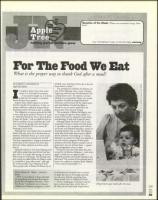
All generations give thanks after the meal.
6/01
it/ rl
/Vt
"WOO
d 1/6
A/
Y
Fi s ■ K'a
4.;,,A M; 1•0K .W "..—
a
•
2001
•ax
83