
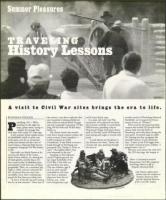

A visit to Civil War sites brings the era to life.
BY SUSAN R POLLACK
etersburg, VA — We're
standing on the edge of a
large, grassy crater, trying to
imagine the carnage that
took place here nearly 137 years ago.
A soft summer breeze ripples across
the battlefield, which is quiet now,
eerily quiet, save for an occasional
creaky tree branch and the voice of
Grant Gates, a National Park Service
interpreter, bringing Civil War history
to life.
Eyes wide, our family listens as he
recounts the Battle of the Crater,
where Union soldiers, in a daring but
ill-fated gambit, secretly dug a 511-
foot tunnel 'under Confederate lines
and packed it with four tons of black
gunpowder. Then, on a moonless July
night in 1864, nervous volunteers lit
the 15-minute fuse not once, but,
incredibly, twice when nothing hap-
pened the first heart-pounding time.
"It was as if the sky was just raining
dirt for several minutes," Grant says of
ri
the massive, near-dawn explosion that
sent hundreds of sleeping Rebel sol-
diers airborne and produced the gap-
ing hole (originally measuring 170 feet
long, 60 feet wide and 30 feet deep)
before us.
The chaotic battle that ensued,
with fierce, hand-to-hand combat, left
twice as many Union casualties —
4,000 compared to 2,000
Confederate. It also failed to secure a
break-through to Petersburg and
prompted Gen. Ulysses S. Grant
call it "the saddest affair' I have
ever witnessed in the war."
Standing on this hallowed,
central Virginia ground, the
last major battlefield of the
Civil War, . I feel chills run
up and down my spine.
Our two children, ages 8
and 10, seem equally
enthralled on this vaca-
tion that's a dramatic
departure from the no-
brainer, sun-, sand-
and surf-getaways typi-
cal of many family trips.
In a state rich with Civil War
attractions, we've planned our three-
day itinerary carefully to avoid battle-
field burnout, spending a day at
Paramount's Kings Dominion theme
park in Doswell, north of Richmond,
and staying each night in motels with
pools.
"I • could almost see the ghosts in
the distance over there," Justin, the
10-year-old, says, pointing through
the trees in
another section of Petersburg National
Battlefield, as we inspect the Union
mortar known as "Dictator."
We're awed by the imposing black
weapon that hurled 225-pound shells
almost daily into the heart of
Petersburg, two miles away, during the
city's grim, 10-month siege in 1864-
65. Leaning her face up against the
powerfiil cannon, 8-year-old Jenny
says, "I want to see if it's bigger than
my head!" and Justin later confides, "I
gasped when I saw it."
We learn more about the city's terri-
ble, 292-day siege, the longest in
Above: A costumed re-enactor
demonstrates Civil War weaponry
and brings history to life at
Pamplin Historical Park.
Left: Bronze soldiers greet
visitors near the entrance to
Pamplin Historical Park
and the National Museum
of the Civil War Soldier.