

Co m mun ity
Spirituality
From Ritual
To Ethical
Shavuot reminds us that
the rites prescribed by
orah and Talmud create
shared language of
rality and social
transformation.
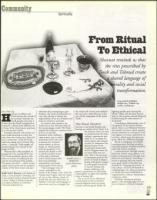
Some symbols. of Shabbat:
challah cover, Kiddush cup,
candles, washing cup.
Ec
New York City
.
owever you believe the
Torah became the record of
the covenant between the
Jewish people and God, it
is clear that the Torah introduced to
humanity a distinctively different set
of values from those known previous-
ly to the ancient world.
Examples abound. All ancient cul-
tures made homicide a crime, but
only when the victim was a local citi-
zen or a free man. Only the Torah
made the taking of any human life a
crime — because, Torah taught, all
human beings were created in the
image of God.
Hammurabi's code punished an
escaped slave by cutting off his ear.
The Torah punished a person who
chose to remain an indentured ser-
vant by the piercing of his earlobe.
The point was clear — while ancient
pagan culture protected the property-
interest of the slave owner and pun-
Rabbi Saul J. Berman is the director of
fdah, a voice of modern Orthodoxy. He
is also associate professor of Jewish Studies
at Stern College at Yeshiva University
and adjunct professor at Columbia
University School of Law.
the rituals still convey and reinforce
ished the slave attempting to gain
the very same values that are at the
freedom, the Torah punished the ser-
core of the uniqueness of the entire
vant who refused to assume the
responsibility of his own freedom and Torah.
chose to remain in servitude.
In instance after instance, the
How Rituals Transform
Torah was at war with the values of
Shavuot is the Jewish holiday cele-
the ancient pagan world. The Torah
brating our receipt of the Torah. It is
entered the world as a counter-cultur-
the moment when we need
al force, to provide
to commemorate the extra-
humanity with a different
ordinary
opportunity pro-
value system, one in which
vided
to
us,
to shape our
all humans were to be seen
values
against
the cultural
as bearers of a common
current,
to
understand
the
tzelem elokim, or divine
distinctiveness
of
the
image, in which persons
Jewish legal-moral order
were not property to be
and to integrate those val-
owned and abused at will,
ues more fully into our
in which sexuality is part
lives.
This is the moment
of the path to holiness,
to experience pride in the
and in which human free-
RABBI SAUL J.
power of Torah to shape a
dom and individual
BE Rivf.AN
society with greater integri-
responsibility are funda-
Jewish Renaissance ty, with greater sensitivity
mental goals of the society.
Me dia
to human feelings and
These messages were, of
human suffering, with
course, embodied in the
greater
commitment
to individual
rituals of the Temple. And, while the
responsibility
to
repair
the imperfec-
Temple may be gone, they are repeat-
tions
of
human
life.
ed now in the ordinary rituals of
But so much of our distinctive
Jewish life, like our observance of
consciousness
as Jews is formed
Shabbat. The form and language of
around
religious
ritual, by eating
observance may have changed, but
matzah and hearing the shofar, by
lighting candles and reciting the
Shema. What role do those actions
play in this counter-cultural drama of
transforming the value system of
humanity?
According to Maimonides, one of
the greatest of the Jewish philoso-
phers, there is no difference between
the Jewish civil laws, which regulate
human behavior in consonance with
the highest of virtues, and Jewish rit-
ual laws, which serve the same pur-
pose, albeit in a different language.
Ritual is a language of symbolic
communication between ourselves
and other persons, between ourselves
and God, and to ourselves.
Communication through actions,
and even actions using objects, is in
reality communication through sym-
bolic , acts and objects. Extending a
hand in greeting will only convey
your good wishes if the other has
learned the "language of actions" of
this culture. As we've all learned in
Anthropology 101, there are societies
in which the outstretched hand is
experienced as a threat, warranting a
retaliatory strike.
Similarly, wearing an evening
gown to the opening night of a con-
cert in Atlanta or Detroit bespeaks
5/25
2001
55