

ALAN ABRAMS
Special to the Jewish News
A
Jewish Army engineer from
Southfield, who during a six-year
period faced multiple investigations
that he spied for Israel, is suing the
Army, claiming that anti-Semitism motivated
the discredited accusations against him.
David Tenenbaum, an Orthod: x Jew
employed at the Army's Tank Automotive and
Armaments Command (TACOM) headquar-
ters in Warren, was never charged with espi-
onage. But the widely reported innuendo that
he spied for Israel has made life a living night-
mare for the 43-year-old father of four, he says.
In a brief filed in his lawsuit against the
Army, Tenenbaum alleges that his religious and
cultural practices — such as seeking kosher
travel accommodations separate from his co-
workers, leaving work early on Friday after-
noons and speaking Hebrew to Israeli liaison
officers — were interpreted by accusers as fit-
ting a espionage profile.
Tenenbaum's brief cites depositions and
Army documents revealing some in the Army
referred to him as our little Jewish spy" and
frequently compared him to Jonathan Pollard,
a Navy analyst now serving a life term for giv-
ing classified material to Israel in the 1980s.
Unlike Pollard, however, Tenenbaum was never
charged with any crime.
But are the comparisons of Ten e nbaum to
Pollard pure prejudice? Southfield attorney
Mayer Morganroth representing Tenenbaum
in his civil lawsuit, thinks so.
"It is completely inappropriate to compare
David Tenenbaum to Jonathan Pollard," he
says. "David has never been shown to have
done anything wrong whatsoever, and the
Department of Justice even admits that David
has never done anything improper.
Morganroth states further, "If anything,
David is like Captain Alfred Dreyfus, who,
despite an excellent service record, had been
falsely accused of espionage for the sole reason
that he was Jewish."
Dreyfus, a decorated officer in the French
Army, was exiled to Devil's Island until a
worldwide public outcry helped clear his name
a century ago.
Accusations Of Espionage
For David Tenenbaum, life has not been the
same since his world was turned upside down
in February 1997. That's when he was suspend-
ed from his job and the media reported on an
unsealed FBI affidavit and search warrant that
targeted him as a spy. News coverage revealed
that the FBI, based on the results of a lie-detec-
tor test, suspected Tenenbaum of committing
espionage for Israel.
Tenenbaum is a civilian engineer at
TACOM. Now, four years later, despite having
never been formally charged, his security clear-
ance has been revoked and his colleagues,
Tenenbaum says, stay away from him on both
a personal and professional level.
Tenenbaum, employed by TACOM since
December 1984, says he no longer has access
to classified information or is part of the work-
group in the research, development and engi-
neering division.
His work revolved around improving the
Army's fighting vehicles, specifically their pro-
tective armor and survivability after being hit by
enemy fire. In 1995, he created an unclassified
project known as Light Armor Survivability
Systems, which he designed to be a cooperative
effort between the U.S., Israel and Germany.
Since his return to work in April 1998, he
says he has been prohibited from working on
projects with Israel, even though he has
received performance awards and positive eval-
uations from his superiors throughout the time
he worked on these projects.
Fighting Back
In October 1998, Tenenbaum filed a lawsuit in
federal court against individuals from the
Department of Defense and the Army. Part of
that suit, charging religious discrimination and
seeking relief under Michigan civil rights law,
was dismissed in April 1999; Tenenbaum was
instructed by the court to exhaust federal
administrative remedies and then file a claim
against the Army under Title VII of the Civil
Rights Act of 1964.
fn January 2000, Tenenbaum accordingly
filed a religious discrimination suit against the
Army in the U.S. District Court for the
Eastern District of Michigan in Detroit. But
Judge Robert Cleland dismissed the suit last
October. Tenenbaum filed an appeal Jan. 17,
2001 to the U.S. Sixth Circuit Court of
Appeals in Cincinnati.
The appeal challenges the October ruling
that Tenenbaum did not file his Title VII reli-
gious discrimination claim with the Equal
Employment Opportunity Commission on
time. Tenenbaum's lawyers claim that, because
it is a continuing violation, the 45-day require-
ment for a timely filing does not apply.
The appeal claims Tenenbaum's constitutional
rights were violated in the process of revoking
his security clearance. But the overriding theme
of the appeal is that all of the suspicions and
accusations against Tenenbaum have been, and
continue to be, motivated by anti-Semitism.
"The legal issue on appeal is the same as it
was in the District Court: 'Whether, in this
day and age, a Jew is entitled to equal protec-
tion, due process and fairness under the U.S.
Constitution and laws of the United States,"'
said Mayer Morganroth, Tenenbaum's lead
lawyer, of the firm of Morganroth and
Morganroth.
Tenenbaum's appellate brief relates that "key
Army officials ... have admitted that
Tenenbaum's being an Orthodox Jew was a
driving factor in accusing him of espionage."
Tenenbaum's brief claims that accusations
made against him may have been because of his
closeness to Israeli liaison officers at TACOM.
"There were four liaison officers on the base
at TACOM," said Tenenbaum in an interview.
"There was a German, Canadian, British and an
Israeli one. There isn't an Israeli one any longer.
"Depending upon the project, there was a time
when I spoke to one more than any other one,"
he added. "And besides, with Jews, you tend to
connect. And as far as I know, there's no law
against one Jew talking to another Jew on base."
The First Investigation
A preliminary investigation in 1992 was
opened when a co-worker filed a Subversion
and Espionage Directed Against the United
States Army (SAEDA) report, which was pre-
pared by the Army's 902nd Military
Intelligence Battalion.
The report states that Tenenbaum had
admitted revealing classified information to the
Israelis. The report prompted the FBI to con-
duct a preliminary inquiry. That allows the
FBI to investigate people who are suspected of
espionage for up to four months where no
documents, witnesses or other evidence exists
to support opening a full investigation. The
FBI ended the preliminary inquiry in 1992 on
the grounds Tenenbaum had not committed
any illegal acts on Israel's behalf.
The co-worker backed off from his initial alle-
gations when the FBI reinterviewed him in 1994,
accordinc, to documents cited in Tenenbaum's
appellate b brief, and the FBI decided to end a sec-
ond preliminary inquiry of Tenenbaum.
But the accusations continued to dog
Tenenbaum through 1998. Subsequent Army
investigations focused on Tenenbaum being
Jewish and speaking Hebrew. These investiga-
tions were based upon what the Army calls
espionage indicators; another reason was that
Tenenbaum had visited Israel, according to
Tenenbaum's appellate brief.
Tenenbaum's appellate brief states that he dis-
covered this information by filing Freedom of
Information Act requests and in the legal dis-
TARGETED? on page 16
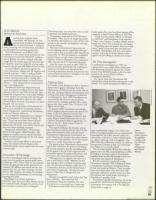
David
Tenenbaum,
center, discusses
his appellate
strategy with
his attorneys,
Mayer
Morganroth
and Daniel
Harold.
5/18
2001
15