

Cover Story
cuss their work; all emphasized they don't hesitate to
call on each other professionally.
"It's most beautiful," says Orthodox Rabbi
Klainberg. "It's liberating," adds Rabbi Schwartz.
In The Beginning
Before taking this course, the rabbis described doing
hospice work by instinct and "by the seat of our pants."
Conservative Rabbi Michaels, a chaplain for 20 years,
puts it more diplomatically. "We all came into this
training course with gifts and they've been enhanced."
Rabbi Kestenbaum understands. As a congrega-
tional rabbi, he had many opportunities to meet
people in need. "My heart was in a good place," he
says, "but I didn't know ir I was doing enough or
too much. I had no way of thinking about what I
was doing, though I functioned as a professional."
Rabbi Kestenbaum went on to study and became cer-
tified as a CPE supervisor by the Association for Clinical
Pastoral Education based in Decatur, Ga., in 1993.
Three years ago, he founded the Jewish Institute
for Pastoral Care in New York, which grew from his
awareness that rabbis and even lay people gifted to
reach out to those in need were unprepared.
Ten years ago in Detroit, Rabbi Freedman, then
executive director of the Southfield-based Yeshiva
Beth Yehudah, was introduced to the concept of
hospice and knew it was the work he wanted to do.
But the Jewish community was unfamiliar and
uncomfortable with hospice, he says. "It was seen as a
Christian thing," he says, (( because nuns and Christian
clergy developed the earliest stages of hospice."
Rabbis were not equipped to handle the new field, says
Rabbi Freedman, who set up the JHCN two years ago.
"Even rabbis in senior citizen facilities were not trained."
In 1998-99, Rabbi Freedman saw a tremendous
need for trained rabbis as new hospices opened at
such centers as Barbara A nn Karmanos Cancer
Institute, headquartered in Detroit, and Beaumont
Hospital in Royal Oak. Though Rabbi Freedman
was then working at the Southfield-based Hospice of
Michigan, he says, none of the other hospices had
Jewish clergy servicing Jewish patients.
Eventually, two years ago, Rabbis Freedman and
Schwartz went to New York and convinced Rabbi
Kestenbaum to put together a flexible program with
a Jewish perspective for full-time rabbis.
"Each culture has its way of dying," says Rabbi
Freedman on the importance of this training. "If there's
any area of life that Jewish people are most traditional,
it's at the end of life. Not only prayers, but halachic
(Jewish law) questions and decisions are made.
"We do things differently than gentiles. Jews have
funerals immediately. The grief process is different.
Jews who haven't been near a synagogue in 40 years
love a Jewish prayer."
However, the rabbis had particular hurdles to cross
before becoming effective pastoral chaplains.
Two Ears, One Mouth
A palpable energy fills tl- room where the rabbis
discuss their patients, role-play, joke and criticize
each other's work once a month.
They agree the major lesson to be learned is how
to listen. "The goal is to get into the same boat with
the patient and help them row," says Rabbi Rabin.
The rabbis learned they have to avoid their typical
5/11
2001
16
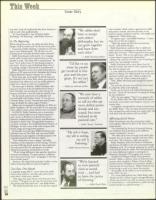
"We rabbis don't
have to accept
each other's
philosophy, but we
can grow together
and learn from
each other.
— Rabbi Yerachmiel Rabin
"I'd like to see
more lay people
get involved in hos-
pice and this pro-
gram. It's not just
for rabbis."
— Rabbi Jim Michaels of Flint
"We now have a
network of rabbis
to call on who are
more skilled profes-
sionals and not
scared, but more
inclined to do
pastoral care.
"
— Rabbi "Bunny" Freedman
"My job is hope,
my job is caring,
my job is
listening."
— Rabbi Dannel Schwartz
"We've learned
to view pastoral
visits as sacred
time ... and had
to learn the tactics
of listening."
Rabbi David Polter
role as teacher, which creates a gap between rabbi
and patient. Instead, they have to listen to the
patient's anxiety, loneliness and fear. "It's totally non-
judgmental," Rabbi Rabin says.
"It's against type," says Rabbi Freedman. "I some-
times have to bite my tongue."
"That's the reason we have two ears and one
mouth," adds Rabbi Shapiro.
Rabbi Kestenbaum explains that in rabbinical
school, there's an emphasis on training the mind
rather than the heart. "We're expected to have good
hearts," he says. "But in my experience, rabbis need
to learn about interpersonal relationships."
Being with a patient, he adds, is not a teaching sit-
uation, but "an exquisite moment."
Rabbi Klainberg tells a story about how he
learned to listen not only to what a patient says
but what he doesn't say.
A nurse called him because his 93-year old patient
said he was dying. The rabbi hurried over to the nurs-
ing home and the man said, "Rebbe, tonight's the
night. I want the Vidui (confessional prayer)."
"OK," Rabbi Klainberg said, though his patient
looked fine.
The next day, the man was well, but twice more
he called the rabbi to his bedside.
Finally, on the fourth call, Rabbi Klainberg told
the man, "You're the first person I'm going to charge
for the confession."
"OK," the man replied. "Then I'm not going to die."
So why did he call? The rabbi realized his patient
was lonely, so he made more frequent visits at a con-
venient time.
"A chaplain's visit should be viewed as sacred time,"
says Rabbi Polter. "The visit takes focused concentra-
tion, introspection and putting your needs aside. Our
work deals with the essence and core of life."
Affirming Jewish Future
Rabbi Kestenbaum says that seeing these rabbis
work together affirms his faith in the future of the
Jewish people.
"I'm astounded by the level of personal sharing
and solidarity they're building across different
streams of Judaism," he says.
"We rabbis don't have to accept each other's phi-
losophy, but we can grow together and learn from
each other. We've become a tight-knit group."
Rabbi Freedman echoes his teacher's enthusiasm
and foresees all rabbis in the area connected through
chaplaincy work. He is already preparing for another
series of local classes for rabbis. He's also preparing for
two more rabbinical students to participate in
Beaumont Hospital's CPE program this summer.
Temple Israel Religious High School graduate
Jennifer Tisdale, a rabbinic intern at Beaumont last
summer while enrolled at Hebrew Union College-
Jewish Institute of Religion in Cincinnati, already is
"paying back the community," Rabbi Freedman says,
by returning to work as his intern this summer.
"Eventually, all the rabbis in town should have
these skills," he says.
On a more philosophical note, Rabbi Rabin adds,
"People can lose a chance to grow through difficulties.
All the tsores (worries) are really an impetus to get closer
to God within us — and sometimes, a rabbi can help
patients do that in a pastoral setting."