

book chairperson, helping to raise more than a quarter
of a million dollars for the religious school. She used
her "cookie lady" fame
as a sales tool.
"Anyone who sold at
least $1,000 worth of
ads got a jar of my
cookies," she says.
Goldenberg also
handled an ad book
for a Jewish National
Fund auction, selling
$32,000 worth of
advertising. She's still a
JNF board member,
and has received a
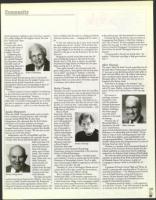
Citation of Honor on Esther Goldenberg
behalf of the JNF's
former Young Women's group, plus a Community
Service Award. She also was the speakers' bureau coor-
dinator for the Jewish Community Council of
Metropolitan Detroit and corresponding secretary of
JETSET, a support arm of the Jewish Ensemble
Theatre.
"I believe a person is always capable of contributing
to the community, and never too old or too young to
find the time to do something," she says.
Goldenberg's daughter, Donna Sklar of Farmington
Hills, adds: "I remember being taught by her as a little
girl that it's important to put a little aside for saving
before you spend it ... and so it is with volunteer time."
Stanley Morgenstern
When the Allied Command needed a pilot to bomb
Nazi installations around Florence, Italy, with high
accuracy during World War II, they chose
Morgenstern, who ultimately flew his B-26 Martin
Marauder in 65 combat missions over Europe.
"We used the famous Norden Bombsight, and we
dropped bombs with precision to protect the valuable
museums and statues," he says. "We were shot at and
shot up, but never shot down."
Morgenstern, now 83, of Southfield, used that
uncanny accuracy throughout life, especially the past
18 years when he has donated his labor to custom-
build more than 150
pieces of equipment
and furniture for stu-
dents with special
needs, many of them
Jewish. This includes
chairs, special potty
seats, bolster seats, tray
tables, bookcases,
scooter boards and
other interactive
mobile items that help
children with disabili-
ties get around class-
Stanley Morgenstern
room obstacles.
He began doing the
work for the Detroit Institute for Children. Now recip-
ients are at JARC (Jewish Association for Residential
Care), other non-profit organizations, Henry Ford
Hospital of Detroit and several area school districts. He
works on the furniture three hours each morning in his
home workshop, lists the items in a catalog and delivers
what the customers want — charging only for materi-
als.
"At this cost, schools can get as many as six items for
the regular price of one," he says. "Most of these chil-
dren just couldn't go to school without my equipment.
It's a great delight to see the look on a youngster's face
when he or she gets to use the furniture or toy for the
first time."
Morgenstern recently retired after more than 50
years of selling life insurance. His wife of 52 years,
Brinah, died in 1994. Born in Detroit, he attended
Northwestern High School and Wayne for two years
before joining the U.S. Air Force.
"Stan applies himself to his volunteer work with
great energy, passion, thoroughness and exacting atten-
tion to detail," says Sarah D. Aasheim, a volunteer
coordinator at JARC. "His work helps promote the
acceptance of individuals with disabilities as valued par-
ticipants within our communities. He's been a pioneer
in creating a more tolerant society."
Bertha Chomsky
Chomsky was only 9 months old when she was afflict-
ed with polio, leaving her with one leg shorter than the
other, but that hasn't stopped her from a lifetime of
work in two different careers and volunteerism.
"I had a wise mother," she says. "She didn't try to
protect me all of the time. She didn't let me say 'I can't
do this,' or 'I won't do that.' I rode a bike, went sled-
ding, did everything like the rest of my friends — and
I still keep up with them."
Born in South
Bend, Ind., Choms
and her family moved
to Michigan when she
was 5. She graduated
from Central High
School and Wayne —
one of six people in
Wayne's first class of
medical technologists.
"And we all got jobs
right away," she recalls.
She later became
laboratory supervisor
Bertha Chomsky
at Brent Hospital
Downriver, then chief
technician in Sinai Hospital's Hematology
Department, giving her membership in the American
Society of Clinical Pathologists.
After retiring, she "got restless," switched careers,
and worked for 18 years as a fund-raiser for the Jewish
Federation of Metropolitan Detroit, "but I've really
been volunteering for different organizations off and on
since I was in my 20s," she said.
Chomsky, 81, lives in Huntington Woods and vol-
unteers three to four days a week. Her late husband,
Max, was a lawyer and a Hebrew scholar.
She is a founder of the Institute for Retired
Professionals (IRP), a 300-member organization for
active older adults that serves the Jewish community as
a small community college, a mini-synagogue, a social
haven and a home away from home. She helped for-
mulate the group in 1985, and served as its first presi-
dent for three years. She still is a co-facilitator for sever-
al discussion groups. She also launched its newsletter.
Chomsky also has devoted her time and talents to
Congregation Beth Shalom in Oak Park, helping to
raise "a lot of money" for the synagogue's renovation
project five years ago. In 1989, she received the Second
Century Award for Synagogue Commitment and
Service from the Jewish Theological Seminary of
America.
"Communal life is bound into Jewish ethic," she
explains. "It has been a privilege to help grow and sus-
tain it."
Albert Newman
The name "Hear Oh Israel" sounds prayer-like, but it's
the label Albert Newman gave the project he founded
17 years ago to provide hearing aids for older adults in
Israel who can't afford them. He collects used hearing
aids, reconditions them himself, sends them to the
Hadassah office in New York, then they go on to a
hospital in Ein Karem, Israel.
"And there is no charge to the recipient," says
Newman, who launched the project in honor of his
wife of 59 years, Phyllis, a long-time Hadassah sup-
porter. "So far, we've collected about 5,500 hearings
aids."
His interest in
audiology continues
through his work
with the Hadassah
Hospital Endowment
Fund for Research in
Pediatric Audiology.
He obtains equip-
ment that allows
newborns to be tested
for hearing.
Newman, 84, of
Bloomfield Hills, is
described by his wife Albert Newman
as an "unpretentious,
generous and dedicated person, whose greatest accom-
plishment is his relationship with his family" He has
made 37 trips to Israel, including separate trips with
each of his three children, seven grandchildren and
nine great-grandchildren. "I feel safer and more corn-
fortable visiting Israel than being downtown in some of
the large American cities," he says.
Newman is a member of the International Board of
Governors of the American Technion Society. He also
helped established an endowment fund in cardiology
research for the Technion-Israel Institute of Technology.
His other charitable activities include being a former
president of suburban B'nai B'rith and board member
of Hadassah House. He has been a member of
Congregation Shaarey Zedek in Southfield for 59
years.
A graduate of Detroit Central High and Wayne, he
retired 15 years ago after spending almost 70 years as a
successful businessman — the third-generation head of
Iron and Metal Products, a scrap iron business in
Detroit. He later formed Metal Ores and Peerless
Metal Powder, a company that manufactured iron
powder for the chemical industry
"The greatest reward for doing — is the opportuni-
ty to do more," he says. "I am very fortunate to be able
to continue to do the things I am involved with."
IMP
..104
5/4
2001
37