

REASON AND EMOTION COLLIDE
AS JEWS TRY TO RECONCILE
MODERN GERMANY WITH
ITS HOLOCAUST PAST.
Lippman is the kind of Jew who makes Kelsey
uneasy, the sort who regularly attends Holocaust-
related lectures, exhibits and films but doesn't allow
them to poison her feelings about Germany. She
typifies a paradox of American Jewish life that has
been noted in surveys by the American Jewish
Committee in 1999 and 2000.
While American Jews consider Holocaust remem-
brance far more essential to their identity than the
synagogue, Torah study and travel to Israel, they are
intrigued by contemporary German life and are
heading there in greater numbers than ever before.
This year alone, there will be more than a half-
dozen American Jewish missions and conferences in
Germany. Jewish leaders generally defend it as a place
where racism and anti-Semitism are not tolerated.
They say that Germany, as Israel's staunchest ally in
Europe, deserves the support of American Jews.
Leading The Charge
If nothing else, leaders argue, it's time to move
beyond purely emotional responses to Germany.
"Without education, it's too easy to go back to the
old stereotypes of Germans," said Steve Selig, a co-
chair of a United Jewish Communities mission to
Berlin and Israel for major donors next October.
Another Atlantan, Sherry Frank, southeast area direc-
tor of the American Jewish Committee, said that
when the AJC organized a Germany tour for a group
of big givers a few years ago, "we just blinked and we
had 30 people who wanted to do the trip," including
some who "swore they would never go to Germany."
The century has turned, and with it a distinct
thawing of attitudes, helped along by the German
government, which has financed Jewish trips to
Germany and made it a high priority to promote the
country to American Jews.
Germany's ambassador to the United States, Juergen
Chrobog, spends a lot of time talking to secular and reli-
gious Jewish leaders about his country's debt to Jews and
its efforts to snuff out neo-Nazism in its borders. He
said he is heartened by a new openness to Germany.
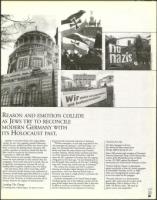
Clockwise from left:
Die Neue Synagoge in former
East Berlin has been restored from
damage suffered during the war.
About 500 extreme-right members of Germany's
National Democratic Party (NPD) demonstrate
in front of the Brandenburg Gate in Berlin
on Jan. 29, 2000, against the planned
construction of a memorial for Holocaust victims.
Protesters hold up a banner to demonstrate
against neo-fascism in front of a Jewish synagogue
in Duesseldoif, Germany, on Oct. 3, 2000.
Police were investigating the extreme-right
in an arson attack on the synagogue.
Thousands take part in a demonstration
against right wing-extremism in front of the
Brandenburg Gate in Berlin on Nov. 9,
2000. The banner reads: "We stand up
against racism and xenophobia."
4/20
2001
15