

Moved To Action
Students at Methodist Albion College will dedicate
a plaque in Poland next month identifying Schindler's factory.
HARRY KIRS BAUM
Staff Writer
I
Europe was struggling under — that
Jews were Christ killers.
"I proposed that we do a first-year
seminar," Frick said. "Geoff Cocks
asked if he could join me. We've
'9. worked closely together on this."
It's always been one of the first
seminars to fill up, Frick said, but
now, in its fifth year, it's required for
all first-year students. Frick will retire
after this year, and his successor will
carry on with Professor Cocks.
As an extension of the seminars, a
five-day Holocaust symposium,
"The Holocaust and Moral
Responsibility," was held on campus
at the end of March. After showing
Holocaust films such as The Last
Days and The Lodz Ghetto, profes-
sors from around the state,
Holocaust survivors and Jewish
leaders spoke of the history and
consequences of the Shoah to
packed classrooms.
t may seem strange that a Christian
student from a small, mid-
Michigan private school would
spend the last two years dealing
with governmental red-tape to place a
plaque of recognition on one of the most
famous small factories in Krakow.
But to Zack Kleinsasser, 22, a senior at
Albion College, the gesture makes perfect
sense.
While taking a walking tour of Krakow
Zack Kleinsasser
in 1999, Kleinsasser and 20 students and
stiq
faculty from Albion explored the city's
Jewish ghetto and learned how most of the
large population were deported to concen-
tration camps, where many died.
Their guide then walked them through
another section of town, and pointed out a
striking art deco building. It was Oskar
Schindler's faaory, the same factory where
1,200 Jews were saved from death. The same
factory made famous by the movie Schindler's
List, which launched a renewed interest in
Why Albion?
Holocaust studies and commemoration.
"We got on the bus and I remember
Albion College, founded in 1835,
thinking how odd it was that there wasn't
has a Methodist affiliation. Nestled
Prof. Fra nk Frick
anything at all to signify what it was,"
about 20 miles from Jackson and
Kleinsasser said. "Here's something that
Battle Creek, the small liberal arts
the entire western world, at least America, knows
school thrives with more than 1,500 students.
about, and there's nothing to commemorate it.
It may seem surprising to see this level of interest
That's when I thought there should be a plaque."
in the Holocaust from a small Christian college.
Now Kleinsasser has turned his well-intentioned
"This is what we see all over the country," said
thought into reality. He and 15 other students from
Michael Berenbaum, former director of the Research
Albion will go to Poland on May 12 to dedicate the
Institute of the U.S. Holocaust Memorial Museum
plaque, written in English, Polish and Hebrew.
Many Albion students, faculty and staff have con-
tributed to the cost of producing the plaque for the
Schindler factory, and the eight-day trip has been
financed with the help of grants.
Kleinsasser couldn't have done it without the help
of two Albion professors already dedicated to
remembering the Holocaust. Geoffrey Cocks,
European history professor, and Frank Frick, religion
professor, are responsible for Albion's annual
Holocaust commemoration program.
Both educators are Christian. Frick is an ordained
minister whose specialty is the Hebrew Bible. Cocks
is an international Nazi scholar, who wrote several
books about psychotherapy in the Third Reich.
Frick said he spent his career fighting the notion
that when Christianity came along, Judaism became
a museum piece, "and backing off the absolutist
claims that created the kinds of problems that
-
in Washington D.C., who spoke at Albion's March
symposium. "The Jewish community doesn't see the
full extent of the power of this event [the Shoah] to
transform and transmit."
Kleinsasser, a history major from. Cottage Grove,
Minn., said he's always been interested in the past.
His father, Keith, is a high school history teacher,
and Zack recalls that every family vacation has been
a history trip.
The family visited the U.S. Holocaust Memorial
Museum during a trip to Washington, D.C. in
1993. "That really struck me," Kleinsasser said.
As a freshman in 1998, he enrolled in Albion's
Holocaust seminar, and the hook was set.
"There's so many issues that relate to the
Holocaust, not just history, but politics, religion,
philosophy," he said.
By the time he went on the 1999 trip to Germany,
Poland and Israel, he already had an interest in the
Righteous Gentiles, those non-Jews who took
chances to save Jewish lives. That led to a just-com-
pleted honors thesis on Holocaust rescuers. He trav-
eled to Europe last year, where he interviewed a
number of rescuers — with names provided by Yad
. Vashem, Israel's Holocaust memorial.
Frick taught an American Jewish Life and
Thought course two years ago in the fall.
"I was told that I had a third of the Jewish student
population on the campus in my course — I had
three Jewish students in the course — so when you
get 16 students to go on this trip, I think it's pretty
remarkable." None are Jewish students.
The plaque cost $3,000, and most of the money
has been raised by contributions from Albion stu-
dents and faculty, Cocks said.
Funding for the trip has come from the partici-
pants, from various state, local and school grants
(such as the Gerald R. Ford Institute for Public
Service and Policy) and from individual contribu-
tions from friends of the college who read about it
in local newspapers, Cocks said.
The students also will help restore a Jewish ceme-
tery in Breslaw, dedicate the plaque, tour Krakow,
then visit Auschwitz/Birkenau.
Kleinsasser calls this "a really neat connection
between America and Europe, and it can demon-
strate today that non-Jewish Americans can get
involved." ❑
Mt
ll
111: (sity
11111,
ICI[ COI
t u v
1121 Dit
isOlv 10n:
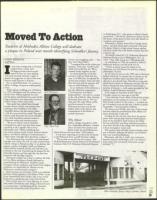
Oskar Schindler's factory today in Krakow, Poland.
4/20
2001