
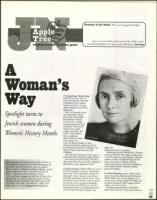

CQuestion of the Week: Who was Giuseppe Ottolenghi?
•061 ur IEM Jo laasIultu sAreii sr p3A.13s 31.4 •3.11129 ilum!pur
lis!maj-urquai 2urprai r sum (061 -8c81) IT-121-mlon0 LIOPASU,9
A
Woman's
Way
Spotlight turns to
Jewish women during
Women's History Month.
can learn a lot by learning a little. In Fact-A-
, AppleTree provides you with fascinating tid-
its about any Jewish subject, past or present.
ere, in honor of Women's History Month, you'll
find a collection of 30 — one for each day of
61— great facts about Jewish women.
Do you have a suggestion for Fact-A-Day? If so,
ease drop us a line at AppleTree Facts, 27676
Franklin Road, Southfield, MI 48034, fax (248)
354-6069, rill (248) 354-6060 ext. 308 (voice-
mail only), or e-mail philapple@earthlink.net
#1) Sarah Feyge Menkin Foner
(1856-1937) was a mere 25
years old when she wrote and
published the first modern
Hebrew novel by a woman,
Ahavat Yesharim (Love of the
Righteous).
Born in Lithuania, Foner
was a descendent of the
great Vilna Gaon (Elijah
ben-Solomon Zalman,
[1720-1797], a scholar
and talmudic genius from
Lithuania). She married
Meyer Foner, a play-
wright and teacher, and
lived in Lodz, Poland.
After completing
Ahavat Yesharim, Sarah
Foner went on to
write The Way of Children: A Story
of Jerusalem (the first published work of
Jewish historical fiction for children), The
Cloak of Traitors and Memories of My
Childhood.
After leaving her husband, Foner came to
the United States where she taught Hebrew.
Her uncle once said of Sarah, "Too bad
she's a girl. If she were a boy, she would prob-
ably become a gaon (genius) in Israel."
#2) Jessie Sampter (1883-1938) was one of
the first American women to settle in pre-
state Israel. This is especially unusual con-
sidering her roots: Sampter came from a
decidedly assimilated, secular home. Then
she learned about Zionism, with a particu-
lar interest in the writings of Hadassah
founder Henrietta Szold. Later, she also
immersed herself in the philosophies and
work of Rabbi Mordecai Kaplan, who
began the
Reconstructionist movement.
Following the end of World War I, Sampter
moved to Rehovot. She taught evening cours-
es for Yemenite Jews (and adopted a Yemenite
orphan, as well), and helped bring the Boy
Scout movement to Palestine. She also
became close friends with Chaim Weizmann,
and translated Chaim Nachman Bialik's
poems for children.
#3) Maya Plisetskaya (born 1925) was for
many years prima ballerina with the famous
Bolshoi Ballet. She was the daughter of an
actress and a mining manager; her father was
murdered during the Stalin purges, and her
mother was sent to prison.
Plisetskaya graduated from the Bolshoi
Ballet School, and by 18 was named soloist at
4/13
2001
93