

This Week
On Common Ground
Israeli hawks and doves agree on
protecting settlements against Arab violence.
DAVID LANDAU
Jewish Telegraphic Agency
Jerusalem
S
ix months into the Palestinian uprising,
Israeli doves and hawks are no longer argu-
ing about the nation's settlement policy.
In fact, they are displaying a rare unity
in the face of repeated Palestinian onslaughts.
Palestinian attacks in recent days on two settlement
enclaves left two 10-month-old Israeli babies among
the victims — one dead, the other gravely wounded
— but the attacks did not produce the once-familiar
calls from the Israeli left to dismantle the settlements.
The first attack took place March 26, when a
Palestinian sniper killed Shalhevet Pass, shooting her
as her father wheeled her stroller by a Jewish play-
ground in the West Bank city of Hebron.
On Tuesday, in Atzmona in the Gaza Strip, a 10-
month-old infant was seriously injured after being
hit by shrapnel in a Palestinian mortar attack on the
settlement. The mother also was hurt, though less
seriously than her child.
The Pass family at first refused to bury Shalhevet until
the Israel Defense Force seized the Palestinian neighbor-
hood of Abu Sneineh from which the sniper fired.
On Sunday, following appeals from public figures
including Prime Minister Ariel Sharon, the family
laid Shalhevet to rest.
The initial refusal to bury Shalhevet triggered some
controversy in Israel, but it was overshadowed by a deaf-
ening silence — the marked absence of debate that such
attacks on the settlements once would have generated.
The Right Message
In times gone by, the attacks would have left Israeli
doves demanding the dismantlement of isolated set-
tlements — to avoid "provoking" Palestinian anger
— and hawks urging that they be strengthened to
show Palestinians that violence is futile.
Such debate now seems anachronistic.
Only a few doves still argue for withdrawing from
any settlements, even the most isolated ones. They
understand that appearing weak under fire would
send the wrong message to the Palestinians and to
the wider Arab world — that violence pays.
The hawks, barring the most extreme among
them, no longer deny that outlying settlements, such
as those in Gaza, would have to be removed if a
peace agreement is reached.
But that presupposes a peace process. In its
absence, there is little for the doves to get enthusias-
tic about or the hawks to argue over.
Both groups now blame Palestinian Authority
President Yasser Arafat and the Palestinian leadership
4/6
2001
22
for the lack of a peaceful solution or of progress
toward one, and for the spiraling violence that has
claimed 72 Jewish lives since late September.
This "domestic peace" among the usually raucous
Israeli parties has made Sharon's unity government
much more than a marriage of political convenience.
For all the lingering unease on the left about
Sharon's hardline past, there is a spirit of unity on
the fear-swept streets of Israel's cities.
And this unity appears to be stiffening the public's
resolve in the face of daily Palestinian suicide bomb-
ings, ambushes, stonings and firefights.
Taking Of The Gloves
Israelis are determined to go about their business
despite their apprehensions, not to give the terrorists a
victory by disrupting normal life in the Jewish state.
When bombs explode and blood is spilled, the
response seems L:o be tougher and more stoic than in
years gone bv, when Israeli society - was divided
between the peace camp" and the national camp"
and every Palestinian terror attack widened the gulf
between the two.
By the same token, Sharon's decisions on how to
strike back at Palestinian violence — which in recent
days have involved a marked military escalation on
Israel's part — have encountered little resistance in
the political center, though the right is clamoring for
a sterner response.
Last Friday, Defense Minister Benjamin Ben-
Eliezer announced that Israel is ready to take off the
gloves in the conflict with the Palestinians.
He also said he would consider sending Israeli troops
into areas under Palestinian control "if they try to mis-
use territory which we agreed in advance was theirs."
On Sunday, the IDF crossed into an area under
Palestinian Authority control and abducted six mem-
bers of Arafat's Force 17 presidential guard, charging
them with cooperating with Palestinian militants in
planning terror attacks against Israelis.
On Tuesday, Israel released three of the men, but
the point had been made. As the IDF chief of
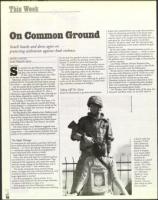
A Jewish settler boy
wearing a T-shirt
with a picture of
killed Jewish baby
Shalhevet Pass
pauses as he gazes
at an Israeli soldier
during the funeral
procession for
Shalhevet at a Jewish
enclave in Hebron
Sunday. The T-shirt
reads in Hebrew:
"The flame won't go
out" referring to
Shalhevet's name
((flame"), and
"Retake Abu
Sneineh," the area
from which the fatal
shot was fired.