

this version features a "fifth cup" ceremony based on
the ingathering of the Jewish Diaspora to Israel.
A Night of Questions: A Passover Haggadah,
edited by Joy Levitt and Michael Strassfeld. Jewish
Reconstructionist Federation.
We were slaves in Egypt, but that will never really be
past tense until messianic redemption. That is one of
the themes running through the commentary of A
Night of Questions, published under the auspices of
the Reconstructionist movement.
The poetry, story, art and prayer selected here deep-
ens one s understanding of the seder. This is a think-
ing family's Haggadah, particularly intriguing for the
way it regards skepticism as a tenet of faith.
Reconstructionist Jews do not necessarily except the
Exodus as historical truth. What impresses them most
about Passover is the way ritual and symbolism have
endured and inspired Jews for thousands of years.
'
The Shalom Seders: Three Haggadot, compiled
by the New Jewish Agenda. Lambda Publishers.
In his introduction, Rabbi Arthur Waskow explains
that "the very word Haggadah (literally, 'telling')
teaches us to rewrite the Haggadah." These seders,
three Haggadot within one book, offer several
opportunities for social action.
The book includes a "Rainbow Seder," originally
written for Passover 1969, the first anniversary of the
assassination of Martin Luther King Jr. There is a "Seder
of the Children of Abraham," focusing on building
bridges between Arabs and Jews; and a "Haggadah of
Liberation," which began as a collection of stories on
women's liberation, and now reads as tales of resistance,
that occurred mostly during the Holocaust.
A Sephardic Passover Haggadah, with a transla-
tion and commentary by Rabbi Marc D. Angel.
KTAV Publishers.
The traditional text is interspersed with blessings
that are translated into Ladino — a mixture of
medieval Spanish and Hebrew. In his introduction,
Rabbi Angel states that "the purpose of this
Haggadah is to bring Sephardic insights and prac-
tices to the seder tables of our generation."
The commentary of Sephardic sages enlivens the
Exodus story, as does presenting various customs such
as placing the afikomen inside of a sack and having
everyone at the seder place it over his or her shoulder
to experience the Israelites' burdens as they left Egypt.
In Every Generation. American Jewish
Committee and 1W-YWHA of Mid-Westchester.
The prose and poetry of more modern writers as
well as paper cuttings of Passover scenes and symbols
make the Passover story, told in both Hebrew and
English, more immediate and vivid. Juxtaposing his-
tory with a contemporary perspective works consis-
tendy well in the telling of the Exodus.
The Breslov Haggadah. Breslov Research Institute.
Coming from a traditional perspective, the commen-
taries in this Haggadah are from the luminous teach-
ings of Rabbi Nachman of Bratslay. Metaphors about
connection and light abound in the text. Although,
the language is patriarchal, this Haggadah may be the
perfect supplement to more basic story lines.
The Carlebach Haggadah: Seder Night with
Reb Shlomo. Urim Publications.
The traditional Haggadah is enriched with running
commentary by the late Reb Shlomo Carlebach.
During the Four Questions, Reb Shlomo interjects
his own questions for God. "God in heaven, why is
this night so long? Why is exile so long? Above all, I
don't understand, how are we so free? We were cele-
brating Pesach in Auschwitz and Mauthausen.
Yidden would get together late at night and they
would sing Mah Nishtanah."
The poignant commentaries are often long and
detailed, fulfilling the commandment of prolonging
the telling of the Exodus. There are no translitera-
tions here and little diversion for children. Still, some
of the stories can supplement other primary
Haggadot. Carlebach's followers will be delighted to
celebrate Passover with the words of their late Rebbe.
The Passover Haggadah, commentary by Rabbi
Menachem M Schneerson. Kehot Publication Society.
The introduction to this traditional Haggadah asserts
that "Passover embodies a far more ambitious free-
dom. The Exodus was but the first step of a seven-
week journey, a forty-nine-step climb in the conquest
and transcendence of self that culminated in our
receiving the Torah on the festival of Shavuot."
The Rebbe's running commentary at the bottom
of each page is scholarly and poignant. On the corn-
mandment to reach your child about the Exodus
from Egypt, the Rebbe notes, "Tonight [this first
seder] we want to enter the child's mind, to view
reality from his perspective."
A Passover Haggadah, by Elie Wiesel, illustrated
by Mark Podwal. Simon Schuster
Nobel laureate Elie Wiesel graces the miraculous tale
of the Haggadah with his inspired, poetic interpreta-
tions, reminiscences and instructive retellings of
ancient legends that interweave past and present. The
text is further enhanced by more than 40 of Mark
Podwal's ingenious and inventive drawings, filled with
fresh juxtapositions of understanding and revelation.
The Illuminated Haggadah: Featuring the
Medieval Illuminations from the Haggadah
Collection of the British Library, edited by
Michael Shire. Stewart, Tabori Chang .
This Haggadah features remarkable illustrations
amplifying the themes of the Exodus from the
medieval texts collected in the British Library.
As the subtitle implies, with its 100-plus illustra-
tions, this is also a tribute to the art of illumination.
The nota'
:guminations include vines running
down the margins of the page, elaborate renditions
of Hebrew letters and iconic depictions of biblical
scenes. This is a visual feast that celebrates the glory
and the majesty of Passover.
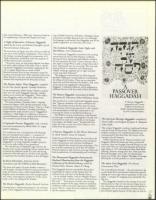
PASSOVER
HAGGADAH
`A Passover Haggadah,"
prepared by the Central
Conference of American
Rabbis, featured illustrations
by artist Leonard Baskin.
The American Heritage Haggadah, compiled by
David Geffen and desired by Stuart E. Eizenstat.
Gefen Books.
This unique Haggadah combines traditional Judaism
With the kitsch of Americana. The Hebrew text and
English translation (no transliterations here) are
accompanied by fun facts from the history of the
American Jewish Passover.
Geffen reproduces ads for Passover products and
Haggadot offered by banks and other commercial
concerns. (And you thought Maxwell House was the
only one!) There are color photographs of American
seder plates, a 1921 advertisement from State Bank
offering a Passover savings plan that "frees you from
financial bondage" and a copy of a dispensation
issued in 1933 by Gov. Eugene Talmadge of Georgia
allowing for a Jewish prisoner to receive matzah.
The Santa Cruz Haggadah. The Hineni
Consciousness Press.
The nonconformist artwork — the cover pictures a fig-
ure that looks like a cross between Moses and a gnome
making the victory sign with an expression of utter tran-
quility — presages the engaging and unabashedly New
Age text:
This Haggadah is based on the concept of not only
looking back to when we were slaves in Egypt but to
also connecting with other groups who are enslaved or
endangered, such as the homeless and those who are
discriminated against because of their age, sex and sex-
4/6
2001
7