
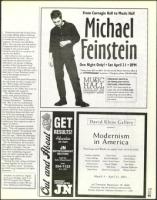

From Carnegie Hall to Music Hall
Twenty-one-year-old Victoria Price
was tough talking, tobacco chewing ,
twice married, and had served time in
a workhouse for adultery and
vagrancy. Seventeen-year-old Ruby
Bates, who was quiet and soft-spoken,
disappeared after the first trial and re-
emerged at the second (which
Liebowitz also lost) as a surprise wit-
ness for the defense.
Like Liebowitz, she was forever
transformed by the trials: She not
only became an advocate for the
defendants, she became a lifelong
member of the Communist Parry,"
Goodman said. The former rural red-
neck ended up living in Harlem with a
black lover. It was, Goodman noted,
one of the stranger journeys in
American history.
For the New York-based filmmakers,
the trek South was also a strange jour-
ney. When Anker and Goodman
arrived in the hilly environs of
Scottsboro in the 1990s, they were ini-
tially regarded with suspicion.
The white citizens of the sleepy,
quaint town perceived them as
Yankees — and a bit like 'Jew-
Commie-filmmakers,'" Goodman
said. "But it was very understated."
The documentarians, meanwhile,
were well aware that time was of the
essence. All of the main characters of
the Scottsboro drama had died, and
two of the last remaining witnesses
were gravely ill. So the filmmakers
were relieved when several Scottsboro
residents put their suspicions aside to
appear on camera.
One of their assumptions shocked
Anker: "They still regarded the black
defendants as guilty," the producer said.
"For them, the case was merely the
story of a rape." (When the defendants
switched to a local lawyer for the third
trial, the decisions had been reversed.)
For the filmmakers, the Scottsboro
affair marked an important victory for
civil rights in America. The case
spurred two, key Supreme Court deci-
sions: One mandating integrated
juries, the other requiring that indi-
gent clients in capital cases receive
adequate legal defense.
"During the trials, whites and blacks
marched together for the first time
ever,". Goodman noted. "Scottsboro
gave birth to an integrated civil rights
movement. 171
Scottsboro: An American Tragedy
airs 9 p.m. Monday, April 2, on
WTVS-Channel 56 in Detroit
and nationally on other PBS sta-
tions. Check your local listings.
is ael
Feinstein
One Night Only! • Sat April 21 • 8PM
Tickets from $25 to $60 • On sale at the Music Hall box office &
all treRelanaster locations • Charge by phone 248-645-6666
MU IC
HA L
CENTER FOR THE
PERFORMING ARTS
350 MADISON • DETROIT
PREMIUM SEATS &
AFTERGLOW WITH
MICHAEL FEINSTEIN
$125 • For reservations or
ticket info call 313-963-2366
All proceeds to benefit Music Hall's
programming, educational efforts
and the Ford Detroit International
Jazz Festival
David Klein Gallery
presents
Modernism
in America
ENTERTAINMENT
SECTION!
Paintings and Works on paper from 1914 to 1950
Anthony Angarola
Ernest Fiene
Louis Lozowick
Henry Billings
David Fredenthal
Alfred Maurer
Charles Burchfield
Aaron Henry Corson
Zoltan Sepeshy
Minna Citron
Samuel Halpert
Ben Shahn
Konrad Cramer
Walt Kuhn
Abraham Walkowitz
Stuart Davis
Edmund Lewandowski
William Zorach
March 3 — April 21, 2001
163 TOWNSEND BIRMINGHAM MI 48009
TELEPHONE 248.433.3700 FAX 248.433.3702
HOURS: MONDAY THROUGH SATURDAY 11 - 5:30
3/30
2001