

Tactics And Victims
Arafat flounders, Sharon ponders and children die.
ERIC SILVER
Israel Correspondent
Jerusalem
y
asser Arafat is floundering. His 6-
month-old intifada has achieved noth-
ing for his people. More and more
openly, Palestinians are questioning
whether their suffering is worthwhile.
The world is in no hurry to intervene. Arab
leaders, gathered in Jordan this week, were long
on sympathy, short on substance, military or
financial.
Ariel Sharon, for his parr, is striving to reconcile
his twin images of "Mr. Security" and "Mr.
Pragmatic Leader" who has put his adventurist
past behind him and cherishes his rapport with
the new man in the White House. The
Palestinians are not making it easy for him.
The intifada is all tactics and no strategy.
Marwan Barghouti, the mainstream Fatah com-
mander calling the shots on the West Bank,
announced one day that he wanted a popular
uprising, with the masses taking to the streets in
peaceful protest, then declared the next day that
the armed confrontation would continue.
The bombers and the gunmen interpreted this
as a license to go on targeting Jews. Israeli com-
mentators suspected Arafat was trying to provoke
the hawkish Israeli prime minister to order drastic
reprisals, which would rally support for the
Palestinian cause — at the Amman summit and
among Israeli Arabs, who are staging their annual
"Land Day" demonstrations Friday, March 30.
The attacks plumbed new depths. In Hebron on
Monday, a Palestinian sniper shot dead a 10-
month-old baby, Shalhevet Pass, as she was being
wheeled by her parents through the West Bank
city's Jewish neighborhood. The same night, a
police disposal crew defused a bomb placed out-
side a falafel bar in Petach Tikva, near Tel Aviv.
On Tuesday, a car bomb went off in Jerusalem's
Talpiot shopping district. Then a suicide bomber
struck at a bus stop across town near the Jewish
suburb of French Hill. A total of 35 were hurt in
the two explosions.
Death At The 'Peace Place'
Wednesday dawned with another atrocity, this
time on the Israeli side of the border between
Kfar Sava and the West Bank town of Qalqilya. A
second suicide bomber blew himself up among a
bunch of teenage boys waiting outside the
"Mifgash Hashalom" ("Meeting Place of Peace")
gas station for a ride to a West Bank yeshiva.
For late-breaking news from Israel, please visit
www.detroitjevvishnews.com
provide security for its citizens everywhere, and
Israel must act with determination against the ter-
rorism which is afflicting us."
Noam Arnon, a spokesman for the Hebron set-
tlers, said of the baby girl's killers, "We have to
annihilate these monsters." Shalhavet's young par-
ents refused to bury her until the army retook the
hillside from which the sniper fired.
Alex Fishman, a sober military analyst, wrote in
Yediot Aharonot on Tuesday, "It is true that
revenge is no substitute for policy. Decisions on
the national level must not be made with the gut.
But it is inconceivable that the murder of a baby
in cold blood be left hanging in the air with no
response. A murder like this must have a price."
Retaliation's Risks
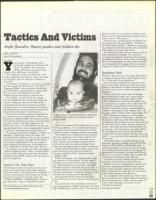
Shalhevet Pass, a 10-month-old killed by Palestinian
snipers Monday, is seen in a recent photo with her
father, Yitzhak.
Two of the students, Eliran Rosenberg, 16, and
Naftali Landskoren, 14, were killed on the spot.
Four others were wounded. One was in critical
condition, another required extensive eye surgery.
The students were riddled with iron nails that
had been packed into the bomb strapped to the
terrorist's chest. The Islamic nationalist move-
ment, Hamas, acknowledged responsibility for
both suicide raids and announced that it had
seven more bombers ready to sacrifice themselves.
Shortly before Wednesday's attack, three bombs
were discovered in the open-air markets of
Netanya and Petach Tikva. The devices were
exploded safely.
Sharon, projecting a new, statesmanlike image,
was reluctant to be provoked. The last thing he
wanted was to revive memories of Arik' Sharon,
the 1950s special forces commander who killed
Palestinian civilians wholesale in reprisal raids, or
the Israeli defense minister who allowed Lebanese
Christian militiamen to massacre refugees in Sabra
and Shatilla near Beirut three decades later.
Having promised his voters to restore their
sense of security, however, Sharon cannot wait too
long.
In particular, his own nationalist constituency
was losing patience. Avigdor Lieberman, the hard-
right infrastructure minister, said, "The state must
Whatever that price turns out to be, the violence
is cutting the ground from under Sharon's quest
for a "long-term interim agreement."
Arafat could not swallow the permanent solu-
tion to the conflict offered by the former prime
minister, Ehud Barak, at Camp David last sum-
mer. But nor, it seems, can he contemplate any-
thing less.
Sharon will not be able to play the benign
grandfather much longer, but a more vigorous
response will risk straining the alliance with
Labor's Shimon Peres and thus the stability of a
his national-unity coalition. Nor will he have the
free hand he enjoyed when Israel's first prime
minister, David Ben-Gurion, unleashed him on
retaliation raids against Arab villagers half a cen-
tury ago. CNN's cameras will be there before him.
With bombings turning into a daily ordeal,
Sharon was forced on Wednesday to abandon his
"business as usual" pose. His aides announced
immediately after the Kfar Sava suicide attack that
he would not call the inner security cabinet into
session. The prime minister's declared policy was
to convene it only once every two weeks. Before
the morning was out, however, Sharon back-
tracked. His ministers insisted that they had to be
heard. It was too much of an emergency to be left
to one man.
While the ministers were still talking, Israeli
helicopter gunships rocketed Gaza and the West
Bank city of Ramallah on Wednesday night. A
military spokesman said they hit specific targets.
Sharon had preferred pinpoint blows against the
men behind the bombers, picking them off one-
by-one over a period of weeks. But he clearly felt
something more dramatic was called for.
It remains to be seen whether Israelis will be
reassured, or the terrorists will be deterred.
Arafat's tactics are making Sharon squirm, but
they solve nothing for the Palestinians. Israel's
Labor defense minister, Binyamin Ben-Eliezer,
began lifting the economic siege. He was repaid
with bombs, mortars and sniper fire.
The roadblocks will have to stay. There will be
no early relief for the 1 million Palestinians living
below the poverty line. There will be no jobs, in
Israel or the Palestinian territories, for the
250,000 unemployed.
VICTIMS ON PAGE 24
3/30
2001
23