

Matter Of Interpretation
Reform movement president takes on crusading philanthropists over synagogue renewal.
HOWARD LOVY
"Close to 100 percent of the Orthodox go to day
schools. How many Orthodox kids date non Jews?
How many non-Orthodox Jews are willing to dedi-
cate their lives to the Jewish people?
"I tend, in my dourest moments, to consider both
the Reform and Conservative Jews as historic acci-
dents in the 21st century and suspect before the end
of this century they will have disappeared."
The hotel ballroom was filled with men and
women who have dedicated their lives to using their
voices. Yet at that moment, not a sound was heard.
The grumbling during the next 24 hours was
quiet and largely "off the record." "Ignorant" is the
word one rabbi used to describe the philanthropists.
Later, Steinhardt told the Forward newspaper that
his goal was to focus the religious leaders' attention
on the "majority of Jews who are not synagogue-
affiliated and not involved." Synagogues, he told the
paper, have historically been slow to respond to
change. He was unavailable for additional comment.
-
Copy Editor
T
he leader of the Reform movement is
tired of the synagogue taking the fall for
all that is wrong in American Jewish life
— and he's fighting back.
The criticism usually goes something like this:
Services are boring and devoid of meaning and spiri-
tual content, and uninspiring religious schools are
chasing young Jews away from Judaism.
But that's all in the past, says Rabbi Eric Yoffie,
president of the Union of American Hebrew
Congregations, which represents 1.5 million Reform
Jews and 900 synagogues in North America.
Synagogues are changing, he says, and those who
push for synagogue renewal should put that word
out rather than reinforce the old perceptions.
Rabbi Yoffie, in an article in the March issue of
Reform Judaism magazine, takes aim at Jewish phi-
gogues began the process of change as soon as baby
boomers brought their families into congregations
and presented them with a list of demands. They
want participatory worship services, Torah study that
is not confined to the religious school, family educa-
tion and a place to support their personal spiritual
searches. The Reform movement has led the way
with initiatives like Synagogue 2000, he said.
As for the notion that Judaism, in the next centu-
ry, will move beyond denominations, Rabbi Yoffie
doesn't buy it.
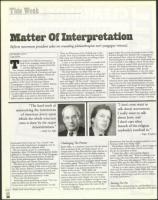
"The hard work of maintaining the institutions of
American Jewry upon which the whole structure
rests is done by the major denominations," he said.
When synagogue renewal and the post-denomina-
tional model are mentioned, Congregation B'nai
Jeshurun on the Upper West Side of Manhattan is
usually given as an example. Their inspiring, musical
services combine elements of everything from Jewish
Renewal to Orthodox to create a unique, inspiring
"I don't even want to
talk about movements.
I really want to talk
about Jews, and
I don't care what
branch of the religion
anybody's involved in.
"The hard work of
maintaining the institutions
of American Jewry upon
which the whole structure
rests is done by the major
denominations."
33
— Rabbi Eric Yoffie
— Edgar Bronfman
lanthropists who he says are "out of touch" with
what is actually happening in synagogues, even as
they fund initiatives to improve them.
He was reacting, in part, to a meeting last
September, when 150 Jewish religious and lay leaders
gathered in Chicago to launch the STAR (Synagogue
Transformation and Renewal) project, funded by
three Jewish philanthropists: Michael Steinhardt,
Edgar Bronfman and Charles Schusterman.
The three sat on stage in a hotel ballroom and said
synagogues need to change if they want to exist well
into this century. Reform, Conservative and Orthodox
labels are growing more meaningless, they said, and
we're entering what both Steinhardt and Bronfman
described as a "post-denominational" world.
Then came the showstopper.
Steinhardt started pondering out loud: "Let's con-
sider the differences between the Reform,
Conservative and Orthodox movements," he said.
Temple Israel marks 60 years: page 60
3/23
2001
20
Challenging The Premise
Rabbi Yoffie, in a telephone interview with the Jewish
News in advance of his visit Friday, March 23, to
Temple Israel in West Bloomfield to help celebrate its
60th anniversary, said he wrote the Reform Judaism
article because he did not want to let predictions of
the Reform movement's demise go unchallenged.
"I was getting reports from synagogue leaders around
the country, saying, 'What is this? Why is it that people
who supposedly are committed to some positive vision
find it necessary to go around and attack the very
essence of who we are?'" Rabbi Yoffie said.
"My own view is that it's unfortunate and a funda-
mental contradiction. I think that it's an impedi-
ment to their own work. People who want to help
synagogue leaders make synagogues stronger do not
advance their own cause by saying exceedingly nega-
tive and derogatory things about the status of the
American synagogue."
The fact is, Rabbi Yoffie wrote in his article, syna-
phenomenon that has the synagogue packed to over-
flowing crowds every Friday night.
The problem, Rabbi Yoffie said, is they're happy to
use the products of the major Jewish movements,
but do not contribute to them.
"I think they offer a very exciting religious
model," Rabbi Yoffie said. "What's troubling to me
here is that who trains the rabbis, for example, in
America? Who trains the educators? Who trains the
cantors? Who pays for that? Where is that supposed
to come from? It doesn't come from the air."
The key is to take creative experiments and "bring
them into the mainstream," Rabbi Yoffie said, rather
than, as he wrote in his article, "pontificate about
the 'boring' establishment and then devote millions
to trendy experiments."
Stirring The Pot
Rabbi Yoffie is missing the point, said Bronfman in an
interview with the Jewish News. Regardless of the efforts