
Wonderful Waltzes
Hitler's love for "The Merry Widow"
helped save the life of its composer's Jewish wife.
BILL CARROLL
Special to the Jewish News
IV
hen members of the Gestapo knocked
on the door of the great Hungarian
composer Franz Lehar, living in Nazi-
dominated Austria, they came to take
away his Jewish wife, Sophie.
But Lehi"- had friends in high places, and a phone c211
saved her, because Hitler himself admired Lehar's music,
especially one of his operettas, The Merry Widow.
The operetta's music comes to the Detroit Opera
House next week — adapted into a ballet by the
famed, New York-based American Ballet Theatre
(ABT), which dazzled Detroit audiences last year with
its production of Swan Lake.
Michigan Opera Theatre (MOT) will present The
Merry Widow in four performances March 29-April 1,
continuing the 2000-2001 DaimlerChrysler Dance Series.
The Merry Widow, with its story of romance and
social intrigue set in turn-of-the-century Paris, features
spectacular sets and costumes along with Lehar's irre-
sistible waltz melodies.
The operetta is danced in three acts and four scenes,
and opens as a scheme is being hatched to save a
small, impoverished European country by arranging a
marriage between First Secretary Count Donilo
Danilowitch and the recently widowed and very
wealthy Hanna Glawari.
Just as romance seems to be blooming, everything
goes awry when Hanna must pretend to love another
man to protect her good friend, Valencienne, from her
jealous husband.
"British choreographer Ronald Hynd has been remark-
ably successful in switching The Merry Widow into a bal-
let," said David DiChiera, MOT's general director.
"He has not lost the essence of Lehar's operetta
through dance, but added another layer to the story
through choreography that unravels the plot using
dancing, mime and gesture.
"Lehar's music is intertwined with the subtlety of charac-
ter and strength of dramatic structure, making The Merry
Widow a key work in the full-length ballet repertoire."
The son of a horn player and composer, Lehar stud-
ied violin and composition at the Prague
Conservatory before playing in military bands while
composing marches and dances.
But he made his name in operetta, which is a form
of light opera developed in Europe in the 19th centu-
ry. Lehar helped revive the operetta as an international
form of entertainment.
3/23
2001
78
With Leon Stein and Victor Leon as the librettists,
Lehar's Merry Widow premiered in Vienna in 1905,
achieving instant success. It since has been performed
in 24 languages throughout the world.
Although Lehar was not Jewish, many of his friends
and colleagues were. Two of his Jewish librettists in his
later years, Fritz Griinbaum and Fritz Lohner, were
murdered by the Nazis in concentration camps.
Tenor Richard Tauber of Austria, the son of a half-
Jewish father, gained worldwide notoriety by singing the
lead roles in many of Lehar's operettas in the 1920s and
'30s, and Lehar wrote music especially for Tauber's talents
in a partnership heralded throughout the musical world.
Tauber had the personality to draw audiences to
Lehar's works, and to do justice to the more ambitious
vocal music that Lehar was able to compose for him.
But the fact that Tauber's father had Jewish roots did
not escape the Nazis' attention.
Tauber was forced to flee to England, where he con-
tinued to sing and record until his untimely death
from cancer in 1948.
Lehar met the woman with whom he would spend
40 years in 1906. Flushed with the international suc-
cess of The Merry Widow and its royalties, Lehar had
become an accepted member of high society and the
Austrian cultural scene.
He acquired a villa in Bad Ischl, Austria, where the
Emperor Franz Joseph and other leading figures spent
their summers. When the 36-year-old Lehar met
Sophie Meth, the daughter of Siegmund Pacshkis, a
Viennese carpet dealer, she was 28 years old, and
according to a Lehar biographer, "of Titian-like beauty
and grace, worldly wise, cheerful, warm-hearted and
tremendously attractive."
The fact that she was already married did not stop
Lehar, who convinced her to leave her husband and
live with him in a "free life partnership." It wasn't
until 1921 that the couple were married. Still, Lehar
insisted on his autonomy, and he and Sophie contin-
ued to live in separate but closely connected quarters.
Hitler's annexation of Austria in 1938 posed prob-
lems for Lehar and Sophie.
Although Hitler was a declared admirer of Lehar's music
— especially The Merry Widow — Lehar was "compro-
mised" through his cooperation with Jewish librettists and
above all because of Sophie's Jewish background.
Also, Lehar was wrapped up in his work and unwilling
to become involved in Nazi politics. (His failure to protest
Nazi atrocities later made him an object of suspicion.)
WALTZES on page 80
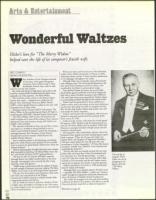
The real life of
composer Franz
Lehar was just as
intriguing as his
famous operetta,
"The Merry
Widow."
Scanned image of the page. Keyboard directions: use + to zoom in, - to zoom out, arrow keys to pan inside the viewer.
March 23, 2001 - Image 102
- Resource type:
- Text
- Publication:
- The Detroit Jewish News, 2001-03-23
Disclaimer: Computer generated plain text may have errors. Read more about this.