

Business
motive business and, at age 40, the youngest president
and CEO of any car and truck corporation. Mazda also
has a chairman, always a Japanese person, but it's mainly a
ceremonial post. Ford Motor Company owns 33.4 per-
cent of Mazda, enough to control the company. Mazda's
most popular vehicles are the 626 and RX-7 sedans, the
MX-5 Miata convertible, the MPV minivan, the Tribute
SUV, and the new Demio subcompact.
Up The Ladder
BILL CARROLL
Special to the Jewish News
W
hen he was a child, Mark Finkelman daydreamed
of being "successful." When he was a teenager in a
New Jersey high school, he excelled in the sport of
cross country — he loved to run.
Now, as Mark Fields, he is running the Mazda Motor
Corporation, one of the leading automotive manufacturers in
Japan, with 24,000 employees and 18 plants worldwide, selling
vehicles in 130 countries at yearly sales totaling about two tril-
lion yen ($21 billion).
But he faces some formidable challenges this year to bring up
to date a company founded in 1920 and named for the
Japanese god of light. Fields is meeting the challenges with a
drastic restructuring program necessitated by predicted financial
losses for this year.
He is the highest-ranking Jewish executive in the global auto-
How did a nice Jewish boy get to Hiroshima, Japan, to
head a foreign company whose language he can't even
speak, and where he receives packages of matzot and
Chanukah candles from his mother to remind him to
keep up Jewish traditions?
It took a lot of intelligence, ability and being in the
right place at the right time. Fields' grandparents were
immigrants from Russia and Romania but, like him, his
parents were born in America. He was bar mitzvah at a
Conservative synagogue in Paramus, N.J., and had an
introverted personality in high school.
His father, manager of a housewares
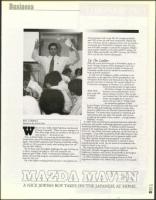
Mark Fields
business, never pressured him to be a
gives a pep talk doctor, dentist or lawyer. "But my par-
to Mazda
ents insisted that I do well in school and
employees.
always encouraged me to choose a
career and stay with it," Fields recalls.
An economics graduate of New
Jersey's Rutgers University, he entered the work force with
IBM in sales and marketing, stayed for six years, then
earned an MBA from the Harvard Graduate School of
Business. "I've always been interested in marketing and
sales because that area deals with people, and you can
quickly see the results of your actions ... you get instant
feedback," he said.
In 1989, Ford was looking for potential executives with sales
promotion and product marketing experience as part of a new
marketing leadership program. "It looked attractive because I
wanted to do marketing, and I loved cars, so Ford was a perfect
fit for me," says Fields, who had a collection of 100 mini-cars as
a youngster. "I was really surprised by Ford's offer because I had
been cynical of the auto industry and its apparent quality prob-
lems. But I quickly learned that perception is not reality.
"I knew that once I left my hometown, I wanted to move
around and see the world. I'm not much of a homebody who
wants to return to my roots."
By corporate standards, Fields rose pretty quickly through the
Ford ranks. He held managerial positions at offices in
California, Dearborn and Detroit, living briefly in Farmington
Hills and Birmingham during the latter assignments.
In 1996, he became assistant managing director of Ford
Argentina in Buenos Aires (where only 2 percent of the popula-
r
A NICE JEWISH BOY TAKES ON THE JAPANESE AT HOME.
3/16
2001
63