

Arts & Entertainment
Greek and American Cuisine
OPEN 7 DAYS A WEEK
154 S. Woodward, Birmingham
(248) 540-8780
Halsted Village
(37580 W.12 Mile Rd.)
Farmington Hills
(248) 553-2360
6527 Telegraph Rd.
Corner of Maple (15 Mile)
Bloomfield Township
(248) 646-8568
4763 Haggerty Rd. at Pontiac Trail
West Wind Village Shopping Center
West Bloomfield
(248) 669-2295
841 East Big Beaver, Troy
(248) 680-0094
SOUTHFIELD SOUVLAKI
CONEY ISLAND
Nine Mile & Greenfield
15647 West Nine Mile, Southfield
(248) 569-5229
FARMINGTON SOUVLAKI
CONEY ISLAND
Between 13 & 14 on
Orchard Lake Road
30985 Orchard Lake Rd.
Farmington Hills
(248) 626-9732
NEW LOCATION:
525 N. Main
Milford
(248) 684-1772
UPTOWN PARTHENON
4301 Orchard Lake Rd.
West Bloomfield
(248) 538-6000
HERCULES FAMILY RESTAURANT
33292 West 12 Mile
Farmington Hills
(248) 489-9777
Serving whitefish, lamb shank,
pastitsio and moussaka
The real "Coffee Talk" lady didn't always know how to laugh.
But Barbra really does make her melt.
ALICE BURDICK SCHWEIGER
Special to the Jewish News
ention Linda Richman,
and what comes to
mind is the Jewish talk
show hostess with a
thick New York accent and long pol-
ished fingernails who used Yiddish
words like shpilkes, fahrklempt, mishpacha
— and "melted like buttah" at just the
thought of Barbra Streisand.
At least that was the caricature pre-
sented by her son-in-law, actor/comedi-
an Mike Myers, whose "Coffee Talk"
lady on Saturday Night Live left audi-
ences howling with laughter.
But for the real Linda Richman, life
wasn't always so funny.
Richman's father died when she was a
small child. While she was raising her
two children, she became agoraphobic
and did not leave her house for 11 years.
Worst of all, her 29-year-old son,
Jordan, died in a car accident in 1990.
But with all the tragedies, Richman
learned how to find happiness. Now, she
wants to share how she found solace in
her life.
She's authored I'd Rather Laugh: How
to Be Happy Even When Life Has Other
Mans for You (Warner Books; $23.95).
On March 15, Richman will be in
Detroit when her TV special, I'd Rather
Laugh, airs 7:30-9:15 p.m. during a PBS
pledge drive on Detroit Public
Television-Channel 56.
The program includes readings from
her book and film footage from her
motivational speaking engagements
about coping with loss. During the com-
mercial break, Richman will answer
questions from callers.
"I hope that I can help people who
have gone through terrible times," says
Richman, who calls her book "self-hope"
not self-help. "The day the police
knocked on my door and told me my
son died, a part of me died. I had to
learn to live again. And that's what the
book is about.
"No matter what horrible things hap-
pen, life still offers humor, regardless of
how low you feel."
Her healing process took years.
During a recent interview with the
Jewish News at the Parker Meridien
Hotel in New York City, Richman
explained how she learned to go on with
her life.
"I set out looking for the meaning for
Uordan's] death," she recalls. "The first
year after he died, I went to 103 lectures
— given by everybody — on death and
dying. I became the foremost expert
until I realized I needed to live.
"So I did things on my own. I found
myself going up to complete strangers
on a bus telling them my son died. It
was wacky, but it made me feel better.
"I had pity parties, where I would
stay in bed watching sad movies like
Terms of Endearment. Then I started
to watch funny movies, Mel Brooks
in particular. I wanted to go for that
first laugh. It takes time, but once
you get that first laugh, you can get a
second.
"Of course, contentment and joy will
never be the same," she goes on to say,
"but it comes in a different way. I will
always have a void inside of me, but
you have to acknowledge that void
and go on."
Being Jewish
Richman, who calls herself a quin-
tessential Jew, says her religion
helped to play a role in her healing.
"I went to Israel after Jordan's
death and it was an amazing experi-
ence," she says. "I walked around
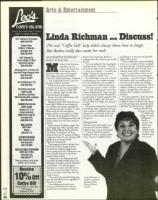
Linda Richman: A
summa cum laude
graduate of the
School of Hard
Knocks.
and fell apart; it was the most beautiful
sight I had ever seen.
"Every cobblestone meant something
to me, as a reminder of what our people
had gone through. I planted trees for my
son and relatives and it was the most
cathartic thing I did. I marked those
trees so I can visit them when I return."
Richman did have one unfortunate
encounter — but not in Israel. "Shortly
after Jordan died I was walking down
the street in New York City, sobbing
uncontrollably," she remembers. "All of a
sudden I looked up and spotted a syna-
gogue. I thought that was a sign of
exactly what I needed, so I knocked on
the door.
"A woman opened it, and I was weep-
ing and told her my son died and I
needed to come in and sit in the sanctu-
ary. She said they were closed for lunch
and [she] wouldn't let me in. I pleaded
with her, but she shut
the door in my face.
"I couldn't stop
crying, so I kept
walking and
found a
church. The
doors were
open, so I
walked in and
sat down. The
minister came
over to me