

hawn Stearn's career as a
ketubah artist came about
simply because he got mar-
ried. Love has long guided
the 28-year-old artist, who met his
wife, Lisa Sherman, in high school.
"The sanctity of marriage is
something I hold close to my heart,"
says Stearn, who sells bearings and
motors for Ithaca, N.Y.-based
Emerson Power Transmission.
"I relate to the amazing feelings
between a bride and groom. The
ketubah becomes a symbol of the
couple — Jewish mysticism adds
incredible spiritual interpretations
such as equating marriage to the
creation of a new universe."
Growing up in Oak Park, Stearn
watched his father putter with
acrylic paints. When he dropped the
hobby, his son picked it up.
At the University of Michigan,
Steam produced 2,000 T-shirts
annually for "Hash Bash." The
money he made from selling T-
shirts bought his wife's wedding ring
and part of their honeymoon. For
his 1995 wedding, Stearn designed a
ketubah with watercolors on cold-
pressed, 90-pound paper.
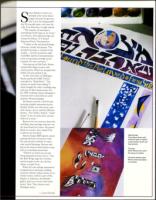
Six hearts encircle a Jewish star,
carrying symbols representing the
fluidity of life: sun and moon, man
and woman, doves, and the Hebrew
phrase, "Ani l'dodi v'dodi li," which
means "I am my beloved's, and my
beloved is mine."
Because he was nervous about his
wedding, that marriage contract was
the most basic he's done. Yet guests
liked it so much, they asked if he
could do one for them.
Stearn charges $600 apiece, repre-
senting 40 hours of intense work.
He uses Jewish symbols to repre-
sent sacred blessings, flowers and
leaves for renewal and circles to sig-
nify an unending connection.
"There's so much you can do,
bring personal touches into it," like
the Red Wings logo for a hockey-
crazed couple or the city skyline
where a couple lives.
When he's not selling automotive
components or painting wedding
contracts, Stearn makes matrix art in
vibrant colors, which is part of the
display at Arthouse, the Berkley
gallery that he co-owns with sister-
in-law Terri. They feature only
Michigan artists.
S
— Lynne Schreiber
Oppostie page:
By day Shawn Stearn sells
automotive parts; by night he
creates ketubot, Jewish wed-
ding contracts.
This page:
Above: Vibrant colors add to
the beauty of a ketubah.
Left: Stearn artfully scripts
Hebrew words and symbols
on a ketubah.