

JNOpinion
Editorials are posted and archived on JN Online:
www.detroitjewishnews.com
Economics 101 At Middle East U.
S
ecretary of State Colin Powell is get-
ting off on the wrong foot in the
Middle East in suggesting that Israel
move first to back off from the cur-
rent confrontation by easing its economic
blockade of the West Bank and Gaza.
After a visit in Gaza City with Yasser
Arafat last Sunday, Powell said the "siege,"
imposed after the Palestinian vio-
lence of Sept. 28, should be lifted.
Noting his "deep concern for the
dire economic situation that every-
day Palestinians must bear," the secretary
said, "It is my view that economic pressure
tinians must realize that their chances as indi-
viduals for a better life depend on living at
peace with the Jewish nation.
The truth is that even if Israel gave in to
every demand Arafat made for a peace deal,
including sovereignty in east Jerusalem and a
full right of return, the economic lot of the
Palestinians would be barely improved. They
need Israeli jobs and know-how if
they want to become a strong force
in the 21st centur)i. The current
economic blockade reminds them
of that simple truth — one that their leader-
ship always conceals.
Prime Minister-elect Ariel Sharon has laid
out quite specifically and correctly what must
be done to lift the restraints:
• Arafat must make a public statement
calling unequivocally for an end to violence.
• The Palestinian Authority must act to
stop incitement.
• Security coordination in the field must
be resumed.
None of those conditions should be hard
for people who are sincerely interested in a
long range, stable relationship with their
next-door neighbor. They are only hard if
your real goal is to drive your neighbor out of
town.
The official Palestinian line is that the
curbs are an unjust "collective punishment."
We think they are more of a lesson in the
economic reality of the Middle East today
and one that Secretary Powell, no less than
those "everyday Palestinians," needs to under-
stand. ❑
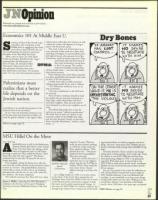
Dry Bones
tF ARAFAT', IT MAKES-41
1-1166 Lovr
NO SENSE
CONTROL...
To N66UnATE
WITH 1-11(4.
EDIT ORIAL
contributes to an overall deterioration in the
situation here in the territories."
In our view, the economic pressure is one
of the best tools that Israel has to build a cli-
mate for greater stability in the region. Pales-
Related coverage: page 20
IrON Ti-1EOTrIER riT MAKES •
HAtZ IF HE IS NO 56(.66
NiCCOAT6
ORCHEMOING
viot,60(6, wiThl
ht
Palestinians must
realize that a better
life depends on the
Jewish nation.
MSU Hillel On the Move
New York City
wonderful story is told in the Babylonian
Talmud (Taanit 23a) about a man named
Honi. One day, Honi was taking a stroll
when he happened upon an old farmer
planting a carob tree. Honi asked the farmer, "How
long will it take this tree to grow?" The farmer
answered that it may take 70 years for the tree to
finally bear fruit.
Honi laughed, telling the farmer how silly this
was, since he would certainly not be around to enjoy
its fruit in 70 years. "My grandchildren, however,
will be able to enjoy its fruit. Just as my forebears
planted carob trees for me, so, too, will I plant for
my children," the farmer explained.
The midrash continues that Honi fell into a deep
A
Jason A. Miller, originally from West Bloomfield, is
studying in his third year of the Jewish Theological
Seminary of America Rabbinical School in New York
City.
sleep for 70 years. When he
woke, he saw a farmer working
in a field by a huge carob tree.
Honi asked the farmer, "Who
planted this tree?" The farmer
explained that his grandfather
did many years ago.
Each year around this time, I
teach this story to my religious
JASON MILLER school class for the Tu B'Shevat
holiday. While I have retold the
Special
story many times, I found
Commentary
added meaning in its lesson this
year.
As a college student in 1996, I co-wrote a letter
to the editor of the Jewish News stating that the
Michigan State University Hillel Center was in need
of the Detroit Jewish community's support to help
fuel some .much needed organizational change. At
the time, the MSU Hillel was without a director, fire
damage kept students from using much of the build-
ing and attendance at student programs was dwin-
dling. The once "reservation-only" Shabbat dinners
became intimate meals among only a handful of reg-
ulars.
Recently, however, I have noticed a sea change
taking place in East Lansing. A few weeks ago, I had
the chance to visit MSU Hillel for the first time
since graduating college in 1998. I was pleasantly
surprised. With open arms, I was invited to the
MSU Hillel to teach about Jewish ritual, coordinate
Shabbat services and lead discussions about Jewish
life on campus.
For me, this proved to be a time for reflection as
well. Tasting Becky's matzah ball soup ('a staple of
MSU Shabbat dinners), I was overwhelmed with
nostalgia. It was wonderful to see how some things
change while others stay the same. Walking into the
second-floor library, I was shocked to find books
exactly where I left them a few years ago, yet pleased
MSU HILLEL on page 28
3/2
2001
27