

At The Movies
POLLOCK
r
MONDAY Si TUESDAY SPECIAL
Sunday Night Special
Dinner for Two
15% OFF each dinner entree
with a party of
up to 6 peop le.*
$
Expires 3/4/01
L
A
2299
(Dinner for one a i i
WE DO CATERING I DELIVERY' .
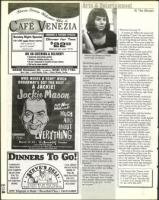
Marcia Gay Harden as Pollock's
Jewish wife, Lee Kramer.
• Corporate and private parties
•Showers, birthday parties, etc.
•At our restaurant or location of your choice.
• Call us for more details!
SPLASH
' Coupon can't be combined with any other offer or discount. One coupon per visit please.
25938 Middlebelt Rd.
tat 11Mile RID
(2483 476.1750
Open 7 days • Lunch: Monday - Friday • Dinner: Monday - Sunday
WHO NEEDS A TONY® WHEN
BROADWAY'S GOT THE BEST
-
A JACKIE!
r
March 12-25 • 14,c,SeccudiCeti. Theatre
Call 248-645-6666
Tickets are available at the Second City box office and all tic Icetnriaster locations.
For more information call 313-965-2222
DINNERS
FABULOUS
SELECTION
AND VARIETY
READY FOR
YOU TO
PICKUP
ON THE WAY
HOME
To Go!
A Little Bit Of New York
Right Here In Bloomfield Hills
6646 Telegraph at Maple
CALL AHEAD
OR FAX YOUR
ORDER, IT
WILL BE
HERE WAITING
FOR YOU.
WHAT COULD
BE EASIER?
• Bloomfield Plaza • 248,932,0800
from page 59
figure. She is both submissive and
aggressive, martyring herself with a
curious combination of compliance,
devotion, vision and purpose.
Surprisingly, the notorious misog-
yny of the art world is largely sup-
pressed.
At their first meeting Pollock
praises her and calls her a good
"woman painter." Its subtle. We
hear only faint echoes of Hans
Hoffinan's alleged evaluation of
Krasner's work in 1937: This is so
good, you wouldn't know it was
painted by a woman."
What does it mean to be regarded
as an artistic genius? And who gets to
decide what qualifies? Again, Harris'
film remains surprisingly complacent
with the cliché.
Pollock critiques the art elite in
familiar terms: it is superficial, arbi-
trary and self-congramlatory, but at
the same time it is a necessary means
by which culture defines itself Art is,
regretfully a product that must be
marketed to society
In its most memorable and
insightful episode, Harris' Pollock
offers a meta-examination of the role
of the media in generating the leg-
end of the "great artist."
When Pollock begins his ascent,
he agrees to be the subject of a film.
The director wants to capture
Pollock's intensity as an artist and an
innovator. But Pollock, the reluctant
subject, reacts violently to the
process of filmmaldng.
"I'm not the phony. You're the
phony" he hisses insistently at the
filmmaker.
How much is Harris revealing here
about his own conflict over telling
Pollock's story?
"I've never been interested in
exploiting Pollock," Harris has said.
"In fact, there were times I would
say to myself, 'Why are you making
a movie about this guy? Let him
rest in peace."" ❑
from page 59
To prepare for Pollock, the actress stud-
ied painting ("I suck," she says), listened
to audiotapes of Krasner and interviewed
her surviving friends and relatives. "Her
nephew told me, 'If you want to play Lee
Krasner, start screaming from the minute
you walk in the door until the minute
you leave," Harden says.
In fact, Krasner focused much of her
creative energy on keeping Pollock
together and furthering his career. But
by 1956, the tension in their marriage
had escalated; Pollock often stormed off
to a tavern or to the arms of his mistress.
Their rows became so violent that
Harden braced herself to receive an
anti-Semitic slur in the film's most
explosive scene.
"I debated a lot as to whether to
leave that in the movie," Harris confid-
ed. "But to me, it was symbolic of just
- how low the relationship had deterio-
rated, and of the despair and anger
Pollock was feeling about himself.
"He wasn't anti-Semitic, but the slur
was just the most heinous, ugly thing
he could think of to say."
Harris helped Harden understand
why Krasner put her own career on
hold to nurture an abusive husband.
"Lee realized this man had the poten-
tial to create art that she loved," he
said. "But she also had her own prob-
lems as a woman.
"Her relationships with her brother
and a previous lover were quite
masochistic. Her brother would degrade
her and talk down to her, and she fol-
lowed him around like a puppy dog."
It wasn't until after Pollock's 1956
death in a car wreck that Krasner
began one of the most productive
periods of her career, Harden notes.
Her impressive body of work was
showcased in a 1999 retrospective at
the Los Angeles County Museum of .
Art (with additional stops in Akron,
Ohio, and Brooklyn, N.Y.), but the
actress was glad she saw the exhibit
after she had completed Pollock.
"The work in the show was confident
and big and bold, and that is not the
person Krasner was while Pollock was
alive," she explains. "My Lee Krasner
was much more insecure. The woman
who could create those big, bold paint-
ings hadn't come into being yet." ❑
The Detroit Film Theater at the
Detroit Institute of Arts screens
Pollock 7 and 9:30 p.m. Friday;
4, 7 and 9:30 p.m. Saturday and
1, 4 and 7 p.m. Sunday, Feb. 23-
25. $6. (313) 833-3237.