

Forever Grateful
Local woman's parents found
refuge in Oswego.
was in intensive care in New York. Then she was
required to shoot the sequence in which Ruth's
beloved father falls ill and dies, which transported her
back to the horror of her own father's death, in 1991,
from AIDS.
She recalled the weeks she cared for him, changing
his soiled sheets and administering sponge baths. After
his death, she immersed herself in AIDS volunteer
work, inspired by a talmudic phrase: "He who saves
one life, saves the entire world."
"My father was my best friend and my rock," she
said, "so his death was just a huge loss, a sense of
being cut adrift, and that is how Ruth feels when
her father dies in the film. For me, that sequence
was all very close to home; I knew it was going to
hurt, but the very fact that it did made the scenes
better."
Like the refugees in Haven, Richardson also
found safe haven in America, where she emigrated
to escape the baggage of being compared to her
famous relatives. She hopes her two small sons will
avoid the family business.
"Having lived for many years in the shadow of my
mother, a great actress, I know what it's like to have to
carry that on your back," she said. "I know how hard
it is to emerge from those long shadows." ❑
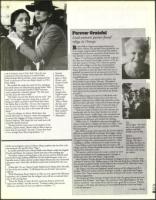
Natasha
Richardson,
right, as Ruth
Gruber, with
Tamara Gorski
as Manya
Hartmayer
Breuer: "I
thought there
might be quite
a few people
wondering,
`Why on earth
did they want
this English
gentile to play
Ruth Gruber?'"
said Natasha
Richardson.
of the most poignant scenes in Haven, Manya explains that the shirt is the
sole memento she has left of her "Papa."
In another powerful_ scene, Manya finally meets Breuer under the chupp ah.
For the real Manya, the sequence stirred memories of her wedding day.
The balmy August morning began as the survivor and her friends raced
around the camp, picking wildflowers for her bridal bouquet. Later, in a
barracks room, Gruber and her mother helped Manya slip into a . borrowed
gray gown and a white silk veil Ruth's mother had crocheted for the occa-
sion.
A little after 10 a.m., Mama Gruber helped escort Manya down the aisle,
in lieu of her own mother. "I will always love you for this," the survivor
told her.
While Hartmayer Breuer believes no film can ever capture the Holocaust
experience, she is pleased that the refugees' story will air on national televi-
sion in the coming days.
"From the Shoah, we learn that the important thing is to love and
respect one another," says the survivor. "It doesn't matter who you are,
where you come from or how you believe in HaShem." ❑
1104 uthe Haler Zogut never stepped aboard the
Hem)/ Gibbons, but she feels forever grateful for one
of its voyages. Zogut's parents, David and Dina Hellner,
esc.aped the Nazis because, escorted by Ruth Gruber, they
were allowed to come to America on that ship.
Zogut, 77 and living in Southfield with her husband,
Sol, does have firsthand knowledge, however, of the for-
mer army camp in Oswego, N.Y., where her parents
and the other refugees on the ship were housed for
more than a year after arriving in the United States.
Zogut, permitted to enter the States when she was 14,
preceded her parents here by six years and went from
Detroit to Oswego many times once she learned of their
successful journey.
"My whole story is one miracle after another, and
Ruth Gruber is part of that," she says. "My parents
loved her and couldn't find enough good words to say
about; her. I've read die book. Haven, and I could picture
every place I knew, from the barracks to the mess hall. I
can't wait to see the miniseries. I've told all my friends
to watch."
The Heilner escape story starts in 1930s Berlin with
David and Dina Heber trying to leave with their two
daughters. Although they couldn't help diemselv-es at first,
they were able to get their I4-year-old to Detroit throu
a friend in America and then their 19-year-old, Judy, to
Scotland and then Buffalo, where the continues to live.
"I had never heard of Detroit, but I felt welcome and
comfortable'with the three foster families who invited
ho was placed and
suepein their homes," recalls
m
by a Jewish WelfareTigut'
w r,t,iosed
. y
N.rgr.ker.
given allowanc
was 17,
- and
♦
114,0e. I rent-
-eat
went i0::*k, first in a
-0
Top:
Ruthi Zogut: 'My whole
after
.07,64, ___,. j , twit' that
is erne
and "' Ruth
:::::.k.,,
OwIrit-
F:akt
,.
4
"
t 414
her youngest daugClter's
tarium and died two years At
The Zoguts, who have two -
Al#R,
to speak or
families. Whenever Gruber comes toc
t treasures a photo she gm
has of
ments
re: eMrs
sape
reileng
ngag- eZ°gu
. GernianY to Ital y
"MY Parents got from
content at Fort Ontario," says Zogut, who works part ti
Deli in Southfield. "My mother alwa.ys said she had a good l
in Oswego or Oak Parlc, after fearing and desperately fleeing
could feel safe again."
❑
2/9
200