

ir Community
Spirituality
SUSAN TAWIL
Special to the Jewish News
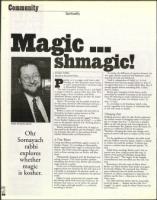
Rabbi Mordichai Becher
Ohr
Somayach
rabbi
explores
whether
magic
is kosher.
ITN
2/9
2001
54
opular as it is, magic could lead to idol
worship, an Ohr Somayach senior lectur-
er told a lunch-and-learn crowd last week
in Bloomfield Township.
The only true power is God, he sad and belief
in magic is belief in a power other than God. That
makes magic a form of idolatry, said Rabbi
Mordechai Becher, speaking at the Max M. Fisher
Federation Building Jan. 31.
About 150 business and lay-.people turned out
for the event, hosted by Ohr Somayach- Detroit, a
Southfield-based adult education and outreach
organization.
Becher, a native of Australia who now lives in
Jerusalem, has been a senior lecturer at Ohr
Somayach-Jerusalem for 15 years.
His lecture was provocatively tagged Is Harry
Potter Kosher? Judaism and the Occult" — a refer-
ence to the popular book by J.K. Rowling about a
boy in wizard prep school.
Becher examined the Jewish view of magic as
discussed by the Rambam and the Ramban, which
are acronyms that refer to the medieval Jewish
scholars Maimonides and Nachmanides.
A Time Waster
Citing the biblical prohibition against sorcery in
Exodus, Chapter 23, according to Mairrionides,
Becher maintained that magic is nothing but fool-
ishness. The Torah injunction against magic pre-
vents us from wasting time on futility and false-
hood.
Nachmanides disagreed with the Rambam's rea-
soning, however. The Torah wouldn't prohibit
something that doesn't exist, Becher said, therefore
magic must be a reality.
In the view of Nachmanides, both positive and
negative forces are necessary for free will. Just as it
is possible to manipulate the physical world, so,
too, must it be possible to manipulate the spiritual
world.
Magic, he said, circumvents the natural order,
the laws by which God wants the world run. So
because God wants LI:. to act within the natural
world, magic, although possible, is /-_,follibired,
according to Becher.
clf
To resolve the difference of opinion between the
two sages, Becher examined the Rambam's under-
standing of truth and falsehood.
Truth is independent of belief, i.e.: 2+2=4.
Falsehood exists because people believe it. Even if
we agreed that 2+2=5, it would still be false. But if
enough people believe something false, it does
have an impact.
Becher gave examples of what havoc could
eventually be wreaked if everyone at the lunch and
learn left believing as small a falsehood as 2+2=5.
"The only real truth, the ultimate truth," he
said, "is God."
So, according to the Rambam, belief in the
occult, regardless of its impact, is ultimately false.
It will only result in futility.
Changing Fate
Fielding questions after his talk, Becher addressed
the Jewish custom of changing names of sick peo-
ple to "change their face." It may have a placebo
affect on the sick person and encouraging him or
her to feel better. But Judaism views the name of a
person as a reflection of his or her essence.
Therefore, changing the name may change one's
spiritual essence and have an impact on his or her
fate.
On the significance of dreams, the rabbi noted
that the Hebrew word for dream, chalom, is related
to chalon, the word for window. "A dream may
serve as a window into the person's psyche," he
said.
Asked about astrology, Becher said it has no
control over Jews, citing as proof the story in
Genesis of the patriarch Abraham being lifted
"above the stars." "The impact of the mazalot
(constellations) does not affect our free will," he
said.
Returning to the title topic of Harry Potter,
Becher was asked whether these books were good
for Jewish children. He cautioned that children
must understand that the books are fantasy.
However, he added, imagination is important for
children and he had r. 3 objection to the Harry
Potter series.
The rabbi admitted earlier that he, personally,
loved the books — "despite the fact that I'm a
muggle," he joked, using the Harry Potter term for
non-wizard. ❑